
Energy savings opportunities are the specific measures that cut what a business pays for energy and emits: better controls, efficient motors, lighting, smarter fleet use and corrected bills. In the UK the phrase also names a law: the Energy Savings Opportunity Scheme (ESOS), which requires large organizations to audit their energy use every four years. This guide covers both. It shows whether ESOS applies to you, where savings usually hide, and how to rank them so the best ones get done first.
TL;DR
- ESOS is a mandatory assessment for large UK undertakings, repeated every four years. For Phase 4, qualification is judged on 31 December 2026 and notification is due by 5 December 2027.
- Official UK guidance points to the same families of savings: building heating and controls, lighting, industrial motors and drives, and fleet efficiency.
- Government guidance estimates an average SME could cut its energy bill by 18 to 25%, with about 40% of the savings needing no capital spend.
- Good bill and half-hourly data come first. You cannot rank savings you cannot see.
- Rank opportunities by savings, cost, payback and fit with planned changes, then track results against a baseline.
Table of Contents
- What counts as an energy savings opportunity
- Does ESOS apply to your organization?
- Where the savings usually are
- Start with your bills and half-hourly data
- How to rank and prioritize opportunities
- Connect savings to net zero and Scope 1, 2 and 3
- See your own opportunities in Enerlytics AI
- FAQ
- Sources
What counts as an energy savings opportunity
An opportunity is any change that reduces energy consumption, energy cost or carbon for the same level of output. Some change equipment. Others change behavior, schedules or contracts. Some are not changes at all but corrections, such as spotting that you have been billed for a meter you no longer use.
The UK has a formal version of this idea. ESOS is a mandatory energy assessment scheme for qualifying organizations. Assessments recur every four years and cover the energy used by buildings, industrial processes and transport. The aim is to identify tailored, cost-effective measures for energy, carbon and cost savings.
Even if you fall outside the scheme, its method is a sound template for any business: measure total energy, find where most of it goes, and look for measures in those areas.
Does ESOS apply to your organization?
For Phase 4, an organization qualifies if it, or a UK undertaking in its group, is a large undertaking on 31 December 2026. In practice that means a UK company with 250 or more employees, or annual turnover above £44 million and an annual balance-sheet total above £38 million. A corporate group qualifies if at least one UK group member meets the definition.
A few points that catch people out:
- The scheme can cover companies, partnerships, LLPs, joint ventures, unincorporated associations and, in many cases, charities. Public-sector organizations do not usually fall within scope.
- Undertakings with no energy responsibility still take part. They submit a notification confirming that.
- Qualification is tested at group level, so a subsidiary of a large group may need to comply even if it is small on its own.
The Phase 4 timeline
The dates that matter are set out in the official guidance and do not move with the calendar year:
| Step | Date |
|---|---|
| Qualification date | 31 December 2026 |
| Notification deadline | 5 December 2027 |
| Action-plan deadline | 5 December 2028 |
| Progress updates | Annually, in 2029 and 2030 |
Failure to comply can bring civil penalties and public naming by the regulator. The ESOS guidance has a section on regulation and penalties, so check it for current amounts. If you are a sustainability lead facing this, our ESOS reporting 30, 90, 180 day plan breaks the work into stages.
What an assessment involves
The official route runs through a clear sequence. You measure total energy across buildings, industrial processes and transport. You identify significant energy consumption, aiming to cover at least 95% where applicable. You calculate intensity ratios, then choose either an audit route or ISO 50001. The relevant consumption is audited using 12 months of data and site visits, opportunities are identified, a report is completed, a director reviews it, evidence is retained and you notify through the MESOS portal. All of this is in the official ESOS guidance.

If an ISO 50001 route interests you, our five-phase ISO 50001 implementation guide starts from measurement, which is where it should start.
Where the savings usually are
GOV.UK's advice on complying with ESOS lists the typical measure types by area. Here they are, grouped by what they usually demand from you.
| Area | Typical opportunities | Usual effort |
|---|---|---|
| Buildings | Heating and ventilation improvements, controls, insulation, draught-proofing, efficient lighting, sensors | Low to medium; controls and lighting are often the quickest |
| Industrial processes | Refrigeration controls, reducing heat loads, efficient motors, variable-speed drives, automatic switch-off | Medium; needs process knowledge |
| Fleets | Telematics, efficient driving, reduced idling, route and load optimization, tyre management, maintenance, fleet renewal | Low for driver behavior, high for renewal |
| Metering and data | Metering and sub-metering to expose unusual or excessive consumption | Low to medium |
The industry body for energy managers notes that metering and sub-metering can help identify unusual or excessive consumption, while HVAC upgrades and renewable energy can need more capital, time and effort.
Buildings
The most useful national evidence is the UK Building Energy Efficiency Survey. It estimated 63,160 GWh a year of total abatement potential, a 39% reduction from current consumption, and found that measures paying back within three years represented 22,080 GWh a year and £1.3 billion in annual bill savings. The survey covered England and Wales in 2014 to 2015, so treat the figures as an indication of scale, not a forecast for your premises.
The same survey found that carbon and energy management, lighting replacement and control, and building-services instrumentation and control together made up 55% of total abatement potential. The practical lesson: management and controls matter as much as hardware.
Manufacturing and industry
Plants tend to have a large base load that nobody questions. Compressed air, refrigeration, heating and motors run through nights and weekends because they always have. Look at what runs when nothing is being produced. If base load is high, automatic switch-off and variable-speed drives are natural first candidates. Recycling and processing sites with heavy motor loads often find the same pattern.

Fleets
Fleet savings split into behavior and assets. Telematics, reduced idling, route and load optimization, tyre management and maintenance cost little and show results in fuel data within weeks. Fleet renewal costs far more and belongs in a longer capital plan. Fuel is a Scope 1 source, so every litre saved shows up in your carbon report too.
Start with your bills and half-hourly data
Opportunities are only as good as the data behind them. GOV.UK recommends working from energy bills, meter readings, fuel or waste delivery notes, transport receipts, routes, mileage claims and heat-import data, then validating them with period comparisons, sample checks, sense checks, gap identification and meter-accuracy checks.
That validation step is itself a source of savings. A bill that does not match the meter, a site billed for the wrong capacity or a gap in half-hourly readings is money you can recover or stop losing. Our guide to avoiding billing errors with half-hourly meter checks walks through the checks.
A simple routine works for most teams:
- Gather 12 months of bills and half-hourly data for every site.
- Compare each month with the same month a year earlier and flag changes you cannot explain.
- Check meter points against what is actually on site.
- Look at the half-hourly profile for overnight and weekend load.
- List every anomaly with an estimated value.
If you want a structured approach to what you measure afterwards, see our energy monitoring strategy for UK businesses.
What to look for in the half-hourly profile
The government guidance suggests examining base load, peak load, fluctuations per unit of output and unexplained waste, and consulting energy users about behavior, practicality and estimated savings. Translated into daily practice:
- Base load: what the site draws when it should be quiet. A high figure points to equipment left on or poor controls.
- Peak load: short spikes that may be avoidable by staggering start-up.
- Fluctuation per unit of output: if energy per unit produced varies widely between similar weeks, something in the process is inefficient.
- Unexplained waste: consumption nobody can attribute. Ask the people who use the equipment.
How to rank and prioritize opportunities
A long list is not a plan. The UK government's guide to implementing savings opportunities says to rank them by savings and return, implementation cost and fit with planned organizational changes. For the larger ones, build a business case covering financial appraisal, ease of implementation, risks and additional benefits.
Here is a practical scoring approach:
| Criterion | Question to ask |
|---|---|
| Annual saving | How many kWh and pounds a year? |
| Cost | What is the capital and staff time needed? |
| Payback | How many months until it pays for itself? |
| Carbon | How many tonnes of CO2e avoided? |
| Fit | Does it coincide with a refit, lease event or planned shutdown? |
Start with no-cost and low-cost measures
The government's SME guide estimates that an average SME could reduce its energy bill by 18 to 25%, with average payback below 1.5 years and about 40% of savings needing zero capital cost. Those are averages and your own result will differ, but they show the order to work in: switch-off routines, set-points, schedules and bill corrections first, then controls and lighting, then plant and building fabric.
Track the result with a small set of indicators. Our list of ten energy management KPIs is a good starting point.
Our perspective
We built Enerlytics AI around a simple observation: most businesses hunt for big projects before they have checked what they are already paying for. Bills contain errors, half-hourly data contains anomalies, and multi-site portfolios hide meters nobody owns.
That is why our core service is automated bill validation and anomaly detection, backed by half-hourly consumption analytics. Once the data is trustworthy, the opportunities become visible and the arguments about priorities get shorter.
We also think access should not be the barrier. Our Starter plan is free forever and lets you manage multiple sites without upfront charges, so a facilities or finance team can see its own numbers before deciding on anything bigger.
Chris
Connect savings to net zero and Scope 1, 2 and 3
Energy savings are the quickest contribution to a net-zero target because they cut emissions and cost together. Government guidance on emissions reporting explains that reporting can map emissions sources, identify hotspots, inform a net-zero transition plan and track progress. It also says Scope 1 and 2 are generally straightforward to measure, while Scope 3 is harder and decisions about it should consider the scale of emissions and your sphere of influence.
In practice:
- Scope 1: fuel burned on site and in fleet vehicles. Boiler controls, process heat and fleet efficiency measures reduce it directly.
- Scope 2: purchased electricity, heat and steam. Every kWh saved cuts it. Our guide to calculating both Scope 2 totals without mixing methods explains the two methods, and the note on emissions factor selection covers which factors to use.
- Scope 3: value-chain emissions. Business travel is one controllable category, covered in our piece on cutting business travel emissions. Leased premises need classifying first, as set out in leased asset emissions. For all categories, see the Scope 3 playbook for energy teams.
Supplier choices also shape Scope 3. Materials such as packaging are one example, and guidance on reducing packaging carbon footprint shows how procurement decisions feed your value-chain emissions.
See your own opportunities in Enerlytics AI
If you manage energy for one site or fifty, the fastest first step is getting your bills and half-hourly data in one place. Enerlytics AI checks bills for errors, flags anomalies in half-hourly data and keeps every one of your sites in a single view, with carbon reporting across Scope 1, 2 and 3.
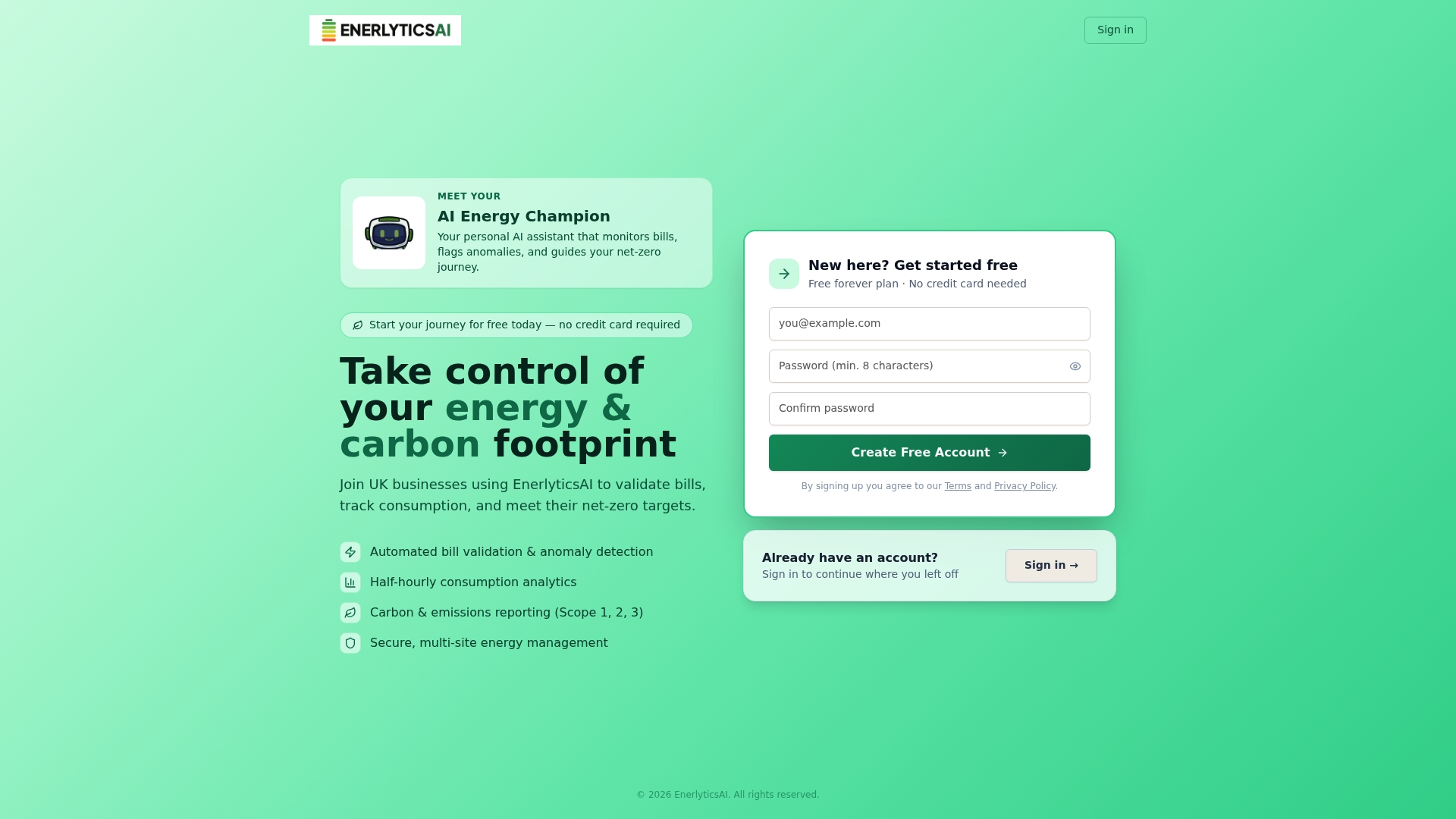
The Starter plan is free forever. When you need more, paid plans run from £49 a month (Eco) through £79 (Growth) and £149 (Professional) to £299 a month (Scale). Create your free account and start with your highest-spend site.
FAQ
Is ESOS the same thing as energy savings opportunities?
Not exactly. ESOS is the UK scheme that requires large organizations to assess their energy use every four years and identify cost-effective measures. Energy savings opportunities in the wider sense are the measures themselves, and any business can look for them whether or not ESOS applies.
Does my small business need to comply with ESOS?
ESOS is aimed at large undertakings: 250 or more employees, or turnover above £44 million and a balance-sheet total above £38 million. A smaller business can still be caught if it belongs to a qualifying group. Check the official qualification guidance for your situation.
What is the quickest way to find savings?
Start with the data you already have. Validate 12 months of bills, compare periods, and look at overnight and weekend load in your half-hourly readings. Government guidance indicates about 40% of an average SME's savings need no capital spend, so behavior, schedules and corrections come before equipment.
How do I decide which measures to do first?
Score each by annual saving, cost, payback, carbon and fit with planned works. Do the quick, cheap ones now and put higher-cost items such as HVAC upgrades or fleet renewal into the capital plan with a business case.
Sources
- Energy savings opportunity scheme (ESOS): find out if you qualify, GOV.UK
- How to comply with ESOS Phase 4, GOV.UK
- Appendix C: Advice for complying with ESOS, GOV.UK
- Building Energy Efficiency Survey, executive summary
- A Guide to Implementing Energy Savings Opportunities
- SME Guide to Energy Efficiency
- Types of Energy and Carbon Saving Measures in ESOS, The EMA Magazine
- Emissions measurement and reporting approaches, GOV.UK
- Reduce your packaging carbon footprint