
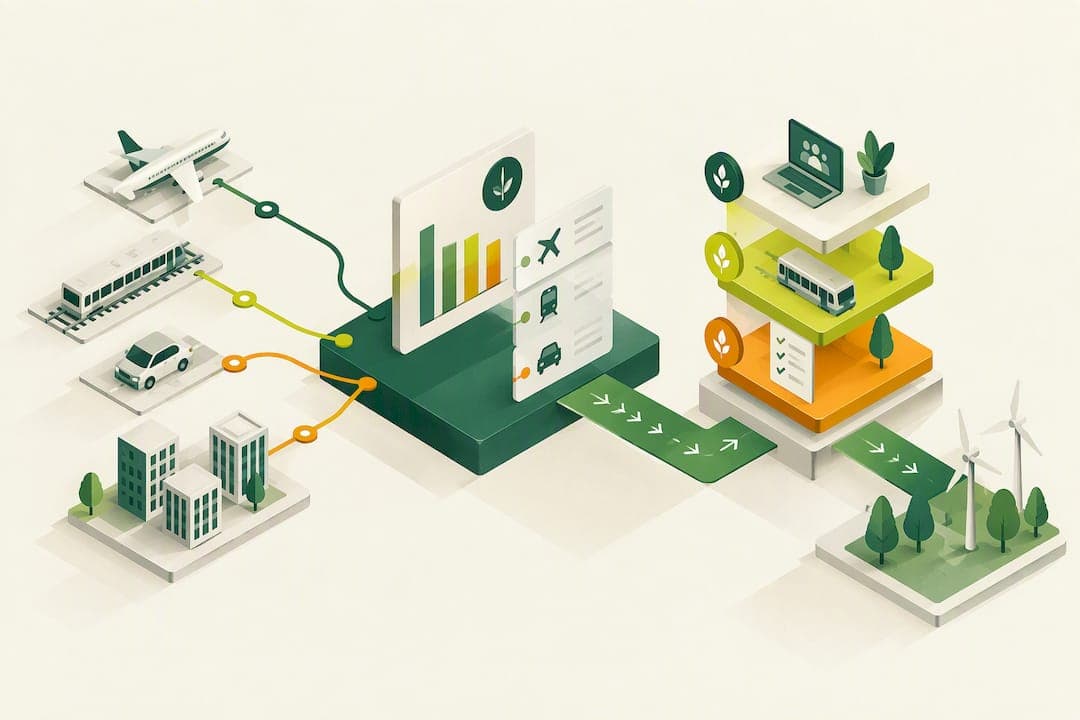
Business travel sits squarely in Scope 3, Category 6 of the GHG Protocol, and the first real move is not policy debate. It is measurement: pick a calculation method, pull your booking and expense data, and build a baseline. Everything else, from virtual-first rules to supplier engagement, only works once you know where the emissions actually sit.
TL;DR:
- Most companies should begin with distance-based calculations using national emission factors, then progressively improve data accuracy as booking details become available.
- Reducing emissions relies on demand management, modal shifts toward rail, and supplier engagement, rather than offsets alone.
- Flight emissions are significantly affected by seat class, aircraft type, and non-CO2 effects like contrails, which can double or triple the perceived climate impact.
- Internal carbon pricing and transparency of department-level travel data are among the most effective strategies to encourage behavior change.
- Automating data collection through platform tools turns annual reporting into continuous tracking, enabling more durable and measurable reductions.
Table of Contents
- What Business Travel Emissions Cover Under Scope 3 Category 6
- How To Calculate Business Travel Emissions: Fuel, Distance, and Spend Methods
- Practical Levers That Actually Cut Business Travel Emissions
- Building a Travel Emissions Program: Targets, Data, and Governance
- The Greenhouse Gases Behind Business Travel's Climate Impact
- Getting Employees To Actually Change Travel Behavior
- What Successful Business Travel Reduction Looks Like in Practice
- Why Platform-Level Reporting Is Closing the Data Gap
- Start Measuring Your Full Carbon Footprint With Enerlytics AI
- Where To Go Deeper on the Technical Guidance
- Sources
- FAQ
What Business Travel Emissions Cover Under Scope 3 Category 6
Under the GHG Protocol's Category 6 guidance, business travel covers employee transport in vehicles owned or operated by third parties. That is a narrower box than most people assume, and it matters for how you scope your inventory.
Company-owned fleet vehicles fall under Scope 1 or 2, not Category 6. Employee commuting is a separate bucket, Category 7. What actually belongs in your business travel emissions figure:
- Commercial air travel, with seat class tracked separately, since premium seating carries a materially higher per-passenger footprint
- Rail and bus journeys booked for work trips
- Taxis, ride-hailing, and rental cars used on business trips
- Employee-owned vehicles used for work travel, reimbursed by mileage
- Hotel stays, which many companies now fold in as an optional but increasingly expected addition
For companies with a large traveling workforce, aviation alone can rival or exceed the emissions from owned facilities. That is why the GBTA Foundation's benchmarking work treats travel as a first-tier category for target-setting and investor-facing disclosure, not a footnote buried in a sustainability appendix.
How To Calculate Business Travel Emissions: Fuel, Distance, and Spend Methods
The GHG Protocol lays out three calculation methods for Category 6, and they form an accuracy hierarchy: fuel-based sits at the top, distance-based in the middle, and spend-based at the bottom. None of them is wrong. They are just suited to different data realities.
- Fuel-based method. You calculate emissions from actual fuel consumption, usually reported by an airline or fleet operator. It is the most precise option, but almost no corporate traveler has access to a carrier's real fuel-burn data, so this method stays rare outside chartered or corporate-owned aviation.
- Distance-based method. You multiply trip distance by mode-specific emission factors, adjusted for aircraft type and seat class where possible. This is the workhorse method for most travel programs, and the GHG Protocol's own guidance treats it as the practical default once booking data is available.
- Spend-based method. You apply an average emission factor per dollar or pound spent on a travel category. It is fast, works off expense reports alone, and it is the least accurate because it cannot tell a business-class London-to-New York flight from an economy hop to a regional airport.
Activity data needs scale with the method. Distance-based calculations require trip origin, destination, mode, and seat class. Spend-based calculations need only category-level expense totals. Emission factors typically come from national government datasets such as the UK's DEFRA conversion factors, from the EPA in the United States, or from ICAO's aviation emissions calculator. Formula tables and worked examples for all three methods appear in the GHG Protocol's Appendix D.
The practical data sources are your booking platform, expense and corporate card feeds, and any travel management company (TMC) reporting you already receive. Seat class and aircraft type are the two biggest gaps: most expense systems capture ticket price, not cabin, so you often have to cross-reference booking records manually until your TMC feed improves.
Pro Tip: Don't wait for perfect data before you start. Most organizations begin with distance-based calculations using national emission factors, then upgrade toward supplier-specific or fuel-based figures as booking data quality improves. A rough baseline this quarter beats a perfect one next year.
Practical Levers That Actually Cut Business Travel Emissions
Reduction levers fall into a rough priority order: eliminate the trip, shift the mode, then clean up what remains. Sustainability managers who skip straight to offsets without touching demand usually see the smallest gains for the largest spend.
- Demand reduction. Virtual-first meeting policies, mandatory approval workflows for flights above a distance threshold, and internal carbon budgets that price emissions into departmental travel decisions all cut trips before they happen.
- Modal shift. Rail beats short-haul flights on most European and Northeast US corridors under roughly four hours; set a firm distance or duration threshold in your booking tool rather than leaving it to individual judgment.
- Booking rules. Default to economy class, encourage combining multiple meetings into single trips, and route through direct flights where a layover would add distance without saving time.
- Supplier engagement and Sustainable Aviation Fuel (SAF). Book-and-claim SAF certificates let you fund cleaner fuel even when your specific flight does not burn it, and pushing suppliers for transparent emission-factor reporting improves your own data quality over time.
- Contrail avoidance. Aviation's warming effect includes non-CO2 impacts from contrails and NOx, and ICAO's operational research shows that rerouting flights to avoid contrail-forming altitudes can meaningfully cut near-term warming at a relatively low fuel penalty. It is airline-side, not something a corporate travel policy controls directly, but it is worth raising with carriers you have leverage over.
- Hotel and ground transport. Favor hotels with third-party sustainability certifications, choose electric rental vehicles where available, and subsidize public transit over taxis for ground travel.
Pro Tip: Internal carbon pricing works better as a nudge than a punishment. Set the internal price high enough that a business-class upgrade or an avoidable short-haul flight shows up as a real line item on a department's budget, not a rounding error.
Building a Travel Emissions Program: Targets, Data, and Governance
A credible program needs a target type, a data pipeline, and someone accountable for both. Skip any one of the three and the numbers stop meaning anything.
- Choose your target type. Absolute targets work for companies with stable headcount. Growing companies usually need intensity metrics instead, and the SBTi's aviation guidance specifically recommends expressing aviation-related targets as grams of CO2e per full-time employee (gCO2e/FTE) so growth does not automatically read as failure.
- Set your KPIs and reporting cadence. Track annual total CO2e, gCO2e/FTE, and emissions broken down by trip category (domestic flight, international flight, rail, ground transport) at minimum quarterly, with a full annual roll-up for disclosure.
- Wire up your data systems. Booking platforms, expense and T&E systems, corporate card feeds, and your TMC's Global Distribution System (GDS) data all need to feed one place, ideally automatically rather than through quarterly manual exports.
- Assign clear ownership. A travel manager who controls policy and a sustainability owner who controls reporting need a shared approval gate for major exceptions, or travel emissions data becomes a source of internal disputes rather than decisions.
- Disclose your method transparently. State plainly whether you used fuel, distance, or spend-based calculations, and whether you applied a radiative forcing multiplier for aviation's non-CO2 warming effects. The GBTA Foundation notes that no single harmonized global standard exists yet, so transparency about your choices is what earns stakeholder trust.
The Greenhouse Gases Behind Business Travel's Climate Impact
Carbon dioxide dominates the conversation, and for good reason: it makes up the bulk of aviation, rail, and road travel's measurable emissions, and every calculation method built into the GHG Protocol treats it as the baseline unit (CO2e, or CO2-equivalent).
But CO2 is not the whole story for aviation specifically. Jet engines also emit nitrogen oxides (NOx), which contribute to ozone formation at altitude, and water vapor that forms contrails under the right atmospheric conditions. These fall under what ICAO categorizes as short-lived climate pollutants, and their combined warming effect can rival or exceed the CO2 impact of a given flight, even though they never show up in a simple fuel-burn calculation.
This matters practically because a standard CO2e figure for a flight understates aviation's total climate impact. Some corporate reporting frameworks now apply a radiative forcing multiplier, typically in the range of 1.9x to 3x the CO2-only figure, to account for these non-CO2 effects, though there is no single agreed multiplier across all frameworks.
Ground transport is comparatively simple by contrast. Diesel and gasoline combustion in taxis and rental cars produce CO2, plus small amounts of methane and nitrous oxide, both far more potent per molecule than CO2 but present in tiny quantities relative to the CO2 output. Rail travel, especially on electrified lines, produces the smallest direct footprint of any common business travel mode, which is part of why modal shift toward rail is one of the highest-leverage reduction levers available.
Getting Employees To Actually Change Travel Behavior
Policy documents do not reduce emissions. Behavior does, and behavior only changes when the incentives point the right way.
Internal carbon pricing is the single most effective lever companies are adopting, according to research tracked by Fast Company, because it moves the conversation from abstract sustainability goals to a number that shows up on a manager's budget. When a business-class seat or an avoidable short-haul flight carries a visible internal cost, travel requests get scrutinized the way any other expense does.
Approval friction works too, but it has to be calibrated. Make every flight require sign-off and you train employees to route around the system, either by booking outside official channels or by padding trip justifications. A better approach: default to virtual meetings, require explicit approval only above a distance or cost threshold, and make the approval form ask a real question, such as whether a video call was considered first.

Transparency helps more than most managers expect. Publishing team-level or department-level travel emissions data, the way some companies now do internally, turns reduction into something closer to a friendly competition rather than a compliance exercise. Combine that with manager-level accountability, where a department head's performance review references their team's travel footprint, and you get the kind of durable behavior change that a one-time policy memo never produces.
What Successful Business Travel Reduction Looks Like in Practice
The clearest pattern among organizations that meaningfully cut travel emissions is that they never rely on a single lever. The GBTA Foundation's benchmarking work describes this as a layered toolbox: measurement first, then demand management, then modal shift, then supplier engagement, with internal carbon pricing running underneath all of it as a behavioral nudge.

Companies that combine a virtual-first meeting default with a firm rail-over-air policy for short routes typically see the fastest early wins, because those two levers require no new technology and no supplier renegotiation. They just require a policy change and consistent enforcement.
The harder, slower wins come from supplier engagement. Negotiating book-and-claim SAF certificates into airline contracts, or pushing preferred hotel chains toward third-party sustainability certification, takes longer to show up in the numbers but produces reductions that survive a change in travel volume. A company that cuts flights by 20% one year but rebounds the next has not built a durable program. A company that shifts its supplier contracts toward lower-carbon options locks in the gain regardless of travel volume swings.
The common thread across programs that stick: they treat the data pipeline as infrastructure, not a once-a-year reporting scramble, which is exactly where platform-level tools start to earn their keep.
Why Platform-Level Reporting Is Closing the Data Gap
Most of the friction in Category 6 reporting is not conceptual. It is operational: reconciling booking data, expense feeds, and supplier invoices by hand, month after month. That is where a platform built for Scope 1, 2, and 3 carbon reporting earns its place in the stack.
A platform that applies half-hourly consumption analytics and automated anomaly detection to the energy side of a company's footprint uses similar logic (consolidating scattered data sources into one clean reporting layer) that can be applied to travel emissions reporting. Multi-site businesses juggling supplier invoices and inconsistent booking exports face a similar reconciliation burden whether they are tracking electricity or air miles, and automating that consolidation is what turns a once-a-year spreadsheet scramble into a running intensity metric a sustainability team can actually track.
— Chris
Start Measuring Your Full Carbon Footprint With Enerlytics AI
Some platforms give businesses a way to manage Scope 1, 2, and 3 carbon reporting from one dashboard, without the upfront cost that usually gates access to proper emissions tracking. Some services offer a free plan covering core usage across multiple sites, enabling sustainability teams to start consolidating data before committing budget to advanced features.
If your business travel emissions work is stuck at the spreadsheet stage, the practical next step is getting your reporting infrastructure in order first. The Emissions product page walks through how the platform structures Scope 1 through 3 reporting, and you can register for the free Starter plan to start managing multi-site energy and carbon data without an upfront charge. Layering in travel-specific tracking typically involves feeding in booking and expense data rather than building a reporting system from scratch.
Where To Go Deeper on the Technical Guidance
For the underlying calculation formulas, target-setting frameworks, and aviation-specific research referenced throughout this guide:
- GHG Protocol Chapter 6 and Appendix D for full Category 6 methodology
- ICAO's contrail and non-CO2 mitigation report for aviation-specific detail
- SBTi aviation guidance for target-setting recommendations
- GBTA Foundation's benchmarking report for program-design comparisons
Sources
- Chapter 6: Business travel | GHG Protocol
- Appendix D: Calculation formula summary tables | GHG Protocol
- Managing emissions from business travel programs: GBTA Foundation report
- SBTi aviation guidance (business travel considerations)
FAQ
How Much CO2 Does a One-Hour Flight Produce?
The exact figure depends heavily on aircraft type, load factor, and seat class, which is why the GHG Protocol recommends distance-based or fuel-based calculations rather than a single flat number. A regional economy-class hop and a short business-class flight on the same route can differ substantially in per-passenger emissions, so pulling the actual emission factor for your specific route and cabin class gives a far more defensible figure than a rule-of-thumb estimate.
What Are the Different Categories of Business Travel?
Under Scope 3 Category 6, business travel includes air travel (tracked by seat class), rail, bus, taxis, rental cars, and employee-owned vehicles used for work trips, with hotel nights often included as an optional addition. Company-owned fleet vehicles and employee commuting are excluded and reported separately, as the GHG Protocol specifies.
Is It Worse for the Climate To Fly or Drive?
For long distances, flying generally produces a higher per-passenger footprint than driving, especially once aviation's non-CO2 warming effects like contrails and NOx are factored in. For shorter distances, particularly under a few hundred miles, a single traveler in a car with low occupancy can sometimes match or exceed a full-plane flight's per-passenger footprint, which is why distance-based calculations that account for the specific mode and load factor matter more than blanket rules.
How Do I Choose Between the Three Calculation Methods?
Start with distance-based calculations using national emission factors if you have booking data with trip distances and modes, since that is the practical default for most travel programs. Use spend-based calculations only when expense data is all you have, and reserve fuel-based calculations for cases where you get direct fuel-consumption reporting from a carrier or fleet operator, per GHG Protocol guidance.
Can Enerlytics AI Help Track Business Travel Emissions?
Some core platforms are built for Scope 1, 2, and 3 carbon reporting with half-hourly consumption analytics and multi-site management, which supports the data consolidation that Category 6 reporting requires. Current plan pricing and feature details are listed on the Emissions product page, with a free forever plan available for teams getting started.