
Implement ISO 50001 by running a phased PDCA energy management system: form your team, start continuous metering and bill validation, and define two or three energy performance indicators before you touch a single efficiency project. Pursue certification through a UKAS-accredited body once your baseline is solid. Pull together templates and setup guides now so data collection starts on day one, not after the scoping meeting.
TL;DR:
- Building a solid baseline from at least twelve months of data is crucial, with half-hour consumption records and automatic bill validation to ensure accuracy.
- Implementation timelines generally range from three to five months for small firms, but complex operations may take over nine months, heavily depending on data collection speed.
- Certification audits verify operational evidence, continual improvement trends, and documented controls, requiring organizations to retain raw data and assign clear responsibilities.
- Early refusal or failure results often stem from under-metering, vague roles, or a paper-only system lacking real staff engagement, which are preventable with proper planning.
- Using connected energy platforms accelerates data collection, anomaly detection, and emissions reporting, effectively compressing project timelines during baseline creation and ongoing monitoring phases.
Table of Contents
- Your phased implementation roadmap from plan to certification
- How long does ISO 50001 implementation actually take?
- Building energy baselines and EnPIs that survive an audit
- What certification auditors actually check
- Common pitfalls that derail implementation (and how to avoid them)
- Resources and templates to start today
- How a connected energy platform speeds up the data-heavy phases
- Why culture, not paperwork, decides whether certification holds
- Get your baseline running with a free EnerlyticsAI account
- FAQ
- Sources
Your phased implementation roadmap from plan to certification
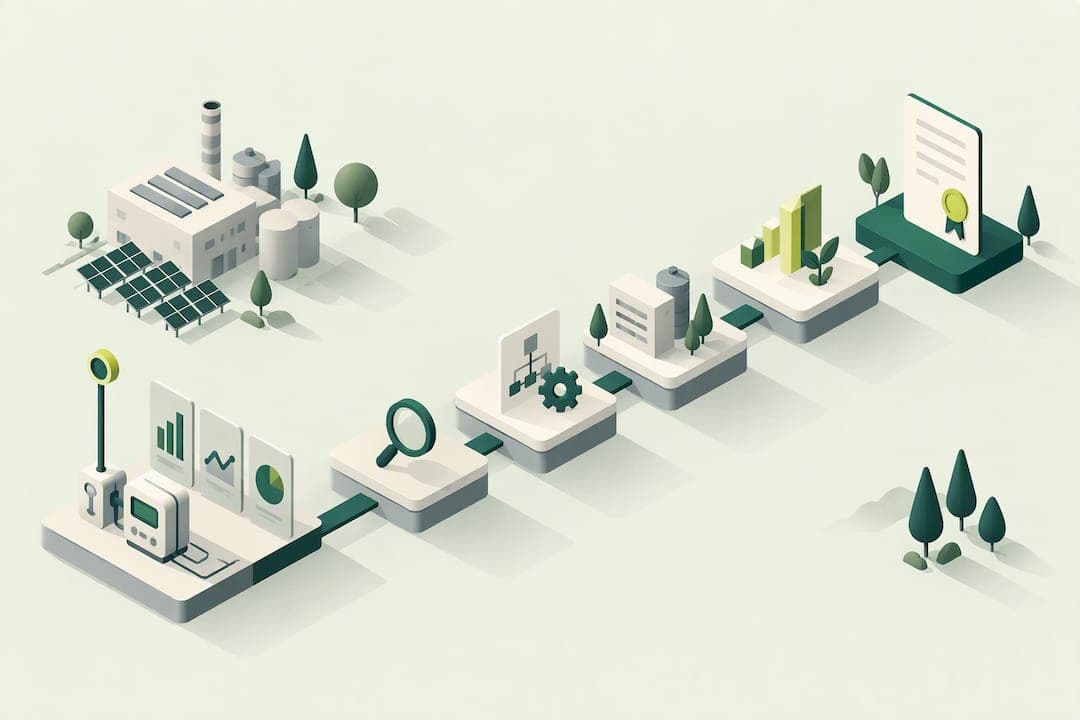
ISO 50001:2018 is built on the Plan-Do-Check-Act cycle, and breaking your project into five phases keeps that cycle manageable instead of theoretical.
- Plan: Define scope and boundaries, draft an energy policy aligned with your organization's goals, appoint an energy management team, and run a gap analysis against the standard's clauses.
- Data and visibility: Install or confirm metering coverage, validate incoming energy bills, build your energy baseline, and pick your first energy performance indicators.
- Implement controls: Roll out prioritized energy-saving projects, write operational controls for significant energy uses, and add energy criteria to procurement and design decisions.
- Check and verify: Monitor performance against your indicators, run an internal audit, hold a management review, and close out corrective actions.
- Certification: Complete a pre-assessment, select a UKAS-accredited certification body, pass stage 1 and stage 2 audits, and maintain the system through ongoing surveillance visits.
Each phase needs a named owner, not just a checklist. The energy team from Phase 1 should include someone with authority over facilities or operations budgets, because Phase 3 controls rarely survive without procurement or engineering buy-in. Training and awareness sessions belong early too: staff who understand why metering cadence matters are far less likely to disconnect a sensor or skip a reading. Treat Phase 2 as the schedule's critical path. Everything downstream, from control design to audit evidence, depends on baseline data that auditors can trust.
How long does ISO 50001 implementation actually take?
Timelines vary by size and energy complexity, and data collection is usually what sets the pace, not paperwork.
- Small or simple organizations sometimes complete implementation in 3 to 5 months.
- Most small and medium-sized businesses need 6 to 12 months to move from scoping to certification.
- Complex or energy-intensive operations often require 9 months or more.
Auditors need a measurable performance period, not a snapshot, so a baseline built on a few weeks of data will not hold up. You can shorten the schedule by keeping scope tight at first, using metering you already have instead of waiting on new installations, and assigning a dedicated person to the data workstream rather than treating it as a side task.
Building energy baselines and EnPIs that survive an audit
Your energy baseline (EnB) and energy performance indicators (EnPIs) are the backbone of the entire management system, and they need to be normalized to mean anything. A manufacturing site might track kilowatt-hours per unit produced, an office might use energy intensity per square meter, and a site with seasonal swings might normalize against degree days.
- Build your baseline from at least twelve months of consumption data where possible, so seasonal variation does not distort your starting point.
- Use half-hourly consumption data where it is available. Finer granularity makes it easier to spot anomalies and justify normalization factors to an auditor.
- Validate bills against meter readings automatically rather than manually, since billing errors are a common source of bad baseline data.
- Keep retention policies that preserve raw readings, not just summary reports, because auditors ask for the underlying records.
Multi-site organizations face an extra step: aggregating EnPIs across sites only works when each site's normalization basis is documented the same way, or your overall indicator becomes meaningless.
Pro Tip: Lock your baseline period and normalization method in writing before you start comparing performance, so a later dispute with an auditor becomes a quick reference check instead of a redo.

What certification auditors actually check
Certification follows a predictable sequence: a gap analysis, an internal audit, a management review, selection of a certification body, then stage 1 and stage 2 external audits, followed by ongoing surveillance visits.
In the UK, choosing a UKAS-accredited certification body matters because non-accredited certificates can lack the independent oversight that government tenders, supply chain contracts, and regulatory schemes expect. Reference ISO 50001:2018 alongside ISO 50001:2018/Amendment 1:2024, which adds climate-action-related updates that implementers should account for before an audit.
In practice, auditors verify:
- Evidence that the EnMS is operating, not just documented, including meeting minutes and monitoring logs.
- Continual improvement demonstrated through EnPI and EnB trends over time.
- Documented operational controls for significant energy uses.
- Training and competence records for everyone with EnMS responsibilities.
Common pitfalls that derail implementation (and how to avoid them)
Most failed audits trace back to the same handful of issues, and they are avoidable with the right habits early on.
- Running a paper-only system where procedures exist on file , but nobody follows them day to day.
- Treating ISO 50001 as an engineering project with no senior sponsorship, which stalls momentum once early enthusiasm fades.
- Under-metering sites or failing to retain raw data, leaving gaps an auditor will flag immediately.
- Leaving roles and responsibilities vague, so nobody owns baseline updates or corrective actions.
Before inviting an auditor, confirm you have a signed energy policy, a documented baseline with normalization logic, at least one completed management review, and evidence that corrective actions from your internal audit were closed out.
Resources and templates to start today
Pulling the right references together before you start saves weeks of rework later.
- The ISO 50001:2018 standard page and its 2024 amendment notice are the primary texts to work from.
- Look for an energy review template, example EnPI calculations, and an internal audit checklist from your certification body or consultant.
- UK organizations should also check the BS EN ISO 50001:2018+A1:2024 preview for national adoption notes.
How a connected energy platform speeds up the data-heavy phases
Baseline creation and ongoing monitoring are the two tasks that eat the most project time, and they are also the two tasks a connected energy platform accelerates most directly.
- Automated bill validation catches billing errors before they corrupt a baseline calculation.
- Anomaly detection flags unusual consumption patterns that would otherwise surface only during a manual review.
- Half-hourly consumption analytics give the granularity auditors look for when assessing EnPI trends.
- Carbon reporting across Scope 1, 2, and 3 emissions turns monitoring data directly into evidence for management reviews and external audits.
These capabilities map onto the data workstream in Phase 2 and the ongoing monitoring required in Phase 4, which are the two places most implementation timelines slip. Setup for connecting meters and bill data is covered on the setup page, and the emissions reporting tools are built for the kind of documented evidence auditors expect to see.
Why culture, not paperwork, decides whether certification holds
The organizations that keep their certification year after year are the ones that fold energy KPIs into procurement decisions and daily operations, not just into an annual audit binder. A baseline and a set of EnPIs mean little if nobody reviews them between audits. Schedule your first management review within three months of completing your baseline, while the data and the lessons from building it are still fresh.
— Chris
Get your baseline running with a free EnerlyticsAI account
Building a credible baseline is the slowest part of ISO 50001 implementation, and we built EnerlyticsAI to remove the manual work from that step. You can manage multiple sites without upfront charges while your energy team gets comfortable with the data.
- Register for a free forever plan and connect your meters and bill data.
- Use automated bill validation and anomaly detection to clean up your consumption records.
- Generate your first EnPI and baseline reports directly from your connected site dashboards.
For a broader look at why energy performance upgrades pay off operationally, Multigroup Contracting's guide to energy efficiency covers the business case from a construction angle worth reading alongside your own project plan.
FAQ
What is ISO 50001 in simple terms?
ISO 50001 is an international standard that gives organizations a structured way to manage and improve how they use energy, built around the Plan-Do-Check-Act cycle described in ISO 50001:2018. It asks organizations to set an energy policy, measure a baseline, track performance indicators, and keep improving over time.
What is the difference between ISO 50001 and 14001?
ISO 50001 focuses specifically on energy performance, requiring energy baselines and EnPIs as its core measurement tools. The two standards often complement each other in environmental and energy management, and they are commonly implemented together using shared procedures for documentation and management review.
Is ISO 50001 the same as Energy Star?
No. ISO 50001 is a management system standard that certifies an organization's process for managing energy, while Energy Star is a product and building labeling program run in specific markets. An organization can pursue ISO 50001 certification regardless of whether it also uses an Energy Star program.
What is the latest version of ISO 50001?
The current version is ISO 50001:2018, updated by Amendment 1:2024, which adds climate-action-related considerations. Organizations implementing or renewing certification should check the amendment text alongside the base standard.