
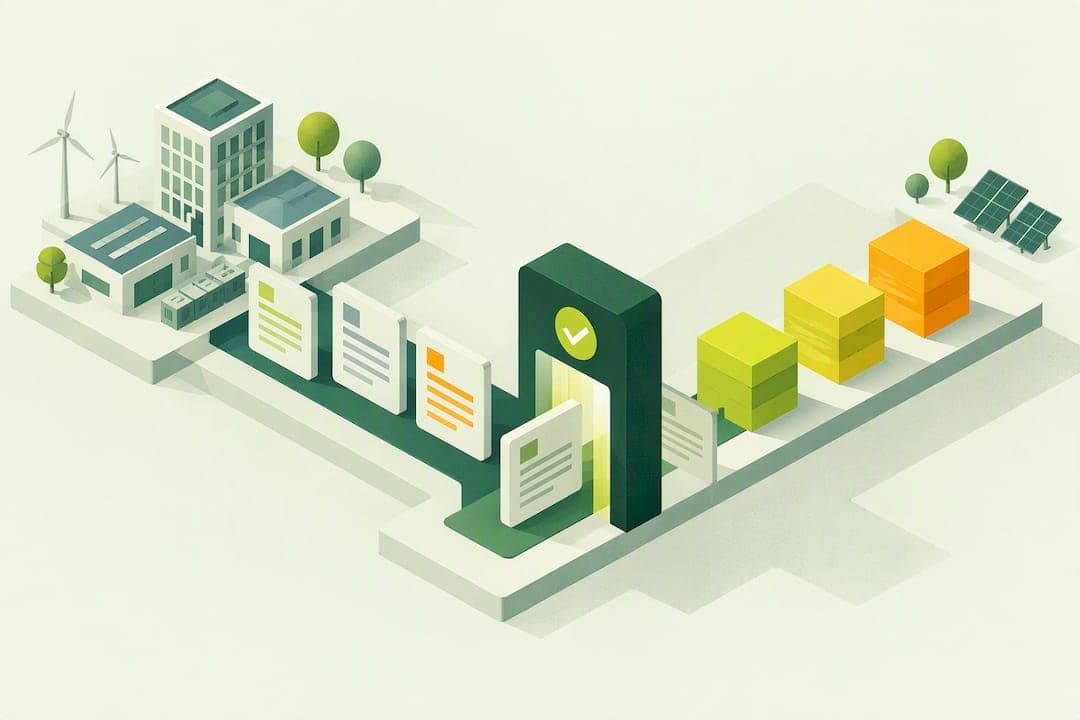
In this article, "business energy tariffs" means the tariff lines and contract rates recorded on your invoices, the numbers your energy-management software pulls in to calculate cost and carbon impact. The action to take is simple: validate every tariff line against your contract and meter data before you approve payment or let it feed into a report. Skip that step, and errors that could have been recovered under the six-year overpayment window quietly become sunk cost.
TL;DR:
- Validating every tariff line against contract and meter data can recover a significant percentage of overpaid costs, especially in portfolios with systemic errors.
- Common errors to prioritize include estimated meter reads, unit rate mismatches, standing charge mistakes, and incorrect VAT or network charges.
- A structured validation process involves cross-checking bill details, recalculating charges manually, and logging discrepancies before raising supplier queries.
- Automated validation platforms like EnerlyticsAI are recommended for multi-site portfolios or complex tariffs, offering anomaly detection and seamless emissions mapping.
- Businesses can recover overpayments for up to six years if they have proper documentation, but undercharges are typically limited to a 12-month recovery window.
Table of Contents
- What Do Business Energy Tariffs Mean for Cost and Carbon Reporting?
- What Are the Most Common Tariff Errors to Check First?
- How Do You Validate a Business Energy Bill Line by Line?
- Should You Use Spreadsheets or Validation Software?
- How Far Back Can You Claim a Refund for a Billing Error?
- What Should Your Monthly Bill-Approval Checklist Look Like?
- What Actually Slows Teams Down Here
- Try EnerlyticsAI's Free Pilot Before Your Next Renewal
- Sources
- FAQ
What Do Business Energy Tariffs Mean for Cost and Carbon Reporting?
A one penny per kWh error looks trivial on a single invoice. Multiply it across a 40-site portfolio over a 12-month contract, and it becomes a five-figure overpayment that nobody notices until an audit flags it. Unit-rate mismatches distort more than the bill itself. When procurement teams benchmark suppliers using bad unit costs, they negotiate the next contract from a false baseline.
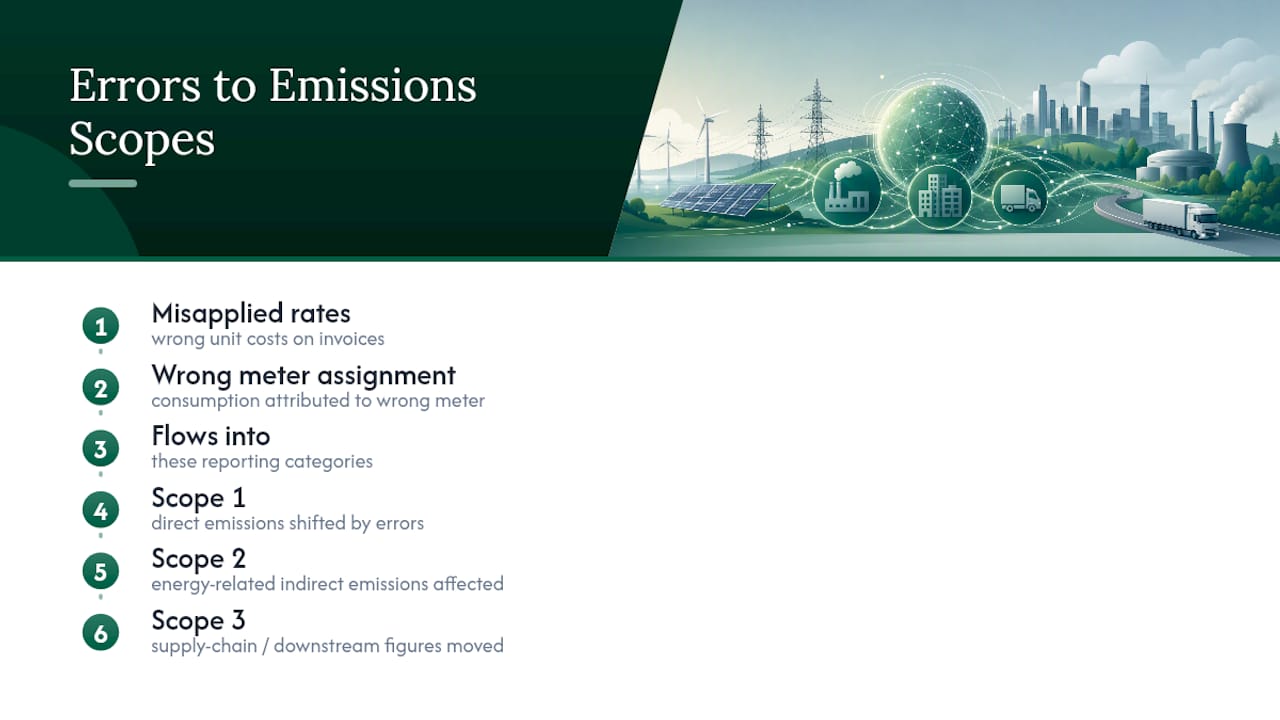
The carbon math suffers too. Misapplied rates or consumption misattributed to the wrong meter can shift Scope 1, 2, and 3 figures enough to throw off an emissions report that leadership or a regulator will eventually see.
The scale of the opportunity is real. Effective bill validation can often recover a noticeable percentage of the bill value on portfolios where systemic errors exist, which is exactly the kind of error that estimated reads and mismapped tariffs create.
What Are the Most Common Tariff Errors to Check First?
Not every line item deserves equal scrutiny. Some errors are rare and cosmetic; others recur monthly and compound. Prioritize the ones that hit hardest and hide longest.
- Estimated meter reads. Estimated reads commonly drift higher than actual consumption, creating a silent overcharge that persists until someone submits an actual read.
- Unit rate mismatches. The rate on the invoice doesn't match the contract, or a time-of-use register gets mapped to the wrong band.
- Standing charge errors. Wrong daily rate, wrong number of days billed, or a standing charge applied twice across split invoices.
- VAT and Climate Change Levy (CCL) misapplication. A missing exemption certificate or an incorrect VAT rate can add real cost fast.
- Agreed capacity (ASC) set too high. Many businesses carry an inherited capacity limit that no longer matches actual demand, and pay for headroom they never use.
- DUoS and TNUoS band errors. Distribution and transmission charges billed against the wrong network band or time band.
- Stale contract rates. Old rates still applied after a renewal, a meter exchange, or a change of tenancy.
Pro Tip: Pull your agreed capacity history once a year. Inherited ASC limits from a previous tenant or an earlier growth forecast are one of the easiest fixed costs to shrink after a proper audit.
How Do You Validate a Business Energy Bill Line by Line?
Validation is a repeatable procedure, not a one-off spreadsheet exercise. Here's the sequence that produces evidence you can actually use in a supplier dispute.
- Gather the inputs. Contract pages, MPAN or MPRN reference, half-hourly consumption exports, the prior bill's closing read, and any VAT or CCL exemption certificates.
- Check the billing metadata. Confirm the billing period length, whether reads are actual or estimated, and that the meter type matches what's on file.
- Recalculate the unit charges. Multiply consumption by the contracted rate for each register, not just the headline rate, since time-of-use tariffs often have three or four bands.
- Recalculate the standing charge. Daily rate times the number of days in the billing period, checked against the contract, not the invoice's own math.
- Verify pass-through and network charges. Compare DUoS, TNUoS, and capacity charges against the published network schedules for that region and voltage level.
- Rebuild the bill total. Add every line back up independently rather than trusting the supplier's subtotal.
- Log every exception. Note the exact discrepancy, attach the supporting file (contract clause, meter export, VAT certificate), and raise the query with a specific ask and a deadline.
- Follow up to close the loop. Confirm the credit or refund lands, and check it's applied to the correct account and billing period, not just issued as a vague goodwill gesture.
This is the same discipline whether you're validating electricity, gas, or water invoices. The underlying method doesn't change even when the inputs do.
Should You Use Spreadsheets or Validation Software?
A single site with one meter and a straightforward fixed-rate contract can usually be checked by hand once a quarter. Manual review works fine at that scale, but the moment you add half-hourly metering, multiple sites, or time-of-use tariffs, spreadsheets start to strain.
- Spreadsheets handle small portfolios well but struggle with half-hourly data volume and cross-site pattern detection.
- Validation software ingests bills automatically, flags anomalies against contract rates, and routes exceptions into a workflow instead of an inbox.
- Automated platforms also map validated consumption directly into carbon reporting, which removes a manual step that's easy to get wrong.
EnerlyticsAI is a free-forever, AI-based platform built for exactly this handoff: it ingests bills, flags anomalies, and connects half-hourly consumption data to emissions reporting without a spreadsheet in between. A sensible pilot is 5 to 10 sites over three billing cycles, long enough to see whether automated flags catch what manual checks were missing.
How Far Back Can You Claim a Refund for a Billing Error?
The recovery window isn't symmetrical, and that asymmetry favors you if you keep good records. Businesses can generally recover overpayments for up to six years once the error is substantiated, under the same limitation rules that apply to most contractual debts in England and Wales. Suppliers, by contrast, are far more constrained when the mistake runs the other way.
| Claim type | Who can claim | Typical limit |
|---|---|---|
| Overpayment by business | Business (you) | Up to 6 years, if evidenced |
| Undercharge by supplier | Supplier | Typically 12 months (back-billing protection) |
To substantiate a claim you'll need the signed contract, the half-hourly export covering the disputed period, VAT and CCL certificates, and the prior 12 months of bills. Prioritize the oldest disputed periods first, since they're the ones closest to falling outside the six-year window.
What Should Your Monthly Bill-Approval Checklist Look Like?
- Pull the invoice, contract page, meter export, and previous bill side by side.
- Confirm whether reads are actual or estimated, and flag any estimate for follow-up.
- Compare unit rates and standing charges against the contract, and check VAT and CCL treatment.
- Verify agreed capacity and the DUoS/TNUoS bands match the site's actual profile.
- Record any discrepancy with supporting evidence and open a supplier query with a firm deadline.
- Escalate anything material, meaning a recurring error or one above your internal threshold, rather than letting it sit in a queue.
Pro Tip: Run this checklist right after a supplier switch or a contract renewal. That's when stale rates and mismapped registers are most likely to slip through.
What Actually Slows Teams Down Here
Most businesses split this work three ways without meaning to: finance owns the payment approval, facilities owns the meter and site data, and sustainability owns the emissions number that depends on both being right. The friction usually isn't the math. It's that nobody owns the handoff between those three, so an estimated read gets paid before facilities ever sees it.
Suppliers aren't usually acting in bad faith either. Most billing errors trace back to a misloaded tariff or a certificate that never got applied, not deliberate overcharging, and treating disputes as collaborative rather than adversarial gets resolutions faster. The metric that matters isn't how many queries you raised. It's the percentage of invoices validated before payment, and the pounds recovered against the pounds you could have recovered.
— Chris
Try EnerlyticsAI's Free Pilot Before Your Next Renewal
There are platforms that let you test automated validation without a budget conversation first. Some free plans let you onboard multiple sites and run bill ingestion, anomaly detection, and emissions mapping with no upfront cost, which matters if you want proof before you pitch a paid tool internally.
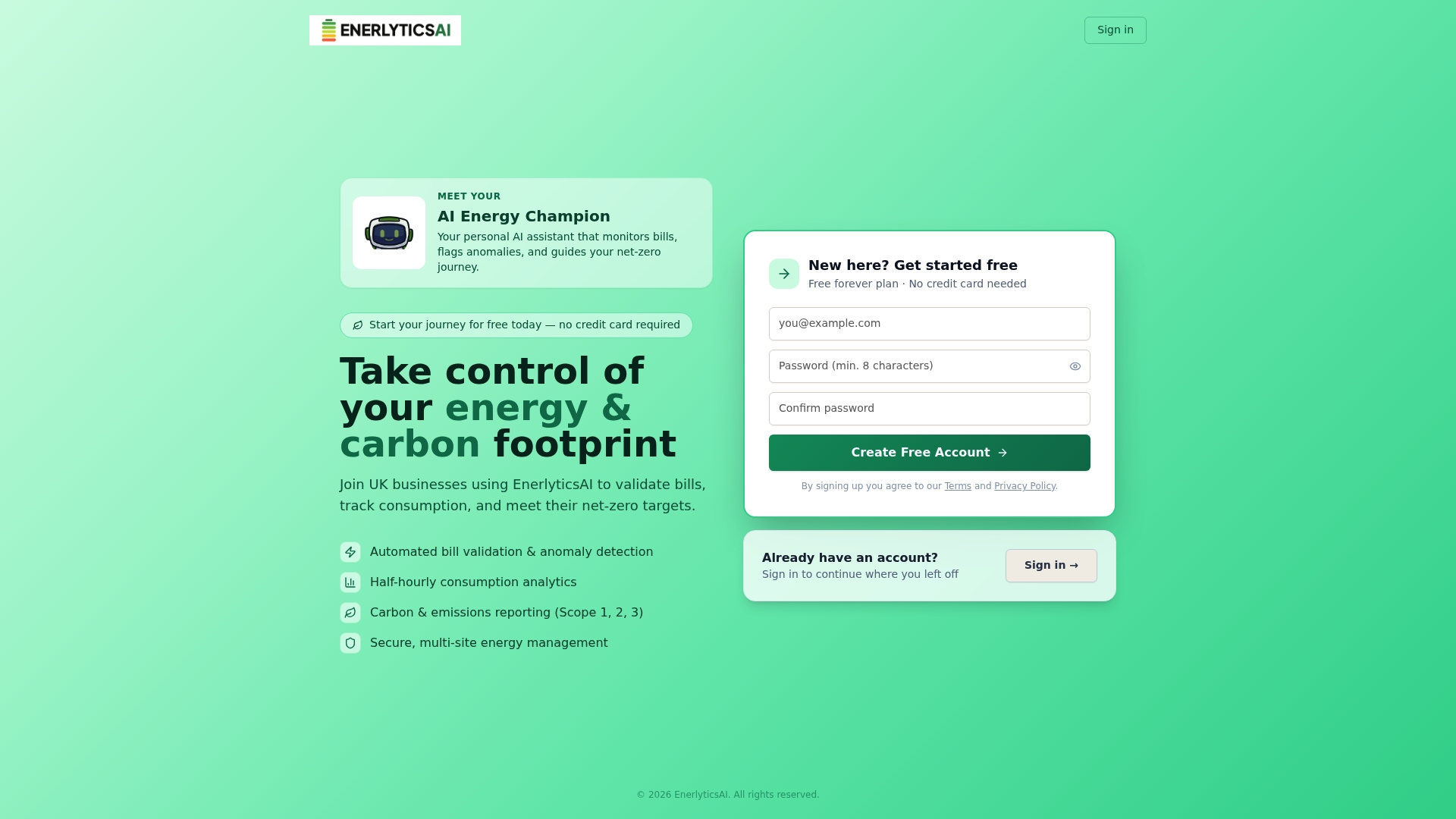
A realistic pilot: bring in 5 to 10 sites, run it across three billing cycles, and track three numbers, exceptions flagged, amounts recovered, and hours saved versus manual review. Every validated tariff line also feeds straight into carbon and emissions reporting, so you're not running validation and carbon tracking as two separate projects. If you want the technical detail on how bills get ingested and matched against contract rates first, the bill validation workflow page walks through it. Start by registering for the free forever plan and loading your first billing cycle.
Sources
FAQ
How Far Back Can We Claim an Energy Bill Refund?
Businesses can generally recover overpayments for up to six years as long as the error is documented with a contract, meter data, and prior bills. Suppliers face a much tighter window, typically limited to 12 months, when recovering undercharges from you.
What Counts as a Business Energy Tariff Line?
It's any individual charge on your invoice tied to your contract rate, meaning unit rates, standing charges, capacity charges, and network pass-through costs like DUoS and TNUoS. Your energy-management software analyzes each of these lines separately rather than treating the invoice total as one number.
Will Disputing a Bill Risk Losing Our Supply?
No. Ofgem guidance treats billing disputes and supply continuity as separate issues, and an active dispute under investigation shouldn't lead to disconnection.
When Should We Move From Spreadsheets to Software?
Spreadsheets work for single sites on simple fixed-rate contracts, but multi-site portfolios with half-hourly metering usually outgrow them fast. Automated platforms catch anomalies across sites automatically and map validated data into carbon reporting without extra manual work.
Does EnerlyticsAI Charge for Bill Validation?
EnerlyticsAI runs on a free forever plan with no published cost, so you can validate invoices and run emissions reporting without an upfront fee. Details on setup and site onboarding are available when you register on the platform.