
If your organization employed 250 or more people, or turned over more than £44 million with a balance sheet above £38 million, on the last qualification date, you owe the government an ESOS submission. The next fixed point on the calendar is December 5, 2026, when Phase 3 organizations must file their second annual progress update through MESOS, signed off by a director. Start now: confirm your qualification date, pull together your evidence pack, and get sign-off scheduled before the deadline crunch hits.
TL;DR:
- Organizations must have at least 250 employees or exceed £44 million in turnover and £38 million in balance sheet value on their qualification date to be in scope.
- The assessment must cover 95% of total energy use across buildings, industrial processes, and transport, with ISO 50001 certification providing a deemed compliance route.
- Clarifying data collection, documenting estimation methods, and securing timely director sign-off are common hurdles that can risk non-compliance if overlooked.
- The December 5, 2026, deadline for Phase 3 progress updates requires avoiding overlapping work with Phase 4, which begins immediately afterward; treating the process as continuous helps streamline efforts.
- Automating energy data analysis with tools like EnerlyticsAI simplifies reconciliation, improves accuracy, and reduces manual effort, supporting compliance and strategic energy management.
Table of Contents
- Who Qualifies for ESOS and What the Assessment Covers
- How to Carry Out an ESOS Assessment Step by Step
- What Goes in the ESOS Report and Evidence Pack
- MESOS: Submitting Notifications and Getting Sign-Off Right
- Action Plans and Progress Updates: What Auditors Expect
- Key ESOS Phase 3 and Phase 4 Deadlines to Track
- Your 30/90/180-Day ESOS Compliance Roadmap
- How EnerlyticsAI Cuts the Manual Work Out of ESOS Reporting
- Penalties for Failing to Comply With ESOS
- What Changed in ESOS Phase 4
- Common Challenges in ESOS Assessments and How to Fix Them
- Who Does What: ESOS Roles and Responsibilities
- Why ESOS Should Inform Strategy, Not Just Satisfy Regulators
- EnerlyticsAI: A Free Way to Simplify ESOS Data Collection
- Sources
- FAQ
Who Qualifies for ESOS and What the Assessment Covers
Qualification hinges on a single test applied on a fixed date: does your organization have 250 or more employees, or does it exceed both £44 million in turnover and £38 million on the balance sheet? If yes to either, ESOS reporting applies, and group structures matter. A parent company's qualification typically pulls its subsidiaries into scope too, even if a subsidiary alone would fall below the threshold.
Once you're in scope, the assessment has to cover the full footprint of energy use, not just the obvious stuff:
- Buildings — heating, lighting, cooling, and general operational energy across owned and leased premises
- Industrial processes — manufacturing lines, refrigeration, compressed air systems, anything process-related
- Transport — company vehicles, business travel, and in some cases outsourced logistics tied to the business
The assessment must account for at least 95% of total energy consumption. Organizations already certified to ISO 50001 across their full energy footprint get a deemed compliance route and can skip a separate ESOS report entirely. From Phase 4 onward, Display Energy Certificates and Green Deal Assessments no longer count as alternative routes, so anyone leaning on those needs a new plan.
How to Carry Out an ESOS Assessment Step by Step
Every ESOS assessment follows roughly the same sequence, whether you're doing it in-house or bringing in a lead assessor.
- Pull 12 months of verifiable energy data. Utility invoices, meter readings, and half-hourly data all count, but every figure needs to convert cleanly to kWh, and any estimation method has to be written down and defensible.
- Map consumption against the 95% threshold. You need to know which sites, fuels, and processes together account for the required share of total energy use before you can decide where audits are actually necessary.
- Select audit targets. Prioritize the highest-consuming sites and processes first. A single warehouse burning 40% of your electricity load deserves more scrutiny than five small offices combined.
- Calculate energy intensity ratios. These express consumption relative to a business metric such as square footage or units produced, and they're what regulators and your own board will use to judge year-over-year progress.
- Appoint a lead assessor. Every ESOS report requires sign-off from a registered lead assessor unless you're covered fully by ISO 50001.
Pro Tip: Start data collection at least two full billing cycles before your deadline. Suppliers routinely take four to six weeks to issue corrected invoices when your usage figures don't match theirs, and that delay has killed more than a few submission timelines.
What Goes in the ESOS Report and Evidence Pack
The ESOS report itself needs to state total energy consumption in kWh, the significant consumption you identified against the 95% threshold, your calculated intensity ratios, and a list of energy-saving opportunities with estimated savings attached to each.
Behind that report sits the evidence pack, which is what an auditor actually wants to see if your submission gets questioned:
- Raw supplier billing data and meter reads for the full 12-month period
- Audit reports from any site-level assessments carried out
- Written notes on every estimation method used to fill data gaps
- ISO 50001 certificates, where relevant, covering the scope claimed
- Documented director or responsible-officer sign-off
Not everything in that pack becomes public. The statutory regulations set out which fields the scheme administrator publishes on the register, generally the high-level compliance confirmation and headline figures, while granular billing data and internal audit notes stay with your organization for inspection purposes only.
A recurring audit failure: undocumented conversion methods for turning raw supplier data into kWh are one of the most common reasons a submission gets flagged during compliance checks.
MESOS: Submitting Notifications and Getting Sign-Off Right
MESOS replaced the old Smart Survey system in April 2024 and is now the only route for ESOS notifications, action plans, and progress updates. You register your organization, build your submission in stages, save drafts as data comes in, and upload supporting documents directly to the portal rather than emailing them separately.
Sign-off is not optional and not delegable to just anyone. A board-level director, or an equivalent senior officer with genuine oversight of the assessment, must confirm the submission before it goes in. If you used an external lead assessor, their registration number gets added alongside that sign-off.
The mistakes that trip people up are consistent:
- Submitting kWh totals that don't reconcile with the underlying invoices
- Estimation methods that exist in someone's head but never got written down
- Waiting until the deadline week to chase a director's signature
None of these are complicated to avoid, but all three show up repeatedly in enforcement notices.
Action Plans and Progress Updates: What Auditors Expect
Phase 3 made Action Plans mandatory and added two annual progress updates on top of the original report, a real shift from earlier phases where organizations could complete an assessment and largely move on.
A compliant Action Plan needs to include:
- Specific measures you intend to implement, described in enough detail that a third party could verify progress later
- Target dates for each measure, not a vague "within the assessment period"
- Expected kWh savings per measure, broken down by purpose (heating, lighting, transport, and so on)
Progress updates report what actually happened against that plan: which measures went live, what was measured or estimated as saved, and the method used to calculate it.
Pro Tip: Don't double-count. If a lighting retrofit shows up as a saving in your ESOS Action Plan and also gets claimed under a separate carbon reduction scheme, an auditor will eventually ask which one is real. Pick one framework as the system of record for each measure.
Commit only to what you can actually deliver and document. A modest, verifiable claim survives scrutiny far better than an ambitious one nobody can trace.
Key ESOS Phase 3 and Phase 4 Deadlines to Track
Two compliance cycles are running in parallel right now, and that overlap is where most scheduling mistakes happen.
- December 5, 2026 — Phase 3's second annual progress update is due, requiring director sign-off and MESOS submission
- December 31, 2026 — the qualification date for Phase 4 organizations, based on your headcount and financials on that day
- Later Phase 4 deadlines for the assessment, action plan, and first progress update follow on from that qualification date
Practitioner guidance on managing this overlap consistently makes the same point: treat Phase 3 and Phase 4 as one continuous process rather than two separate projects. Organizations that run them as a rolling loop, reusing data collection systems and evidence templates across both, avoid duplicating work that a fragmented approach forces twice.
Your 30/90/180-Day ESOS Compliance Roadmap
Start today with three tasks: confirm your exact qualification date against the thresholds, pull twelve months of energy bills and any half-hourly data you have, and either appoint a lead assessor or verify your ISO 50001 certificate covers the full scope required.
From there, a phased roadmap keeps the work manageable:
- By day 30: finish data collection, identify gaps needing estimation, and assign an internal owner for each site's figures.
- By day 90: complete audits on your highest-consuming sites, calculate intensity ratios, and draft the Action Plan measures.
- By day 180: finalize the evidence pack, secure director sign-off, and submit through MESOS well ahead of the statutory deadline.
Pro Tip: *Auditors flag missing site coverage more than any other issue.
Assign named owners to each deliverable. A roadmap with no accountable person attached to each step rarely survives contact with a real deadline.
How EnerlyticsAI Cuts the Manual Work Out of ESOS Reporting
Most of the effort in ESOS reporting isn't the analysis. It's chasing invoices, reconciling meter reads, and manually converting supplier data into kWh across every site you operate.
Half-hourly consumption analytics remove a chunk of that aggregation work automatically, converting raw usage into the consistent kWh figures your report needs. Automated bill validation and anomaly detection flag discrepancies between supplier invoices and actual consumption before they become a gap an auditor later questions, building a documented trail as you go rather than after the fact. For organizations running multiple sites, consolidating totals and intensity ratios across a group structure is exactly the kind of task that eats days when done manually and hours when it isn't.
Penalties for Failing to Comply With ESOS
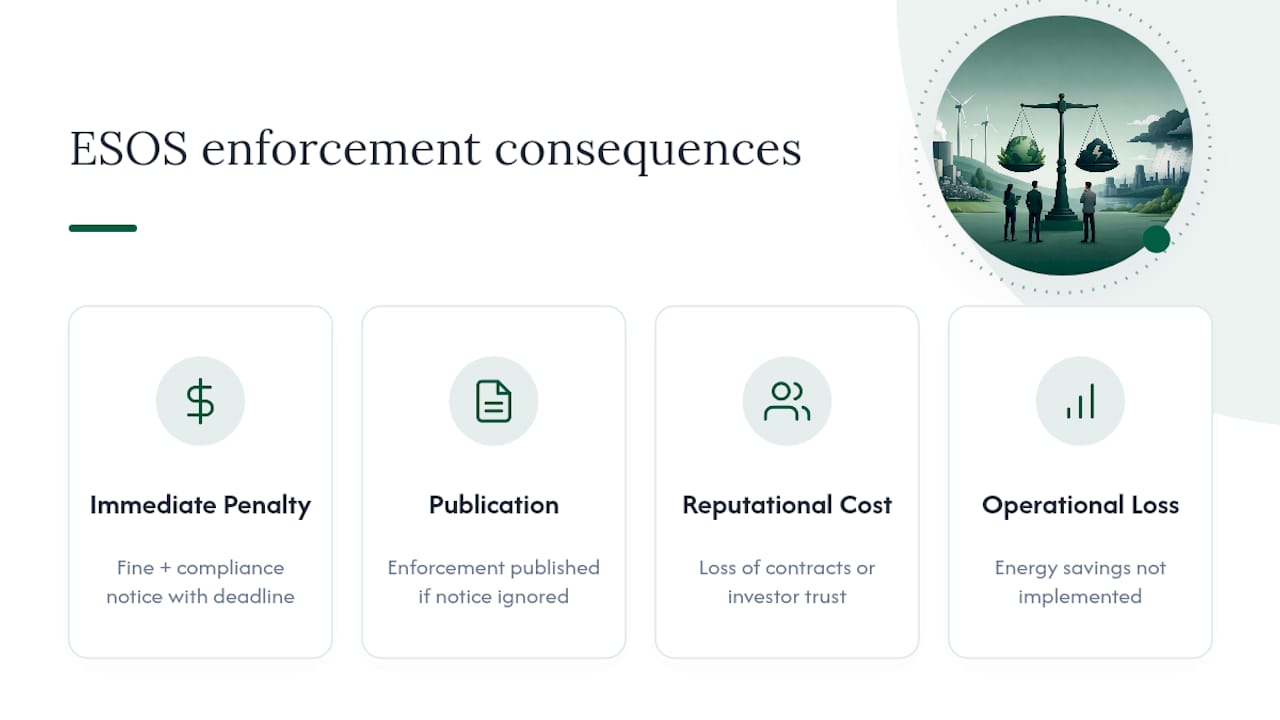
Non-compliance carries civil penalties enforced by the relevant scheme administrator, and the consequences scale with how the organization fails. Missing the notification deadline, submitting an inaccurate compliance notification, or failing to keep adequate evidence records can each trigger a financial penalty and a compliance notice ordering corrective action within a set timeframe.
Repeated or willful non-compliance escalates further. An organization that ignores a compliance notice can face a publication penalty, meaning the enforcement action itself becomes part of the public record, alongside the underlying financial penalty. For a business that depends on public sector contracts or investor confidence in its sustainability claims, that reputational exposure often costs more than the fine itself.
There's also a quieter cost that doesn't show up in any enforcement notice: organizations that treat ESOS as a paperwork exercise routinely skip the operational upside. An assessment that surfaces a genuine energy-saving opportunity and then gets shelved because nobody owns implementation wastes the one part of the process that pays for itself. Regulators can't fine you for that, but your finance director eventually notices the gap between what the audit found and what actually changed on the ground.
Enforcement is not automatic on every late submission, but organizations should not assume a missed deadline goes unnoticed. Scheme administrators do follow up on non-notifiers, and the safest position is treating every deadline as firm rather than testing how much slack exists.
What Changed in ESOS Phase 4
Phase 4 tightens several things that earlier phases left looser. The most consequential change is the removal of Display Energy Certificates and Green Deal Assessments as accepted alternative compliance routes, closing off a shortcut some organizations used to avoid a full audit-based assessment.
Phase 4 also pushes harder on demonstrating actual implementation rather than just identifying opportunities. Where earlier phases were largely satisfied by a completed audit and a report, the Phase 4 framework expects organizations to show what they did with the findings, feeding into the same Action Plan and progress update structure introduced in Phase 3.
Publication requirements have also expanded. More of what an organization submits ends up visible on the public register than in earlier phases, which raises the stakes on getting the figures right the first time rather than treating early drafts as low risk.
For organizations that qualified under Phase 3 and expect to qualify again, the practical shift is continuity of evidence. Data systems, estimation methods, and site coverage decisions made for Phase 3 need to carry forward cleanly into Phase 4, since assessors and auditors will expect consistency across cycles rather than a fresh start each time.
None of these changes are dramatic on their own, but stacked together they mean the margin for a loose, once-every-four-years approach to compliance has narrowed considerably.
Common Challenges in ESOS Assessments and How to Fix Them
The same handful of problems come up across almost every ESOS assessment, regardless of sector.
Incomplete or inconsistent data tops the list. Multi-site organizations often find that different locations use different meters, different billing cycles, and sometimes different units entirely. The fix is standardizing data collection templates across sites before the assessment period starts, not scrambling to reconcile formats after the fact.
Estimation without documentation is close behind. When actual meter data is missing for a period, an estimate is acceptable, but only if the method is written down and reproducible. Auditors treat an unexplained estimate the same as no data at all.
Smaller sites and less obvious energy uses, like a company vehicle fleet, can collectively make up the missing percentage and get overlooked until late in the process.
Sign-off delays are almost always organizational rather than technical. The data is ready weeks before a director's calendar has space for a formal review, so build that lead time into your internal schedule rather than treating sign-off as a final formality.
Group-level inconsistency affects larger organizations with multiple qualifying entities. Without a shared evidence repository and a common Action Plan template, group companies end up disclosing similar information in different formats, which creates confusion during any regulatory review.
Who Does What: ESOS Roles and Responsibilities
ESOS reporting works because specific people own specific parts of it, and confusion about who's responsible for what is one of the fastest ways to miss a deadline.
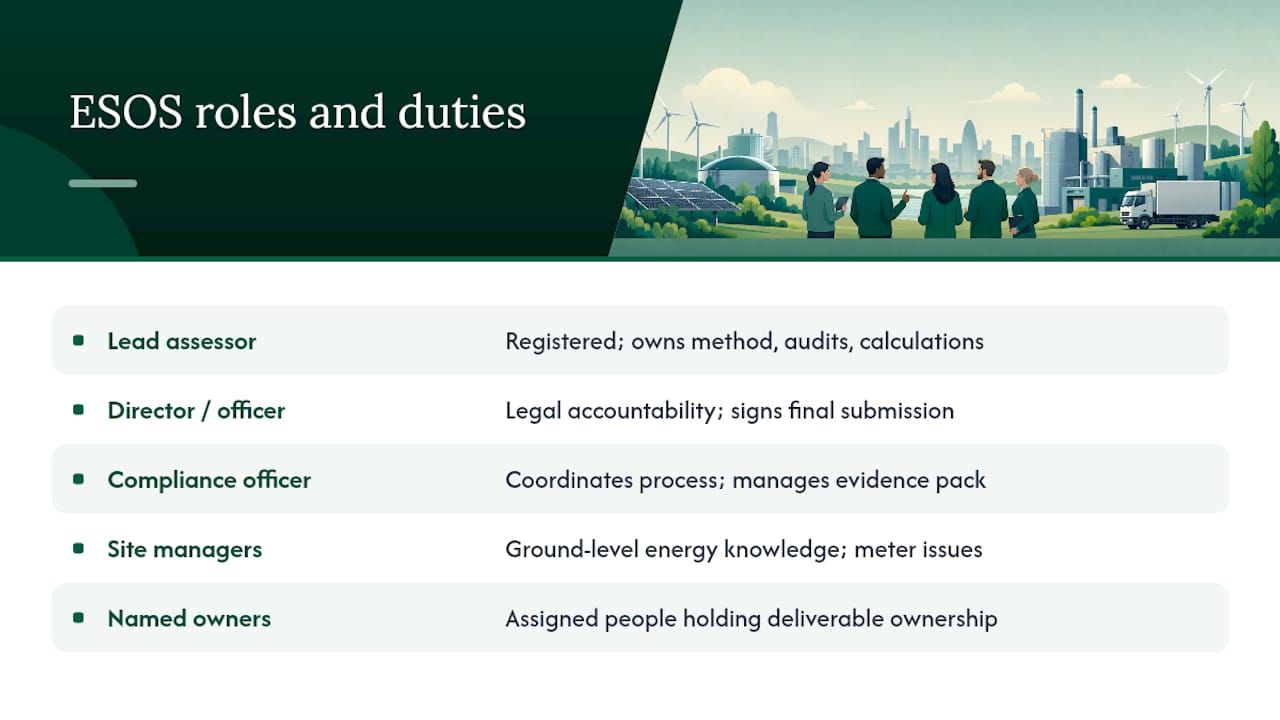
The lead assessor, whether internal or external, is registered with an approved professional body and takes technical responsibility for the assessment methodology, the audits carried out, and the accuracy of the calculations behind intensity ratios and savings estimates. Their registration number goes on the final submission.
The director or responsible officer carries legal accountability for the submission itself. This person doesn't need to run the audits personally, but they do need enough understanding of the findings to sign off in good faith, since that signature is what MESOS requires before anything can be submitted.
The compliance officer or sustainability manager, where an organization has one, typically coordinates the whole process day to day: chasing data from site managers, keeping the evidence pack organized, and making sure the lead assessor and director have what they need on schedule.
Site or facility managers hold the ground-level knowledge of energy use that data alone doesn't capture, which meters are unreliable, which equipment runs outside normal hours, which invoices are missing. Skipping their input is a common reason assessments miss real consumption.
Getting these roles clearly assigned early, ideally with names attached rather than job titles, prevents the scramble that happens when a deadline is a week away and nobody's sure who was supposed to finalize the evidence pack.
Why ESOS Should Inform Strategy, Not Just Satisfy Regulators
Most organizations treat ESOS as a box to tick every four years. That's a mistake. Publishing your progress update is a public statement of intent, and stakeholders, investors, and increasingly customers read it that way whether you intended it as marketing or not.
The smarter move is aligning ESOS outputs with SECR reporting and whatever net-zero targets your board has already committed to. The intensity ratios and verified savings you calculate for ESOS are the same numbers that strengthen those other disclosures. Treat the four-year cycle as a running feedback loop rather than a deadline that resets to zero each time, and the compliance burden starts paying for itself.
— Chris
EnerlyticsAI: A Free Way to Simplify ESOS Data Collection
EnerlyticsAI is the alternative to spreadsheet-and-invoice chaos for ESOS reporting: instead of manually reconciling supplier bills against meter reads across every site, the free forever plan gives you automated bill validation and half-hourly consumption analytics that turn raw energy data into the kWh totals and intensity ratios your report needs.
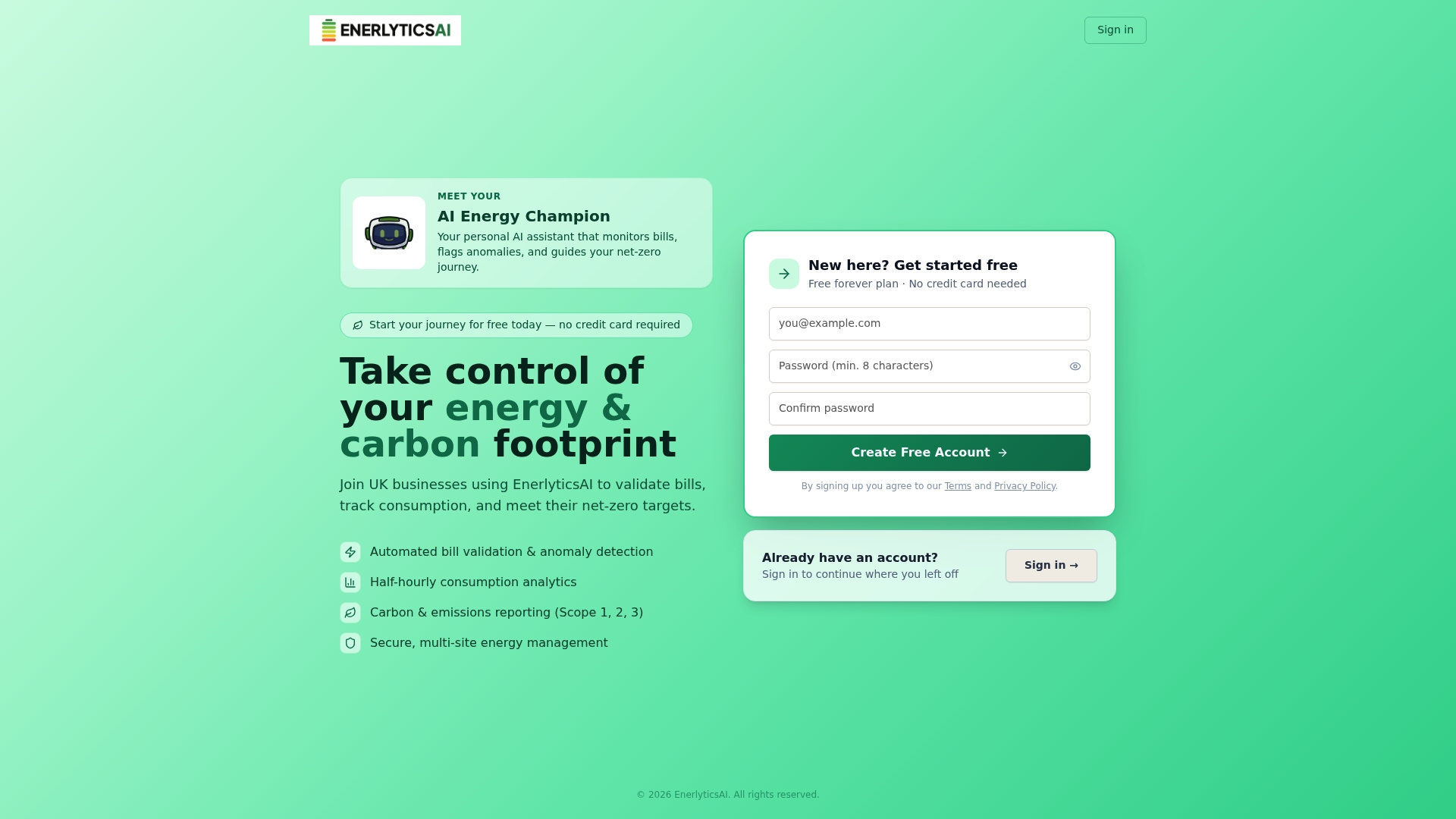
Some platforms offer consolidated reporting across multiple locations at no upfront cost, which is especially useful for group structures pulling together evidence from multiple facilities on tight deadlines. Anomaly detection features can also help build documented trails auditors look for when they question estimation methods or billing discrepancies.
If your next ESOS deadline is closer than your data collection process is ready for, register for the free plan and start consolidating your energy data before the next progress update comes due.
Sources
FAQ
What Does ESOS Stand For?
ESOS stands for the Energy Savings Opportunity Scheme, a mandatory UK program requiring large organizations to assess their energy use every four years. It covers buildings, industrial processes, and transport, and it's enforced through GOV.UK's ESOS guidance.
Do I Need to Comply With ESOS?
You need to comply if, on the qualification date, your organization has 250 or more employees or exceeds £44 million in turnover and £38 million on the balance sheet. Group structures can pull subsidiaries into scope even if they wouldn't individually qualify.
What Is an ESOS Audit?
An ESOS audit is a site-level or process-level energy assessment carried out to identify significant consumption and potential savings opportunities. It feeds directly into the ESOS report's intensity ratios and the Action Plan's proposed measures.
Who Signs Off on an ESOS Submission?
A board-level director or an equivalent senior responsible officer must sign off on every ESOS notification before it goes through MESOS. If an external lead assessor conducted the assessment, their registration details are added alongside that sign-off.
Can EnerlyticsAI Help With ESOS Data Collection?
EnerlyticsAI's free forever plan offers half-hourly consumption analytics and automated bill validation that help convert raw energy data into the kWh figures ESOS reporting requires. Current details on the plan and its features are available on the EnerlyticsAI website.