
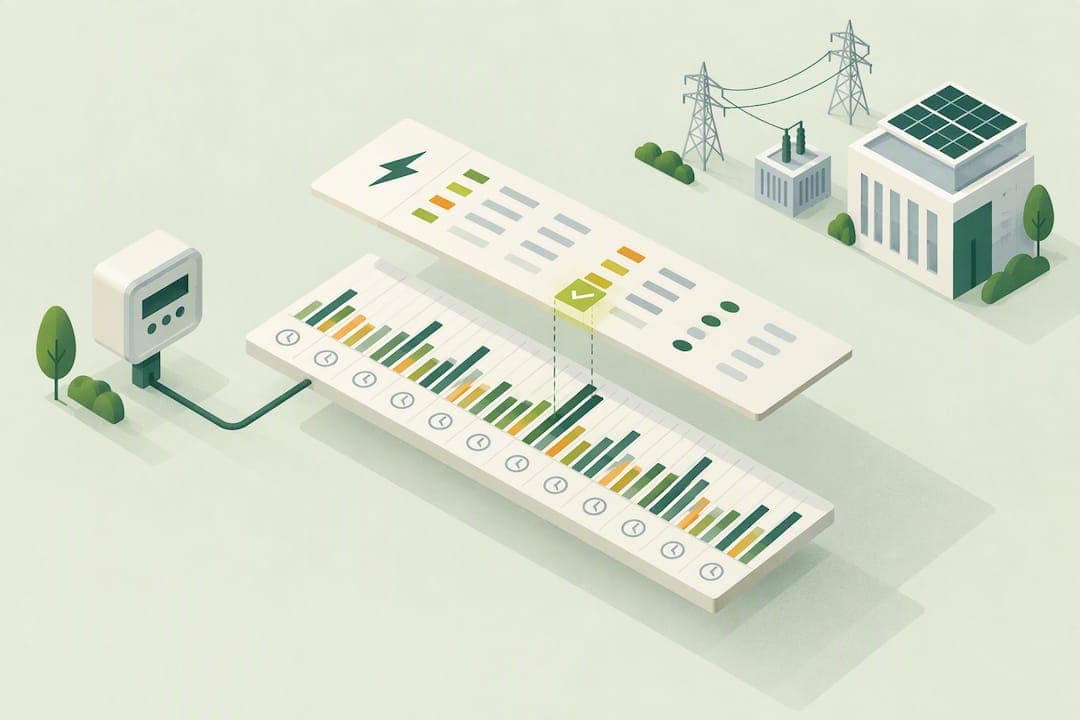
A half-hourly (HH) meter, sometimes shown on a bill as an "00" profile, records your electricity use in 48 separate 30-minute blocks every day instead of one lump reading. That interval data replaces estimates with actual consumption, which is why half-hourly meters are mandatory above roughly 100 kW or kVA of demand. Market reforms are pushing HH settlement to nearly every business site over the next few years.
TL;DR:
- Sites with a maximum demand of around 100 kW or kVA are required to move to half-hourly metering, while some smaller sites voluntarily opt in for better visibility.
- Half-hourly data passes through multiple parties before reaching the bill, with communication failures and SIM swaps being common sources of missing or flatlined consumption blocks.
- Additional charges for HH sites include capacity fees, DUoS network tariffs, and capacity penalties, which are often overlooked but can significantly impact costs if not reconciled.
- Regulatory programs like MHHS and P272 are accelerating the rollout of half-hourly settlement, making it increasingly standard for both large and medium-sized businesses.
- Automated platforms for bill validation and anomaly detection can help businesses identify discrepancies and optimize demand and capacity without upfront investment.
Table of Contents
- What a half-hourly meter actually records
- How your data reaches settlement: MOP, DC, and DA explained
- Does your business need a half-hourly meter?
- What you gain, and what it costs you
- The bill line items unique to half-hourly sites
- Getting an HH meter installed or switching your setup
- Turning half-hourly data into cost and carbon savings
- MHHS and P272: the rules reshaping every business meter
- Where energy and finance teams should start this week
- Try automated bill validation without committing budget upfront
- Where to check the details yourself
- Sources
- FAQ
What a half-hourly meter actually records
An HH meter logs 48 readings a day, one for every 30-minute settlement period the electricity market runs on. On your MPAN (Meter Point Administration Number), the profile class shows as "00," which is shorthand for "half-hourly, settled directly rather than estimated from a standard profile." That single detail on your bill tells you everything about how your site gets charged.
The hardware behind this can be either an AMR (Automated Meter Reading) unit or a modern smart meter. Both are capable of capturing and transmitting HH data. What matters more than the box on the wall is whether that data actually reaches you and your supplier.
When you pull a data file from a supplier portal or a monitoring platform, expect one of two shapes:
- Wide format: one row per day with 48 columns (HH1 through HH48), each holding a kWh value.
- Long format: one row per half-hour period, with a timestamp and a single consumption figure.
Timestamps can mark the start or the end of each period, so check that convention before you compare files from two sources.
How your data reaches settlement: MOP, DC, and DA explained
HH data does not go straight from your meter to your bill. It passes through a chain of appointed parties, and as the customer, you have the right to choose who fills each role.
- The meter captures consumption in 30-minute blocks and stores it locally.
- Communications hardware (a SIM-based module in most modern installs) pushes that data out on a schedule.
- The Meter Operator (MOP) owns, installs, and maintains the physical meter.
- The Data Collector (DC) retrieves the readings from the meter's communications link.
- The Data Aggregator (DA) validates and formats that data for the wider market.
- Your supplier uses the aggregated data for settlement and billing.
Any weak link in that chain shows up as gaps in your consumption record. Communications loss and SIM swaps are the two most common culprits, and they tend to appear as missing or flatlined blocks rather than obvious errors, which is why data completeness checks matter as much as the readings themselves.
Does your business need a half-hourly meter?
The rule of thumb is straightforward: sites with a maximum demand around 100 kW or 100 kVA must move to half-hourly metering. Below that, there is an optional band starting near 70 kVA where you can choose to switch in voluntarily. Typical mandatory sites include manufacturing plants, large retail units, warehouses, and data centers using advanced visitor management systems, where consumption is high enough that estimated billing becomes financially risky for both sides.
To check where you stand, look at your MPAN. A profile class of "00" confirms you're already on HH settlement. Anything else (profile classes 01 through 04, generally) means you're on a non-half-hourly, estimated-consumption arrangement.
Plenty of smaller sites opt in even when they don't have to, usually for one of these reasons:
- Access to time-of-use tariffs that reward shifting load to cheaper periods
- Better visibility for pass-through and flexible contract structures
- Eligibility for demand-response or flexibility revenue schemes that require interval data
What you gain, and what it costs you
Estimated bills are the single biggest problem HH metering solves. No more reconciliation shocks months after the fact, no more guessing whether last quarter's invoice reflects reality. You also unlock access to time-of-use pricing and far sharper visibility into when and where your operation actually burns energy, which feeds directly into carbon reporting accuracy.
None of that comes free. HH sites typically carry additional charges that flat-rate customers never see:
- MOP and DC fees, usually billed monthly per meter
- Standing and availability charges tied to your agreed capacity
- Exposure to capacity (Available Supply Capacity, or ASC) penalties if you exceed what you've contracted
Pro Tip: Set a monthly reminder to compare your actual peak half-hourly demand against your agreed capacity. A site running consistently well below its ASC is often paying for headroom it doesn't need, and reducing agreed capacity can cut standing charges with zero operational change.
Watch for red flags in your data: unexpected demand spikes at odd hours, missing 30-minute blocks on your supplier statement, or sudden shifts in your DUoS banding that don't match any change in your operations.
The bill line items unique to half-hourly sites
HH metering doesn't just change how you're read. It changes what you're billed for. The glossary of HH-related charges reads very differently from a standard business energy bill, and finance teams who don't know what to look for tend to miss real money.
Start with capacity. Your Available Supply Capacity, quoted in kVA, sets a ceiling on your demand, and exceeding it triggers excess-capacity penalties that can be steep and easy to overlook on a dense invoice.
Then come the network charges:
- DUoS bands (red, amber, green), which price your usage differently depending on the time of day
- TNUoS and triad exposure, where a handful of winter peak periods can set a chunk of your annual transmission costs
- BSUoS and other wholesale pass-through charges, which move with market conditions rather than your own consumption
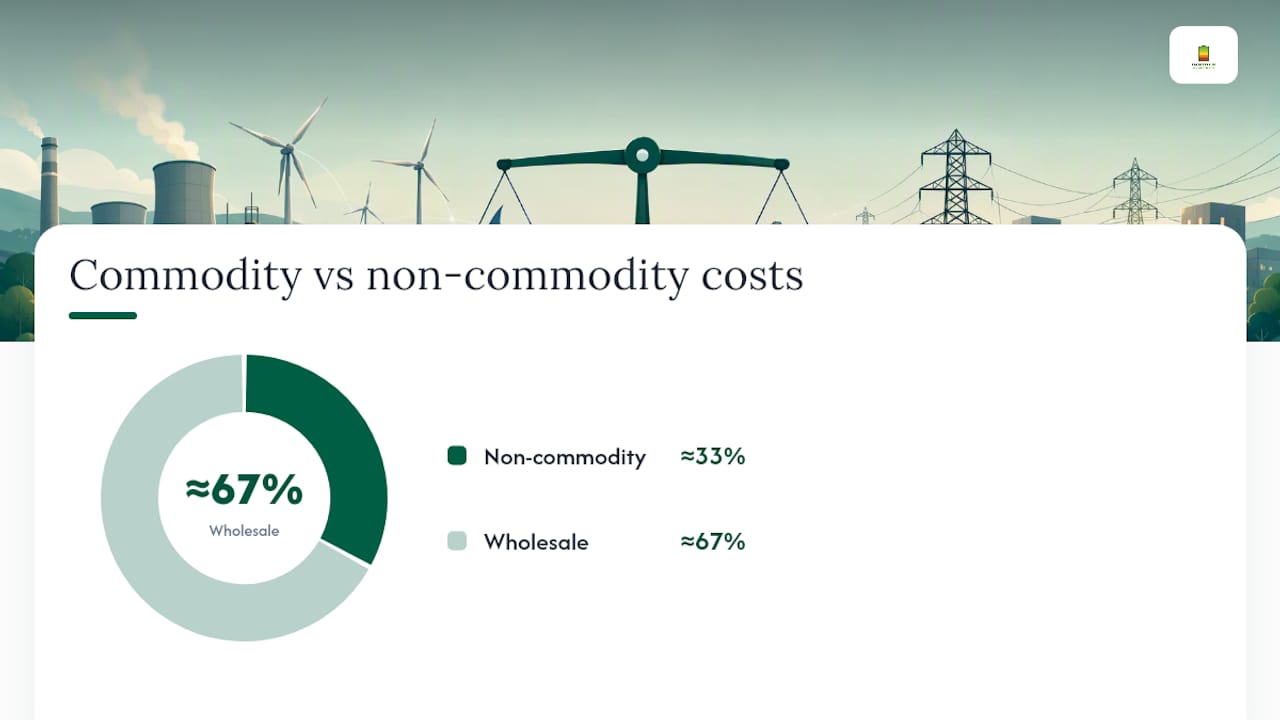
Roughly a third of the total cost on a complex commercial energy bill can come from non-commodity charges layered on top of the wholesale rate, which is exactly the category where HH billing errors tend to hide.
Reconcile every invoice against your own metered blocks, not just the total kWh. Capacity charges and DUoS banding are the two line items most often wrong, either from stale agreed-capacity figures or misapplied time bands.
Getting an HH meter installed or switching your setup
Whether you're mandated to switch or opting in voluntarily, the process follows a fairly predictable path.
- Confirm eligibility and notify your supplier or broker that you want (or need) HH metering.
- Your supplier appoints or confirms your MOP, DC, and DA, unless you've chosen to appoint them independently.
- The MOP schedules a site survey and installation date.
- The new meter is installed and commissioned, with communications tested on-site.
- Data starts flowing to your DC and DA, and you confirm you can actually access it.
- Your supplier switches your billing basis to settled HH data, usually within one to two billing cycles.
Most switches take several weeks to a few months start to finish. Delays almost always trace back to site access scheduling, incomplete paperwork, or communications signal issues in basements and dense industrial units.
Have these ready before you start: proof of site ownership or tenancy, your current MPAN, recent bills showing your existing profile class, and site access authorization for the installation team. One detail worth flagging: even a modern smart meter may not be sending you HH data by default. You often have to explicitly request activation and confirm the feed lands in a platform you can actually use.
Turning half-hourly data into cost and carbon savings
Raw interval data is only useful once you know what to check. Three questions should run on a standing basis:
- Are all 48 blocks present for every day, or are there gaps?
- Do your metered blocks match what your supplier actually settled and billed?
- Are there unexplained peaks that don't correspond to any known operational change?
That third question is where most savings hide. Businesses use HH data to validate bills line by line, build a case for reducing an over-specified agreed kVA, spot load-shifting opportunities against time-of-use tariffs, and feed accurate consumption figures into carbon reporting.
Pro Tip: Run a completeness check before you trust any anomaly your monitoring tool flags. A missing block can look exactly like a genuine consumption drop, and acting on bad data undoes the whole exercise.
This is precisely the workflow Enerlytics AI automates: automated bill validation against settled HH data, anomaly detection on unexplained peaks, and a free Starter plan that lets multi-site operators pilot the process without upfront cost.
MHHS and P272: the rules reshaping every business meter
Two regulatory programs explain why HH metering has gone from a large-site requirement to a near-universal expectation. Market-wide Half-Hourly Settlement (MHHS), led by Ofgem, is moving the entire electricity market toward settlement based on actual half-hourly consumption rather than estimated profiles, for both business and domestic supplies.
P272 came earlier and specifically reprofiled larger non-domestic meters onto the "00" profile, forcing HH settlement for sites that previously ran on standard estimated profiles.
Together, these programs mean:
- More businesses see HH data become the default rather than an opt-in extra
- Suppliers face pressure to improve data accuracy and communication with customers about the switch
- Meter replacement cycles are accelerating as legacy non-HH meters get phased out
If your business hasn't been touched by either program yet, it likely will be within the current rollout window.
Where energy and finance teams should start this week
Pull your last three MPAN records and confirm your profile class. If you're already on "00," check your last 90 days of peak demand against your agreed capacity. Most sites carry more headroom than they need.
Before rolling out changes across a whole portfolio, pilot the approach on one or two sites. It's the fastest way to see whether load-shifting or a capacity renegotiation actually moves the needle before you commit resources everywhere else.
— Chris
Try automated bill validation without committing budget upfront
Some platforms offer services for businesses that want half-hourly data working for them instead of sitting unused in a supplier portal. Where most teams manually cross-check invoices against interval files (or skip the check entirely because it eats hours every month), such platforms run automated bill validation and anomaly detection on your HH data as it arrives, flag capacity and DUoS discrepancies before they become disputes, and roll consumption straight into Scope 1, 2, and 3 carbon reporting.
You can start on the free forever Starter plan, upload a sample HH file or connect your supplier feed, and see anomaly detection running against your own half-hourly data the same day. Multi-site operators, including operations managing data-center-scale demand, can test the process on a single site before deciding whether to expand across a portfolio.
Where to check the details yourself
- Ofgem for official MHHS program guidance and regulatory timelines.
- Bionic's half-hourly meter guide for a detailed breakdown of eligibility and mechanics.
- Clearsight Energy's HH glossary for definitions of capacity, DUoS, and related charge types.
- Energy data import guidance for interval file formatting and timestamp conventions.
Sources
FAQ
What does half-hourly meter mean?
A half-hourly meter records your electricity consumption in 48 separate 30-minute blocks every day rather than one estimated total. On your bill, this shows as an "00" profile class, and it's the standard for larger commercial and industrial sites under Ofgem's settlement framework.
Should I agree to half-hourly smart meter readings?
If your site sits near or above the 100 kW/kVA threshold, agreeing is close to mandatory anyway, and even below that, it opens access to time-of-use tariffs and far more accurate billing. The main trade-off is added MOP and DC fees, so weigh those against the potential savings automated platforms can help you identify from your own interval data.
Why is my bill higher with a smart meter?
A smart or HH meter doesn't raise your rates. It exposes charges that were previously smoothed into an estimate, including capacity charges, DUoS banding, and triad exposure that only show up clearly once billing runs on actual 30-minute readings. If a bill jumps sharply, check your agreed capacity against your actual peak demand first.
What does a half-hourly meter reading mean for British Gas customers?
The mechanics are the same regardless of supplier: your consumption is captured in 48 daily blocks and passed through a Data Collector and Data Aggregator before it reaches your bill. Supplier-specific portals may present the data differently, but the underlying settlement process and charge structure follow the same industry-wide rules.