
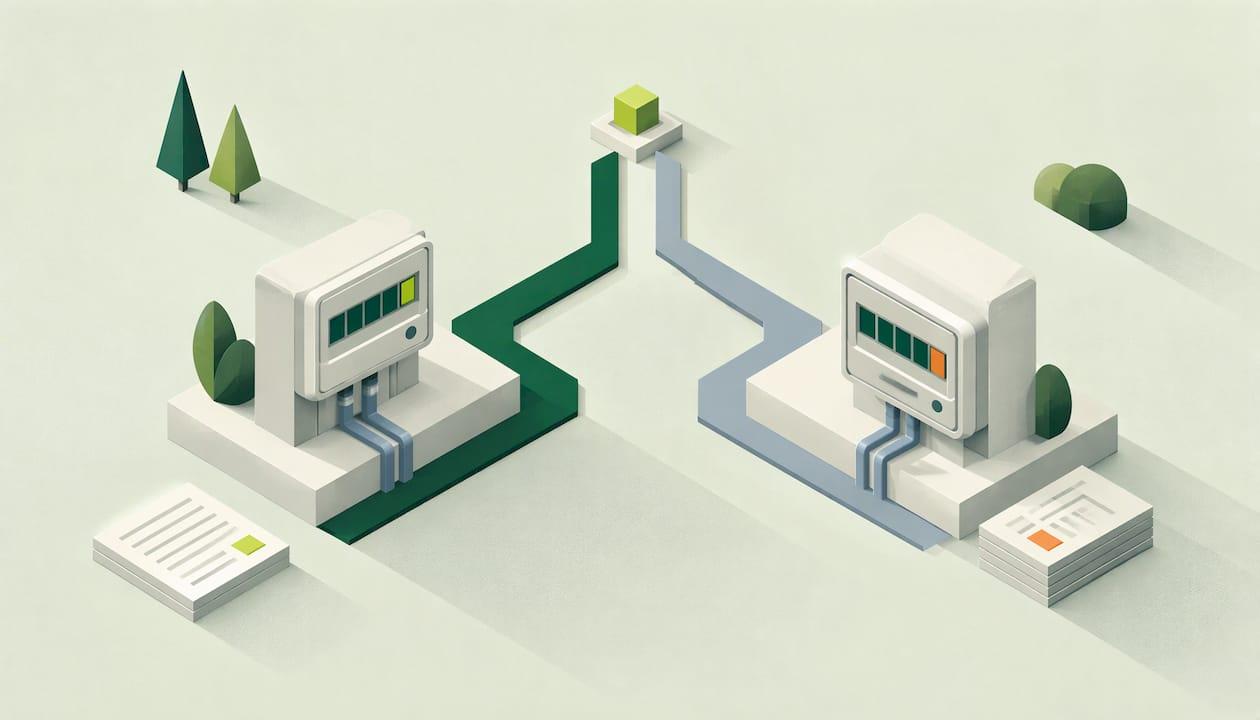
A meter read dispute starts when the reading on your business energy bill does not match what your meter shows, or the meter, dates or units on the bill are wrong. To win it, prove the error with dated photos and half-hourly data, put the complaint to your supplier in writing, and ask for a rebill against the actual readings. If the supplier will not fix it, you can escalate to the Energy Ombudsman. This guide walks through each step, and shows how routine meter data validation catches most errors before they turn into disputes.
TL;DR
- Check four things on every bill: the meter serial number, the reading, the reading dates and the units. Most disputes trace back to one of them.
- Take dated photos of the meter display and serial number, and pull your half-hourly data if the meter is smart or half-hourly.
- Complain in writing, ask for a complaint reference, and request a rebill against actual readings, not estimates.
- If the complaint is unresolved after 8 weeks, or you receive a deadlock letter, you can go to the Energy Ombudsman.
- Validating meter data every month, across every site, stops most disputes from starting.
Table of Contents
- What counts as a meter read dispute
- Check the bill before you call anyone
- Build the evidence file
- Using half-hourly data as proof
- Meter validation: catching errors early
- Suspected meter faults
- How to raise the dispute with your supplier
- If the supplier will not resolve it
- Multi-site businesses: validated data also feeds your carbon reporting
- Perspective
- Start validating your meter data
- FAQ
- Sources
What counts as a meter read dispute
In practice, a business meter read dispute falls into one of five groups:
- Estimated reads that drift. The supplier bills on estimates for months, then a true-up read produces a large catch-up charge.
- Opening or closing reads that do not match. When you switch supplier or move premises, the final read from the old supplier and the opening read from the new one should line up. When they differ, one of them is wrong.
- Wrong meter or wrong supply point. The bill uses a different serial number, the readings of an old meter, or another site's supply.
- Faulty or misreporting meters. The meter, or the data flowing from a smart meter, shows consumption that your site could not physically have used.
- Wrong units or multipliers. Gas in cubic meters billed as if it were cubic feet, or a missing multiplier on a current-transformer meter, for example.
The industry has its own rules for the switching case. A 2019 draft schedule of the Retail Energy Code proposed that suppliers raise a switch reading dispute when the consumption difference between the closing and opening reads exceeds 250 kWh for electricity or 1,200 kWh for gas. Treat those figures as a guide to how large a gap the industry considers worth chasing, not as a threshold that stops you querying a smaller one on your own bill. Check the current Retail Energy Code for the rule in force.
Check the bill before you call anyone
A dispute is far easier when you can point to one specific line. Work through the bill in this order.
Meter identity
Start with the serial number. Business guidance from British Gas says the serial number on the bill should match the meter at your property, and that if it does not, you should contact the supplier so the meter can be investigated. The Energy Saving Trust notes that wrong supply-point identifiers or meter serial numbers can lead to the wrong supply being billed, or readings from an old meter being used.
Keep three identifiers together for each site:
- MPAN, the long supply number for an electricity supply point.
- MPRN, the supply number for a gas meter.
- Meter serial number, printed on the meter itself.
If you run several sites, a single spreadsheet or platform record of these identifiers saves hours when something goes wrong.
Reading, dates and type
Look at whether each reading on the bill is marked as actual, customer or estimated. Then check the dates. A billing period that is a few days longer than the dates you expect, or that overlaps the previous bill, is a common source of overcharges.
Units and consumption
Compare the consumption on the bill with the difference between two readings you trust. For electricity this is kWh; for gas, check whether the supplier converted from cubic meters or hundreds of cubic feet to kWh. If your own sums disagree with the bill by more than a rounding error, you have a specific figure to query.
Our guide to energy bill validation covers the full checklist, including tariff and charge checks that sit alongside the meter read.
Build the evidence file
Suppliers act on evidence. Ofgem has told suppliers to keep records of customer contacts and of the communication methods they attempted when they manage billing discrepancies, particularly where they say a customer prevented accurate billing. You should keep an equally good record on your side.
What to collect
| Evidence | Why it matters | How to get it |
|---|---|---|
| Photo of the meter display with a visible date | Shows the actual reading on a known day | Phone photo; include the whole meter face |
| Photo of the serial number plate | Proves which meter is at the site | Same visit, close-up |
| Previous and current bills | Shows the reading jump and the dates | Supplier portal or your finance system |
| Half-hourly or smart meter data | Shows when and how consumption actually happened | Supplier, data collector or your analytics platform |
| Move-in or move-out documents | Fixes the opening or closing date | Lease, handover note, inventory |
| Record of every contact | Shows you raised it and when | Email, call log with names and reference numbers |
How to take a clean reading
- Read the meter on a set day, ideally the same day each month at every site.
- Photograph the display, the serial number and the surrounding area in one or two shots.
- Note the register: on a multi-rate electricity meter, record each register separately, and note whether the meter shows day and night rates.
- Send the reading to the supplier in writing, so there is a timestamp, and keep the confirmation.
If you do not already have a regular reading habit, start with the sites where bills have been estimated. Our piece on meter data gaps explains how missing reads lead to estimates in the first place.
Using half-hourly data as proof
If your meter is half-hourly or smart and you can obtain the data, it is the strongest evidence you can bring. A disputed bill claims a total. Half-hourly data shows the shape of the consumption: base load overnight, ramp-up at opening, and the stop at closing time.
That shape lets you test a claim in three ways:
- Empty premises. If a unit was closed for a month and the bill shows normal usage, the overnight and weekend profile will show it.
- Impossible peaks. A reading that implies more demand than your connection could supply points to a faulty meter, a wrong multiplier or another site's data.
- Gaps and flat lines. Missing intervals or identical values for days usually mean a communications fault, not real consumption.
Our guides to half-hourly meter checks and smart meter data access explain how to get the data and what to look for.
Meter validation: catching errors early
Meter data validation means comparing what you are billed against independent data, every cycle, before you pay. The checks are simple, and they work best when automated:
- Does the billed consumption equal the difference between the opening and closing readings?
- Does the billed period start where the previous one ended?
- Does the meter serial number match your site record?
- Is the consumption plausible against the same month last year and against half-hourly data?
- Is the read type actual, and if not, how many consecutive bills have been estimated?
On the last point, consecutive estimated bills can make overcharges compound. One UK guide to checking business bills advises submitting actual readings and asking for a rebill against them for any period that was billed on estimates.
To see the pattern across all your meters at once, our guide to energy anomaly detection shows how unusual consumption is flagged.
Suspected meter faults
Sometimes the reading is right and the meter is wrong. Signs include consumption that rises and falls with no link to activity, a display that does not advance, or a serial number that does not match the bill.

Ask your supplier in writing to investigate the meter, and give them the evidence file. Depending on the meter type, the supplier may arrange a visit, test the meter or replace it. Ask for the outcome in writing, including what period, if any, will be corrected as a result.
If you want an independent view of how measuring instruments are verified, electrical calibration services show what accredited testing of measurement equipment involves. For a supply meter itself, though, the supplier or its meter operator is the party that must test or replace it.
How to raise the dispute with your supplier
Follow this sequence.
- Contact the supplier's billing team in writing. Say it is a formal complaint, name the account, the site, the MPAN or MPRN and the serial number.
- State the problem in one sentence. For example: the bill dated X uses a reading of Y, but the meter read Z on date W.
- Attach the evidence. Photos, readings and half-hourly data.
- Ask for a specific remedy. A corrected bill based on the actual readings, a credit or refund of the overcharge, and a written explanation of the cause.
- Ask for a complaint reference and the date by which you will receive a response.
- Hold payment of the disputed amount only as your contract allows. Pay the undisputed part and check your contract terms on late payment before withholding anything.
Rebilling and the 12-month rule
When the supplier has under-billed you, Ofgem's back-billing rules matter. As summarized in a UK guide to business bill checks, suppliers cannot charge microbusinesses for energy used more than 12 months ago when the under-charge came from the supplier's own failure, such as billing on wrong estimates or failing to issue bills, provided the customer was not obstructive. That protection depends on your business qualifying as a microbusiness, so confirm your size and consumption before relying on it. Our explainer on bill backdating rules goes through the limits in more detail.
If you suspect you have been overcharged for a long period, see our guide to recovering past refunds on business tariffs.
If the supplier will not resolve it
Per Citizens Advice, if your complaint is still unresolved after 8 weeks, or the supplier sends a deadlock letter, you can complain to the Energy Ombudsman. You have 1 year from receiving a deadlock letter to do so.
The Energy Ombudsman's service is free for small businesses, including microbusinesses, and its decision binds the supplier if you accept it. Bring the same evidence file you sent the supplier, plus the complaint reference and every reply.
Escalation checklist
- Complaint made in writing, with date and reference.
- Eight weeks have passed, or a deadlock letter has arrived.
- Evidence file is complete: photos, bills, half-hourly data, correspondence.
- You have stated the outcome you want in a sentence or two.
- You know your eligibility category (microbusiness or small business) and have noted it.
Multi-site businesses: validated data also feeds your carbon reporting
An error in meter data does not only cost money. The same readings feed your emissions figures. Scope 2 emissions come from purchased electricity, and Scope 1 from gas burned on site. If a billed reading is wrong, your carbon report is wrong too, and the error repeats at every site that shares the fault.

Validating readings monthly gives you three benefits at once: fewer billing disputes, cleaner site-by-site consumption data, and carbon reports built on figures you have already checked. For a plan that connects the pieces, see our energy monitoring strategy, and for programmatic access to meter and market data, our guide to energy data APIs. If part of the bill disagreement is about charges rather than reads, the difference between standing charge and unit rate is worth reading too.
Perspective
Most meter read disputes we see described are not really arguments about one number. They are the result of nobody looking at the data between bills. A supplier estimates, the estimate drifts, and months later the catch-up lands on the finance team with no way to tell what was real.
We built EnerlyticsAI around the idea that bill validation and anomaly detection should be routine, not a reaction. Half-hourly analytics show what a site actually used, and bills are checked against that picture, across every site, in one place. When you can show the date, the reading and the profile, a supplier conversation becomes short.
We also think this should be open to every business. That is why our Starter plan is free forever, with multi-site management included, so a facilities team can begin validating before there is any budget conversation.
Chris
Start validating your meter data
EnerlyticsAI is a web platform that checks business bills automatically, flags anomalies, shows half-hourly consumption and reports Scope 1, 2 and 3 emissions across multiple sites. You can begin with the free forever Starter plan, which costs £0, and add your sites on the Sites page.
When you are ready for more, paid plans are Eco at £49 per month, Growth at £79 per month, Professional at £149 per month and Scale at £299 per month. You can review how bills are checked on the Bills page and look at consumption on the Half Hourly Data page.
FAQ
How long do I have to dispute a meter reading?
Raise it as soon as you spot it, because evidence is freshest then. If the complaint stalls, you have 1 year from a deadlock letter to take it to the Energy Ombudsman. Back-billing protections for microbusinesses also work on a 12-month horizon, so delay can matter.
What should I do first if my bill uses an estimated reading?
Take a dated photo of the meter and send the actual reading to the supplier in writing. Then ask for the bill to be reissued against that reading. Keep the confirmation email with the figure.
Can my supplier bill me for energy used years ago?
Not always. Where the under-charge was the supplier's own fault and you are a microbusiness who did not obstruct billing, charges for energy used more than 12 months ago are generally barred. Check your classification and the circumstances before relying on this.
Where do I go if the supplier and I cannot agree?
After 8 weeks without resolution, or on receiving a deadlock letter, you can complain to the Energy Ombudsman. Its service is free for small businesses and its decision binds the supplier if you accept it.
Sources
- REC Schedule: Resolution of CFSB Problems, 17 June 2019 (Ofgem)
- Something wrong with your business energy bill? (British Gas)
- How to understand your energy bill (Energy Saving Trust)
- Expectations for energy suppliers undertaking charge recovery action (Ofgem)
- How to Check a Business Energy Bill for Overcharges (UK)
- Problems with your business energy supplier or broker (Citizens Advice)
- Energy Complaints and the Energy Ombudsman (Civil Help)
- Electrical Calibration (PCS Precision)