
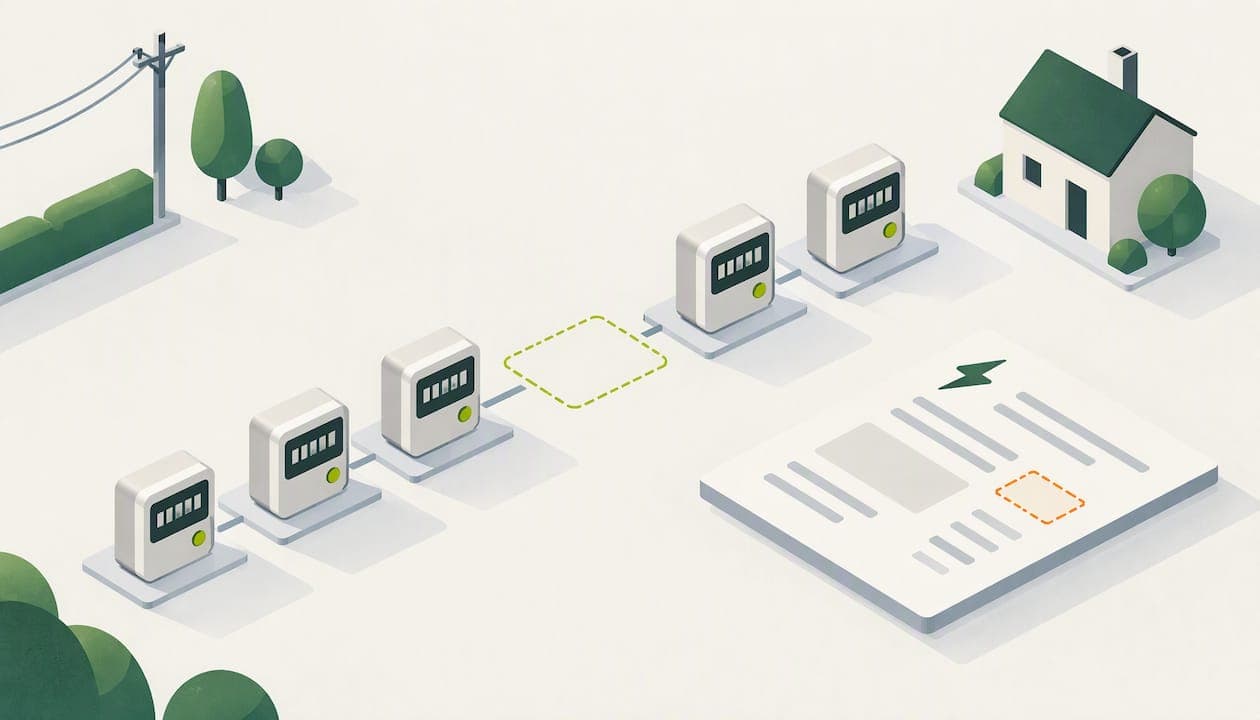
A meter data gap is a period where your supplier received no usage readings from your smart meter. The fastest check is your supplier's usage graph, or a gap-check tool, where blank ranges or long flat lines give it away. At EnerlyticsAI, we help you monitor energy data.
TL;DR:
- Check your supplier’s graph for blank ranges or flat lines, screenshot them, and compare exported readings before later portal updates can backfill data.
- A communications failure often blocks delivery, not local recording; ask your supplier to retrieve stored meter readings before accepting estimates or arranging a visit.
- Brief gaps may have little billing effect, but gaps lasting days or occurring during high consumption can shift charges; later actual readings reconcile estimates.
- Ofgem reported that actual readings underpinned 81% of bills at first issue and 89% after reconciliation; check later bills for corrections.
- If repeated supplier contacts over several weeks produce no retrieval or repair, submit a written complaint and keep graphs, timestamps, and reference numbers.
Table of Contents
- How can you check your meter data for gaps?
- Why do meter data gaps happen?
- How do suppliers fill in missing data?
- How do gaps affect your bills and settlement?
- What are the steps to report and restore missing readings?
- When should you escalate a data gap?
- Why monitoring data health matters
- Automate gap detection with EnerlyticsAI
- FAQ
- Sources
How can you check your meter data for gaps?
You do not need technical skills to find a gap. Start with what your supplier already shows you, then dig deeper if something looks off.
- Usage graph: open your supplier app or portal and look for blank ranges or prolonged flat lines, especially at night when usage should still show small variations.
- Half-hourly export: if your supplier offers a half-hourly CSV or log, scan for "no read" entries or repeated null values.
- Gap-check tools: online checkers and in-house utilities can flag missing intervals faster than eyeballing a spreadsheet.
- Hardware status: check the in-home display and the communications hub for lost-connection warnings.
Once you spot a gap, judge its shape. A brief gap may be temporary, but check whether the readings return and contact your supplier if the gap persists. Multi-day grouped gaps point to something persistent, like a failed communications link, and deserve a call to your supplier.
Pro Tip: Screenshot the graph the moment you see a blank range. Portals sometimes backfill data later, and your screenshot is the proof the gap ever existed.
For energy teams running many meters, our half-hourly meter checks offer guidance on validation.
Why do meter data gaps happen?
Most gaps come from the journey a reading takes, not from the meter failing to measure. Understanding the path helps you decide whether to troubleshoot yourself or call your supplier.
- Communications failures: a reading travels from the meter to a communications hub, then across a wide area network to the DCC, which passes encrypted messages to your supplier. Smart DCC explains this route, and the in-home link typically uses Zigbee. A communications problem can interrupt the route. Where range is a problem, Dual Band hubs exist to help.
- Power and hardware: issues with power or equipment can be worth investigating if readings are missing or appear misplaced.
- Switching and reconfiguration: when you change tariff or supplier, the update has to reach the meter. Industry procedures aim for midnight activation, but communications failures can prevent reconfiguration at midnight, and suppliers then exchange reads as an interim arrangement.
- Storage behavior: if the meter has retained readings, your supplier may be able to retrieve them remotely.
Importantly, Ofgem confirms that smart meters still record usage when they are not operating in smart mode. Your consumption is usually measured; it just has not reached your supplier.
How do suppliers fill in missing data?
Suppliers and industry bodies use a layered approach, trying the most accurate fix first.
- Remote retrieval: the supplier asks the meter for its stored half-hourly log. If the meter kept the data, the gap closes with real readings.
- Physical read: when retrieval fails, a customer or engineer reading may be requested.
- VEE processing: suppliers may use validation, estimation and editing to handle missing readings.
- Statistical imputation: when retrieval is impossible, models estimate the missing consumption from surrounding patterns. A benchmark of statistical and machine-learning methods shows that recovering missing smart meter data is technically hard.
The industry also flags exclusions such as large outages and clock drift, which need special handling rather than routine estimation.
Perfect repair is rare. Research on advanced data repair finds that complete data perfection is rare, and promising physics-guided approaches focus on telling plausible consumption apart from communication-induced anomalies. Treat any estimated value as a placeholder until a real read replaces it.

How do gaps affect your bills and settlement?
When real readings are missing, billing falls back on estimates. An estimated read is a best guess, and a later actual read triggers reconciliation, which corrects the earlier bills up or down.
- Reconciliation matters: it is the mechanism that turns estimated bills into accurate ones.
- Backbilling: if you are concerned about an undercharge, check the applicable rules with your supplier or an official source.
- Materiality: a few missing half-hours rarely change a bill. Multi-day or multi-week gaps, or gaps during high-usage periods, can shift a bill meaningfully.
Ofgem's latest assessment found that 81% of bills were based on actual readings at first issue and 89% after reconciliation. That gap shows reconciliation works, and the same report points to system alerts and proactive monitoring as practices that improve outcomes. Waiting for a corrected bill is slower than flagging the problem yourself.
What are the steps to report and restore missing readings?
Follow this order to recover data and protect your billing.
- Capture evidence: screenshot the portal graph, export any half-hourly logs, and note timestamps from the in-home display.
- Run safe local checks: confirm the communications hub has power and a clear position, and reboot only if your supplier's guidance recommends it.
- Contact your supplier: send your evidence, name the date range, and ask for remote retrieval or a manual read visit.
- Check your own systems (energy teams): review internal half-hourly collectors and health flags, and file formal data requests before billing closes.
- Expect the follow-up: a remote pull, VEE processing, then reconciliation on a later bill.
Pro Tip: Ask your supplier for a reference number on every contact, and diary a follow-up date. A dated paper trail speeds up every later step.
Teams that need a documented process can adapt our meter to report governance checklist.
When should you escalate a data gap?
Move from troubleshooting to a formal complaint when your supplier has had a fair chance and nothing has changed.
- Benchmark: if repeated contacts over several weeks bring no retrieval or fix, put your complaint in writing.
- Keep records: graphs, exports, reference numbers, dates of calls and the supplier's replies all matter for an Ombudsman referral.
- Compensation: Ofgem has published a draft assessment concerning guaranteed standards of performance for smart meters. Check with your supplier whether compensation may apply.
- Business teams: maintain an audit trail from meter to report so any dispute rests on documented evidence.
Why monitoring data health matters
Here is my view: most teams treat missing readings as a billing nuisance, when the bigger cost is trust in the numbers. A gap that slips into a carbon report or a budget forecast quietly distorts decisions for months. Automated health flags catch problems while they are still cheap to fix, and they free finance and sustainability staff from hunting through spreadsheets. Monitoring should be routine, not a reaction to a surprising bill.
— Chris
Automate gap detection with EnerlyticsAI
Everything above can be done by hand, but it gets tedious across many meters and sites. We built EnerlyticsAI to support energy data management, including half-hourly analytics, anomaly detection and bill validation.
You can start on our Free forever Starter plan; current prices for paid tiers are on our pricing page. Explore our half-hourly data and bill validation pages to see how it works, then create your free account and run your first gap check today.
FAQ
Do smart meters ever give wrong readings?
Yes, occasionally. Faults, clock drift or communication problems can produce missing or misplaced readings. Meters still record usage locally, so contact your supplier if a reading looks wrong.
Can you give me an example of a data gap?
A typical example is a graph showing normal usage on Monday, a blank stretch from Tuesday morning to Thursday evening, then usage resuming. The meter often kept recording and simply could not send the data while its communications link was down.
Is there a problem with smart meters at the moment?
Some meters are not working in smart mode. Ofgem's impact assessment found that about 9% of smart meters were not operating in smart mode, which has hurt consumer trust.
What should you check before choosing a gap-check tool?
Look for half-hourly support, automatic flagging of missing intervals and an exportable record you can send to your supplier. A tool that only shows totals will miss short gaps.
Sources
- Domestic Billing Performance Assessment
- Smart meter performance | Ofgem
- How do smart meters send readings? | Smart DCC
- Pubmed
- Bridging Smart Meter Gaps: A Benchmark of Statistical ...