

Energy data governance is the set of policies and controls that decide who owns your meter, invoice and emissions data, how it is checked for quality and how it gets audited later. The single most useful first move is assigning one data owner and one source of truth for each data stream, before you worry about tools or dashboards. Platforms like EnerlyticsAI can operationalize that structure, and the government's conversion factors give you the reference point for turning verified activity data into a defensible carbon number.
TL;DR:
- Assign a single, accountable owner to each data stream and establish a clear source of truth before implementing tools or dashboards.
- Maintain a detailed data lineage log, including who ingested and transformed the data, to ensure auditability.
- Use standardized data requests to suppliers for raw activity data and document any gaps or assumptions used to fill missing information.
- Retain verification evidence, including meter reads, calibration records, and change logs, for at least ten years to support audit readiness.
- Automate bill validation and anomaly detection through platforms like EnerlyticsAI to improve data quality and support Scope 1, 2, and 3 carbon reporting.
Table of Contents
- Core governance principles: ownership, access and lineage
- A practical governance framework: roles, checklist and retention
- Data quality operations: meter matching, validation and anomaly detection
- How governance supports credible carbon reporting
- Closing supplier data gaps for Scope 3 reporting
- Preparing an audit-ready evidence pack
- How EnerlyticsAI operationalizes these governance controls
- What actually matters in energy data governance
- Get started on a governance-ready starter plan
- Sources
- FAQ
Core governance principles: ownership, access and lineage
Good governance rests on knowing who is responsible for a piece of data at every stage, not just who created it. A data owner sets policy and accepts accountability, a data custodian manages the systems that store and move the data, and a data consumer uses it for reporting or analysis without changing the underlying record. Keeping these roles distinct stops the common failure where an analyst quietly edits a source file and nobody can explain the change six months later.
Ofgem's Data Best Practice Guidance treats data as an asset that should be presumed open unless there is a documented reason to restrict it, a useful default for businesses tempted to lock everything down out of habit.
- Assign one named owner per data stream: electricity, gas, water, waste.
- Log every access restriction with a reason, not a blanket rule.
- Maintain a searchable catalogue with metadata for each dataset's source, format and update frequency.
- Record lineage: who ingested the data, what transformations ran, and when.
Pro Tip: Store lineage notes next to the data itself, not in a separate wiki nobody checks before an audit.
A practical governance framework: roles, checklist and retention
A governance framework only works if people can act on it without rereading a policy document each time. Start with a role matrix, then a one-page checklist, then retention rules that match what verifiers actually ask for.
- Data owner: approves access requests and signs off on quality thresholds.
- Data steward: runs day-to-day validation and flags anomalies.
- Approver: reviews reports before external submission.
- Verifier: an internal or third-party check on the final numbers.
A one-page policy checklist should cover:
- Who owns each meter, site and utility type.
- Access rules and how exceptions get logged.
- Minimum data quality thresholds before a figure is used in reporting.
- Retention periods, matched to your longest reporting obligation.
- An escalation path when data looks wrong.
- Audit logging for every change to a stored record.
On retention, the UK ETS MRR guidance describes an expectation that verification evidence be archived for approximately a decade where installations fall under that scheme, providing a useful benchmark for similar deployments.
Data quality operations: meter matching, validation and anomaly detection
Billing accuracy starts with confirming the meter on the invoice is the meter actually installed at the site. Teams should periodically check meter serial numbers on bills against the physical unit and its approval markings, catching mismatches before they distort a year of consumption data.
A bill validation routine typically checks:
- Tariff rates against the current supplier contract.
- Consumption readings against expected usage or previous periods.
- Duplicate invoices for the same billing period.
- Standing charges and any pass-through costs applied correctly.
Anomaly detection works best with defined thresholds, for example a site flagged when consumption jumps more than a set percentage against its rolling average, triggering a manual review rather than an automatic correction. Half-hourly or interval data sharpens this further, since it lets you match consumption to the exact half-hour emission factor rather than a flat annual average, which matters directly for Scope 2 precision.
Pro Tip: Run anomaly checks weekly, not monthly. A billing error caught in week one is a five-minute fix; caught in month three, it is a dispute.
How governance supports credible carbon reporting
Emissions numbers are only as credible as the governance behind them. The 2026 government greenhouse gas conversion factors are the required reference for turning kWh, liters or other activity units into CO2e for UK company reporting, and they are updated annually.
The government publishes these conversion factors annually, typically updating them in the middle of the year. Using an outdated version, even by one release, can shift a reported total enough to draw a verifier's questions.
Governance controls that keep reporting defensible include:
- Reporting Scope 2 using both location-based and market-based methods where applicable, matching the temporal precision of your activity data to the emission factor, as GHG Protocol Scope 2 guidance recommends.
- Requesting raw activity data (kWh, Nm3) from suppliers rather than relying on a supplier-calculated CO2e figure as your only source.
- Documenting which conversion factor version, methodology and assumptions were used for each reporting period.
Closing supplier data gaps for Scope 3 reporting
Scope 3 data rarely arrives clean. The most reliable fix is a standardized request template sent to every supplier: raw activity data in physical units, meter identifiers, reading timestamps and, where relevant, calibration evidence for the metering equipment. This keeps emission-factor application under your control rather than a supplier's, which GHG Protocol's value-chain accounting standard treats as the more auditable approach.
When a supplier cannot provide primary data, invoices are an acceptable fallback, but the gap and the assumption used to fill it need a written note, not a silent estimate.
- Send the same standardized data request to every supplier in a category.
- Add data-sharing clauses to renewal contracts to secure activity data over time.
- Keep a gap log: what was missing, what assumption filled it, and why.
Pro Tip: Where residency or sovereignty rules affect where supplier data can be stored, a primer on data residency versus sovereignty is worth a read before signing a new data-sharing clause.
Preparing an audit-ready evidence pack
Verifiers and auditors want a specific set of documents, not a general assurance that the numbers are right. Build the pack as you go rather than reconstructing it under deadline pressure.
- Meter reads and the invoices that correspond to them.
- Calibration or approval evidence for the metering equipment.
- Data transformation logs showing what changed between raw input and reported figure.
- A written methodology note, including which conversion factor version applied.
- Version-controlled copies of each report, not just the final submission.
The MRR general guidance sets the retention expectation this pack should meet, and a second reviewer checking figures before submission (a four-eyes check) catches errors a single preparer tends to miss. An annual review of where uncertainty is the highest helps decide whether a fuller uncertainty assessment is warranted that year.
How EnerlyticsAI operationalizes these governance controls
EnerlyticsAI is built around the parts of this playbook that are hardest to do manually: automated bill validation, anomaly detection and half-hourly consumption analytics feeding into carbon reporting across Scope 1, 2 and 3. That combination maps directly onto the meter matching, validation and interval-data precision covered above.
The platform also supports managing multiple sites under one account with free access, which matters for the ownership and catalogue work described earlier: one place to assign a site owner, log access decisions and see every meter in a group of properties. It extends into related operational areas too, including waste tracking alongside energy data.
- Automated bill validation flags tariff and duplicate-invoice errors before they reach a report.
- Half-hourly analytics support Scope 2 precision matching.
- Multi-site management gives one owner-per-site structure without extra licensing cost.
What actually matters in energy data governance
Most advice on this topic treats governance as a compliance exercise, a checklist to satisfy an auditor once a year. That undersells it. The businesses that get real value from good governance treat it as an operational habit: catching a duplicate invoice in week one saves more money than any amount of after-the-fact carbon accounting can recover.

The conventional advice also overweights tooling and underweights the boring part: deciding, in writing, who owns each data stream and what counts as the source of truth for it. A team with a spreadsheet and a clear ownership rule will produce more defensible numbers than a team with expensive software and no agreed owner.
If you can only do one thing this quarter, do this: pick your highest-spend site, assign one owner, and get its meter data validated against its last three invoices. That single exercise usually surfaces the billing errors and data gaps that a full governance rollout would otherwise take months to find.
— Chris
Get started on a governance-ready starter plan
An entry-level plan on an energy management platform can cover the first real steps in this playbook without any upfront cost: setting up a site in the catalogue, uploading your first invoice and running an initial bill validation check. It is a practical way to test the ownership and validation habits above on one site before extending them across a full portfolio.
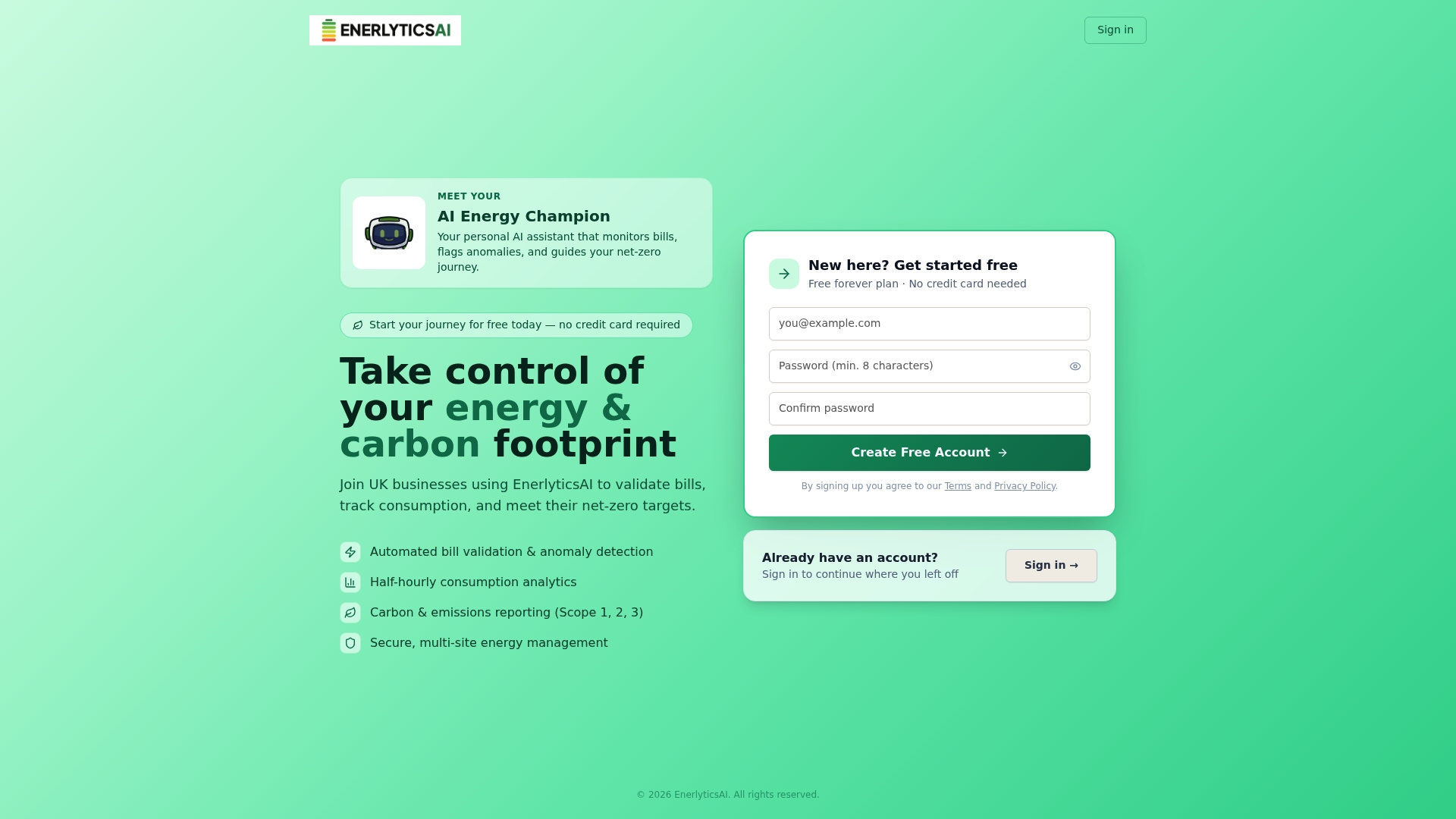
Start with a single low-risk site, confirm the validation catches what you expect it to catch, then scale the same setup to the rest of your sites. You can create your account and set up your first site in a few minutes.
Sources
- Government conversion factors for company reporting: 2026
- Ofgem Data Best Practice Guidance (v3.5)
- UK ETS01 — MRR general guidance for installations
- GHG Protocol Scope 2 guidance (revision)
FAQ
What is the first step in setting up energy data governance?
Assign one named owner for each data stream, electricity, gas, water or waste, and agree on a single source of truth for each. This single decision resolves most of the confusion that causes billing and reporting errors later.
Which conversion factors should I use for carbon reporting?
Use the government's published greenhouse gas conversion factors, which are updated annually and required for UK company reporting. Always record which version you used, since the factors change with each yearly update.
How long should I retain energy and carbon data for audits?
Retention needs to vary by scheme, but MRR guidance points to keeping verification evidence for around 10 years where an installation falls under that framework. Match your retention policy to your longest reporting obligation rather than the shortest.
How do I handle missing supplier activity data?
Send suppliers a standardized request for raw activity data in physical units rather than accepting a CO2e figure at face value. When data is genuinely unavailable, use invoices as a fallback and document the assumption behind any estimate for audit purposes.
Can a platform like EnerlyticsAI handle this governance work for me?
EnerlyticsAI automates bill validation, anomaly detection and half-hourly analytics feeding into Scope 1, 2 and 3 carbon reporting, which covers much of the data quality work this playbook describes. It offers free access for managing multiple sites, making it a practical starting point rather than a full replacement for a written governance policy.