
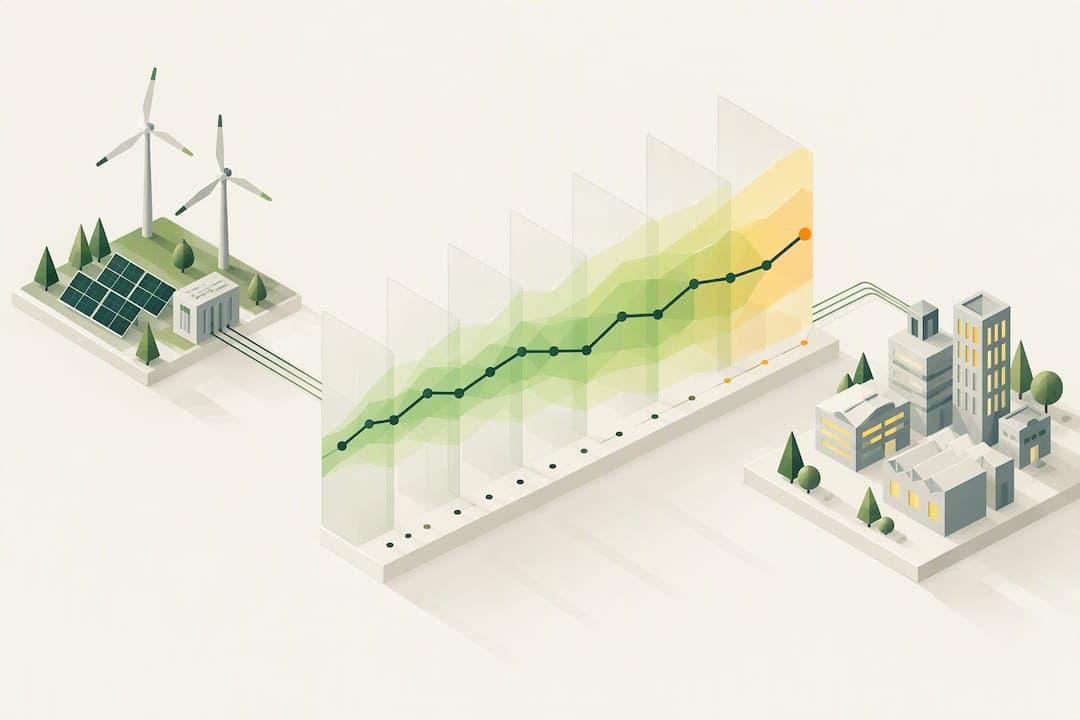
Energy cost forecasting delivers probabilistic cost ranges and scenario outputs that feed directly into budgeting, procurement timing, and risk management, rather than a single guessed number. A reliable forecast combines wholesale market data, network charge projections, and consumption patterns across short, medium, and long horizons. The output businesses actually need is a range of likely outcomes with confidence levels attached, not a point estimate that looks precise but rarely holds.
TL;DR:
- Wholesale market indicators updated weekly and monthly by Ofgem are essential for accurately tracking baseline energy costs.
- Using probabilistic forecasts with range outputs and confidence levels reduces budget overruns caused by relying on single-point predictions.
- Medium to long-term planning should incorporate regulatory and network charge trends, which significantly influence energy costs beyond wholesale prices.
- Aggregating site-specific half-hourly consumption data enhances forecast precision, especially for operational and demand response decisions.
- Combining advanced machine learning models with decomposition techniques offers the strongest resilience against energy price volatility.
Table of Contents
- Key drivers and data inputs for robust forecasts
- Forecasting methods: what models do and when each is appropriate
- Forecast horizons and business use cases
- How to implement forecasts in budgeting and procurement: a short playbook
- Interpreting forecasts and managing forecast risk
- Practical example: how an AI-based energy platform applies forecasting to budgets and procurement
- Author perspective: priority actions for energy managers this planning cycle
- EnerlyticsAI: an implementation option
- FAQ
- Sources
- Primary datasets and documents cited
Key drivers and data inputs for robust forecasts
A forecast is only as good as what feeds it. The wholesale cost of gas and electricity sets the baseline, and Ofgem's wholesale market indicators track this through weekly average forward delivery contracts and monthly day-ahead baseload contracts for the GB market. These figures move with global gas supply, generation mix, and interconnector flows, so any forecast built without them is guessing at the largest line item in the bill.
Non-commodity costs matter just as much, and they're easier to overlook. Network charges, policy costs, and system operator decisions can shift a budget by a meaningful margin even when wholesale prices stay flat.
- Wholesale indicators: forward and day-ahead contract prices published by Ofgem set the commodity baseline.
- Network charges: transmission and distribution costs shift with regulatory price controls and system operator rulings.
- Operational inputs: half-hourly consumption, weather patterns, generation mix, and interconnector flows refine site-level accuracy.
- Update cadence: forecasts built on stale data miss turning points that matter at renewal time.
Ofgem updates wholesale indicators weekly for forward contracts and monthly for day-ahead baseload contracts, which means a forecast refreshed less often than that is already behind the market it claims to predict.
Half-hourly consumption data adds a layer that annual or monthly averages miss entirely. Pairing site-level half-hourly data with regional tariff projections lets a business see how its own load profile interacts with peak pricing periods, rather than relying on a generic average that assumes flat consumption around the clock.
Forecasting methods: what models do and when each is appropriate
Not every forecasting method suits every decision. Simpler statistical models handle stable, seasonal patterns well and are easy to audit, while more complex approaches earn their complexity only when volatility demands it.
- Time-series and statistical models (ARIMA, exponential smoothing) work well for predictable seasonal demand and short planning horizons.
- Decomposition and ensemble strategies separate trend, seasonality, and shock components, which helps when a single model struggles with sudden price spikes.
- Machine learning and hybrid frameworks, including XGBoost, random forests, and neural networks, handle nonlinear volatility better than pure statistical methods when paired with decomposition techniques.
- Probabilistic outputs (quantile forecasts, fan charts) show a range of plausible outcomes instead of one number, which matters more than the headline accuracy of any single model.
Systematic reviews of deep learning approaches to energy price forecasting identify hybrid and ensemble frameworks that combine machine learning with decomposition-based techniques as consistently strong performers for handling the nonlinear and volatile dynamics typical of energy prices. A related approach, topology-aware probabilistic forecasting, incorporates transmission network structure and renewable generation forecasts to improve accuracy across interconnected regions, which matters for any business sourcing power across multiple grid zones.
Reading a fan chart correctly means treating the widest part of the range as a real possibility, not an edge case to dismiss. A forecast that shows only its median outcome hides the information you need most.

Pro Tip: Ask any forecast provider for their back tested out-of-sample accuracy before trusting a single projected number.
Forecast horizons and business use cases
Different decisions need different forecast windows, and matching the two is where most budgeting mistakes start. A forecast built for trading desks rarely suits a finance team setting next year's budget line, and vice versa.
- Short-term (day-ahead to weekly): operational scheduling and trading decisions, used by energy managers adjusting load or demand response in near real time.
- Medium-term (monthly to two years): procurement timing, contract length negotiation, and working capital planning, the horizon most finance teams and procurement leads rely on for annual budgets.
- Long-term (three years and beyond): investment planning for on-site generation, battery storage, or efficiency upgrades, typically owned by sustainability and capital planning teams.
A facilities manager watching day-ahead prices to shift a production schedule needs a completely different tool than a finance director locking in a two-year supply contract. Both are using energy cost forecasting, just at opposite ends of the horizon.
How to implement forecasts in budgeting and procurement: a short playbook
Turning a forecast into a usable budget takes a defined process, not just access to good data.
- Define the decision first. Are you setting a budget line, choosing a contract length, or timing a purchase? Each needs a different horizon and confidence level, and the stakeholders involved (finance, procurement, sustainability) should agree on this before pulling any data.
- Build a data pipeline with the right cadence. Ingest half-hourly consumption continuously, pull wholesale indicators on at least a weekly basis, and roll the budget forecast monthly so it never drifts far from current market conditions.
- Convert probabilistic ranges into budget allowances. Use the median forecast for the base budget line and the upper quantile band to size a contingency buffer, rather than budgeting to the most optimistic scenario.
- Interrogate your data sources. Ask any internal analytics team or external provider what inputs feed the model, how often it's validated against actuals, and how frequently it updates.
Pro Tip: Set contingency buffers from the forecast's upper quantile band, not from a flat percentage guess, so the buffer actually reflects current market volatility.
A monthly rolling forecast, reviewed at each contract renewal window, keeps budgets realistic without requiring a full re-forecast every time wholesale prices move.
Interpreting forecasts and managing forecast risk
A single-point forecast invites false confidence. Reading the full quantile range, or a fan chart showing how the forecast spreads over time, tells you how much budget cushion a decision actually needs.
- Quantiles over point estimates: a forecast showing 10th, 50th, and 90th percentile outcomes lets you size risk deliberately instead of guessing at it.
- Scenario stress tests: run budgets against network charge and policy shocks, not just commodity price swings.
- Hedging categories: fixed-length contracts, price collars, and indexed contracts each trade certainty for flexibility differently, and the right choice depends on your risk tolerance and renewal timing.
- Governance: keep forecasts auditable, with documented inputs and update logs, so finance teams can trust the numbers behind a budget line.
Ofgem's RIIO-3 final determinations approved a multibillion-pound amount of upfront network investment across electricity and gas price controls, with effects on network charges projected through 2031, which means any multi-year budget forecast that ignores regulatory price control windows is missing a direct cost driver.
Practical example: how an AI-based energy platform applies forecasting to budgets and procurement
A workable data-to-decision flow looks like this: half-hourly meter data feeds automated bill validation, validated consumption feeds predictive models, and the output becomes a portfolio-level cost scenario finance can actually budget against.
- Bill validation and anomaly detection catch billing errors before they distort a forecast's baseline consumption figures.
- Predictive forecasting turns cleaned half-hourly data into site-level and portfolio-level cost scenarios.
- Carbon reporting across Scope 1, 2, and 3 connects those same cost forecasts to sustainability planning, so a budget line and an emissions target are built from the same underlying data.
Author perspective: priority actions for energy managers this planning cycle
This planning cycle, I'd push three things: adopt probabilistic outputs over single-point numbers, tighten half-hourly data quality before trusting any model, and set a monthly rolling forecast with a governance checkpoint at each contract renewal.
— Chris
EnerlyticsAI: an implementation option
Our platform is built around principles such as half-hourly data quality, automated bill validation, and predictive forecasting that feeds budget planning rather than a static annual estimate.
- We ingest half-hourly consumption and run automated anomaly detection to keep forecast inputs clean.
- Our predictive forecasting tools turn that data into portfolio-level cost scenarios.
- We include carbon reporting across Scope 1, 2, and 3 so cost and emissions planning draw from one dataset.
We offer a free forever plan with no upfront charges, so you can manage multiple sites and see how predictive forecasting applies to your own portfolio before upgrading to a paid tier. For a broader look at trimming operating costs alongside energy spend, practical finance-focused cost reduction tactics cover complementary ground worth a look.
FAQ
What is energy forecasting?
Energy forecasting is the practice of projecting future energy prices or consumption costs using historical data, wholesale market indicators, and statistical or machine learning models. For businesses, it typically outputs a range of likely cost scenarios rather than one fixed number, which supports budgeting and procurement decisions.
Should I fix my energy for one or two years?
The right contract length depends on your risk tolerance and how forecasts show wholesale and network charge trends moving over your planning horizon. A longer fix offers budget certainty but can lock in a higher rate if the market is expected to soften, so comparing contract options against a probabilistic forecast range before committing is the safer approach.
What does Martin Lewis say about fixing energy prices?
Advice on fixing household or business energy prices circulates widely from consumer finance commentators and tends to depend heavily on current market conditions at the time it's given. Rather than relying on general commentary, check current wholesale trends and your own forecast range before deciding whether a fixed contract suits your situation.
What are the energy predictions for 2026?
Specific price predictions vary by provider and model, and nobody can state a single definitive figure for 2026 costs with certainty. The more reliable approach is to track Ofgem's wholesale market indicators as they update weekly and monthly, and to treat any single-year prediction as one scenario within a wider probabilistic range rather than a fixed outcome.
Sources
Building or validating a credible forecast means grounding it in public data rather than a black-box number.
- Ofgem wholesale market indicators (Data Portal)
- Deep learning-based price forecasting in energy markets: a systematic literature review and future research directions
- PriceFM: Foundation Model for Probabilistic Electricity Price Forecasting
Combining these public datasets with your own half-hourly consumption data produces a forecast specific to your sites rather than a generic market average applied uniformly across a portfolio.