
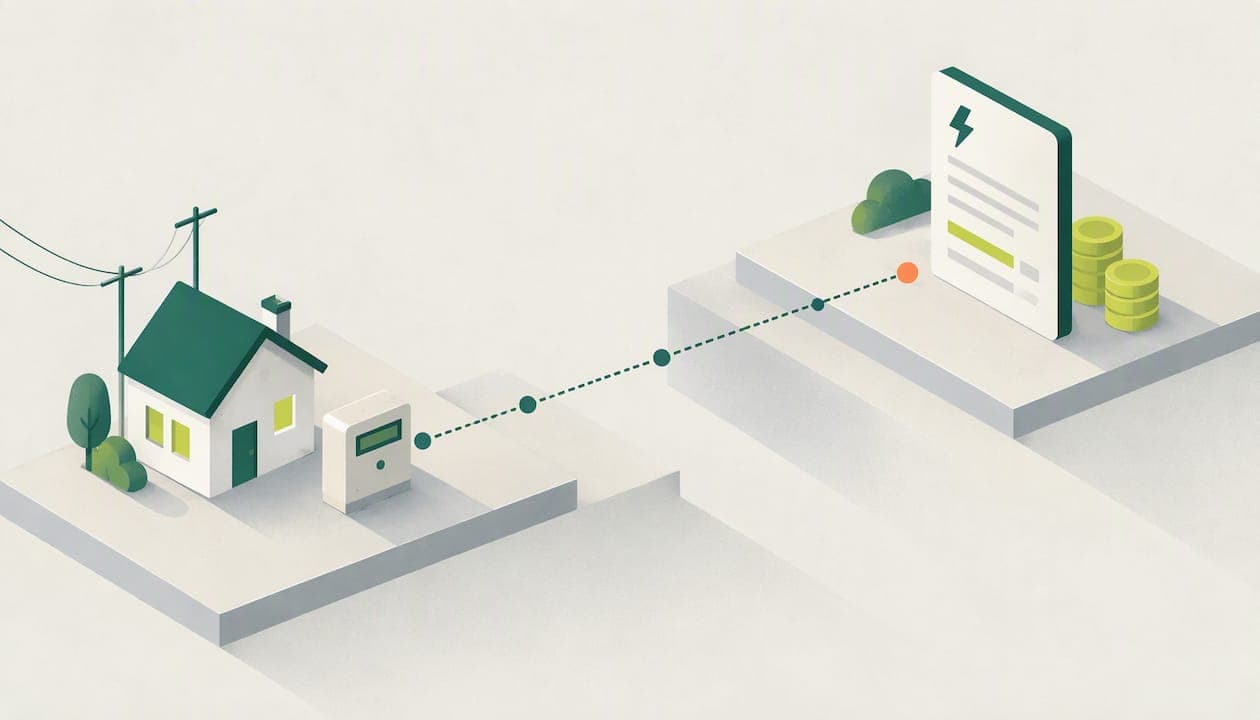
If your supplier sends a backdated energy bill, the rule that matters is Ofgem's 12-month limit. For domestic and microbusiness customers, a supplier cannot charge for energy or standing charges used more than 12 months ago if it never billed that amount accurately at the time. Larger businesses sit outside that rule and depend on their contract. There are also a few exceptions, and a clear route to challenge the bill.
This guide explains who the rule covers, what counts as the supplier's fault, the exceptions, and what to do in the first weeks after a catch-up bill arrives. It also covers how to make one much less likely.
TL;DR
- Ofgem's back-billing rules stop suppliers charging domestic and microbusiness customers for usage older than 12 months that was never accurately billed. Payment method and meter type make no difference.
- The main exception is obstructive behaviour, such as blocking meter access or stealing energy. In that case suppliers can look back much further.
- Missing a meter reading does not by itself cancel your protection. Dispute the bill in writing, and if the supplier has not resolved it after eight weeks, or sends a deadlock letter sooner, go to the Energy Ombudsman.
- Larger non-micro businesses are not covered by the 12-month rule in the same way. Check your contract and challenge the data behind the bill.
- The cheapest defence is accurate half-hourly data and regular bill checks, so errors surface in weeks, not years.
Table of Contents
- What back billing is and why it happens
- The 12-month rule in plain terms
- Are you a microbusiness? It decides everything
- When the 12-month limit does not protect you
- What to do when a backdated bill arrives
- A worked example
- How to stop backdated bills before they happen
- Our perspective: why we built around half-hourly data
- Check your bills with EnerlyticsAI
- FAQ
- Sources
What back billing is and why it happens
A back bill is a request to pay for energy you have already used but were not charged for correctly. Ofgem says this can follow a billing mistake or a problem with your meter. The usual pattern is a run of estimated bills. When an actual reading finally arrives and shows higher consumption, the supplier issues a catch-up bill for the difference.
The industry's own explanation is that back billing is a catch-up mechanism for energy actually consumed. Energy UK argues that costs a supplier cannot recover from one account end up spread across other customers. Suppliers are also expected to keep back billing to a minimum through regular, accurate billing.
For a business, the common causes are:
- a meter that was never added to the billing system, or was set up with a wrong opening reading;
- estimated reads that ran for months because nobody supplied a read or the smart meter lost communications;
- a changed meter, a wrong multiplier or a wrong meter-to-site match after a move or refit;
- a site that changed supplier and was billed on the wrong profile or the wrong tariff.
The Energy Ombudsman reports that billing is the largest complaint category, with inaccurate usage estimates a major driver. In 2024 there were 3,218 disputes relating to back billing. The same report says the most common single billing problem was a disputed gas or electricity bill.
The 12-month rule in plain terms
Under Ofgem's back-billing requirements, a supplier cannot charge you for energy or standing charges used more than 12 months ago if it did not accurately bill you for them at the time. The Energy Ombudsman's guidance describes the same limit. It applies to domestic and microbusiness consumers.
Three points that people often get wrong:
- The limit runs back from the bill date. A bill issued today can include the last 12 months of unbilled usage, and no earlier months.
- It does not matter how you pay. Direct debit, quarterly invoice or prepayment all fall under the same limit.
- It covers standing charges as well as units. Standing charges are part of what the supplier cannot recover beyond the window.
The back-billing rule restricts what the supplier can recover. It does not say you owe nothing. You still owe the supplier for the energy you used within the last 12 months that was not billed correctly, so the sensible aim is to check that figure and agree a fair payment plan.
Does a missing meter reading cancel your protection?
Usually not. Many people assume that if they did not send readings, the supplier can charge for any period. Ofgem's open letter on charge recovery says the protection applies unless the consumer behaved in an obstructive or manifestly unreasonable way. Failing to give a reading is not obstruction in itself. Which? summarises the rules as protecting you where you asked for a bill and did not get one, among other situations. Read that page for the full list of conditions.
Are you a microbusiness? It decides everything
Ofgem's definition of a microbusiness rests on the size of the organisation and how much energy it uses. Many small offices, shops, workshops and small manufacturers qualify. Mid-sized and large companies do not. Check your status with your supplier or on Ofgem's site before you rely on the 12-month limit, because the answer changes which protections you have.
If you are covered, the 12-month rule and the Energy Ombudsman route both apply. If you are a larger business, the picture is different:
- Your contract terms and general contract law set what the supplier may bill for and how late.
- Many suppliers' terms allow corrections for a long period, so read the billing and adjustment clauses.
- Your strongest tools are evidence and the accuracy of the underlying data. If the meter data does not support the charge, the charge can be challenged whatever your size.
Since 19 December 2024, the Energy Ombudsman has been able to resolve disputes between suppliers and small businesses. It assesses whether a business meets its criteria at the point the problem occurred. A business is generally eligible if it became aware of the problem on or after that date. If the supplier has already issued a deadlock letter or reached the eight-week point, the dispute can be considered regardless.
Our own guide to recovering up to six years of refunds on business energy tariffs covers the other side of the same coin. Errors can run in your favour, and the time you spend on audits can pay back.
When the 12-month limit does not protect you
The rules have limits. Know them before you argue.
Obstructive or manifestly unreasonable behaviour
The main legal reason suppliers can go beyond 12 months is the customer's own conduct. Ofgem's letter to suppliers names examples such as blocking meter access or energy theft. In those cases a supplier may pursue unbilled usage over a much longer period, up to six years. This is rare, but it is the exception suppliers cite most often. If a supplier says you obstructed them, ask for the evidence in writing: the dates they tried to reach you, the letters they sent and the visits they attempted.
Heat networks and service charges
Facility managers in managed buildings should note that heat network rules changed. From 27 January 2026, Ofgem's heat network consumer protection guidance extends protections to heat network consumers. It treats back billing as a last resort. But where heat costs are recovered through a service charge within the meaning of section 18(1) of the Landlord and Tenant Act 1985, the 12-month Ofgem limit does not apply. Section 20B of that Act applies instead, which gives the landlord 18 months to notify or demand payment once costs are incurred. If you pay for heat through a service charge, find out which regime your lease follows before you dispute anything.

Larger business contracts
As above, a non-micro business relies on its contract. Look for the clause on billing errors and adjustments, and check the notice periods and any interest on late payment. If the clause is unclear, ask the supplier to point to the exact term it is relying on.
What to do when a backdated bill arrives
The first two weeks matter most. Work through this order.
- Do not ignore it and do not pay in a panic. Contact the supplier quickly. Energy UK says the most useful step for a business is to raise billing irregularities as soon as they are spotted, which allows tailored support and stops debt building up.
- Establish the period. Ask the supplier for the exact dates covered, the meter readings used, and whether any were estimated. Compare them with your own reads.
- Check the 12-month window. For a microbusiness, any charge for usage older than 12 months that was not previously billed should come off. Ask for a revised bill in writing.
- Check the arithmetic. Even within the window, the bill can be wrong. A bad opening reading, a wrong tariff or a wrong multiplier can inflate it. The Energy Ombudsman published a case where a supplier opened an account on an incorrect meter reading, which inflated a bill of around £2,200. The supplier corrected it when the complaint reached it.
- Put your dispute in writing. Keep dated meter readings, photos of the meter, and all correspondence. These disputes often turn on proving when the inaccuracy began.
- Ask for a payment plan on any amount that is genuinely owed. Suppliers can offer time to pay. If you pay by direct debit, Citizens Advice notes the supplier might raise your payments to clear the amount over time, so check what is proposed.
The eight-week clock and the Energy Ombudsman
If you dispute the charge, the supplier has eight weeks to respond. If the problem is still unresolved at that point, or you get a deadlock letter earlier, you can take it to the Energy Ombudsman for a free, impartial review. Which? reports that the Ombudsman found fewer than half of cases were correctly signposted to it by suppliers at that stage, so do not wait to be told. Ask directly for the deadlock letter if you are stuck.
The Energy Ombudsman also says suppliers are encouraged to settle at the complaint stage, including through goodwill offers. A persistent, well-documented log of contact often speeds that up, even when the first reply is poor.
A worked example
Imagine a small workshop with one electricity meter. For 18 months the supplier estimated bills because the meter was not communicating. Then an engineer visit produced an actual reading, and the supplier sent a catch-up bill for the whole 18 months.
- The workshop is a microbusiness, and it never obstructed access. The supplier cannot recover the first six months of unbilled usage.
- The workshop checks the other 12 months. It finds the opening reading on the new account was too low, which overstates usage. It asks for a corrected calculation.
- It agrees a payment plan for the corrected balance and keeps all letters. If the supplier is silent after eight weeks, the workshop can go to the Energy Ombudsman.
This is an illustration, not a real case. It shows the order of work: scope the window, then check the maths, then agree the payment.
How to stop backdated bills before they happen
Most catch-up bills trace back to missing or wrong consumption data. Ofgem encourages treating 12 months as a benchmark for good practice, not just a legal minimum. Accurate, high-frequency data is the strongest operational defence against the errors that lead to backdated charges.
Close the gaps in your meter data
A bill is only as good as the reads behind it. Missing half-hourly reads lead straight to estimates. Our guide to UK meter data gaps shows how to spot missing reads before bills are estimated. If you are not sure whether you can get the data you need, see our overview of smart meter data access for UK businesses.
Check every bill against your own data
Compare billed consumption with what your meters recorded, check the standing charge and unit rate against your contract, and flag differences within the month. Our walkthrough on energy bill validation lists the checks, and the piece on half-hourly meter checks covers the meter-side errors that cause trouble. If you want to see how the two charge types affect the total, read standing charge vs unit rate.
The habit of monitoring electricity consumption closely is useful in any market. Regular reads against bills catch errors long before a supplier would.
Keep a simple evidence file
For each site, record the meter serial number, the dated readings you submitted, the supplier's replies and any photos of the meter display. If a dispute opens, you will already hold the evidence the Ombudsman asks for.
Our perspective: why we built around half-hourly data
We see backdated bills as a data problem before they are a legal one. The legal protections are useful, but they only start working once a shock bill has landed and someone has spent weeks proving the supplier wrong. A finance team with a clean record of half-hourly consumption can see an estimate or an anomaly the month it happens.
That is why EnerlyticsAI is built around automated bill validation, anomaly detection and half-hourly analytics. A bill that does not match the consumption on your meter is flagged early, while the paperwork is fresh and the supplier can still fix the cause. The same data feeds carbon reporting across Scope 1, 2 and 3, so the effort of keeping it accurate pays off twice: once in billing, once in emissions reporting.
Our advice to any finance or facilities lead: do not wait for a catch-up bill to find out how good your data is. Pick one site, compare three months of bills against meter data, and see what you find.
— Chris
Check your bills with EnerlyticsAI
If you manage business energy across one site or several, you can start on our free forever Starter plan and see bill validation and half-hourly consumption for yourself. Paid plans start at £49 per month for Eco, with Growth at £79 per month, Professional at £149 per month and Scale at £299 per month, for when you need more. You can also look at how the Bills page works before you sign up.
FAQ
Can a supplier back bill me for more than 12 months?
For domestic and microbusiness customers, generally not, if the supplier failed to bill accurately and you did not behave in an obstructive or manifestly unreasonable way. Obstruction, such as blocking meter access or energy theft, is the main exception, and then suppliers can look back much further. Larger businesses should check their contract terms.
Does it matter if I never sent a meter reading?
Not by itself. Not providing a reading does not remove your protection unless your conduct was obstructive or manifestly unreasonable. Keep a record of any reads you did send, and of any requests the supplier made.
How long does the supplier have to answer my dispute?
Eight weeks. If it has not resolved the issue by then, or it sends you a deadlock letter earlier, you can take the dispute to the Energy Ombudsman, which is free and impartial. Keep dated readings and all correspondence to support your case.
Can I still be asked to pay something?
Yes. The 12-month rule limits how far back the supplier can charge. It does not cancel energy you really used within that window that was never billed correctly. Check the figure and ask for a payment plan if you need one.
Does the rule apply to heat networks?
Heat network consumers gained Ofgem protections from 27 January 2026, but where costs are recovered as a service charge under the Landlord and Tenant Act 1985, the 18-month limit in section 20B applies instead of Ofgem's 12 months.
Sources
- Ofgem: What to do if you get a back bill
- Ofgem: Expectations for suppliers undertaking charge recovery action
- Ofgem: Heat networks regulation, consumer protection guidance
- Energy Ombudsman: What is back billing?
- Energy Ombudsman: How we assess when a business consumer meets the criteria
- Energy Ombudsman: Reports 24% drop in complaints
- Energy Ombudsman: Estimated meter readings case study
- Energy UK: Back billing explained
- Which?: Back-billing rules
- Citizens Advice: If you haven't received an accurate energy bill