
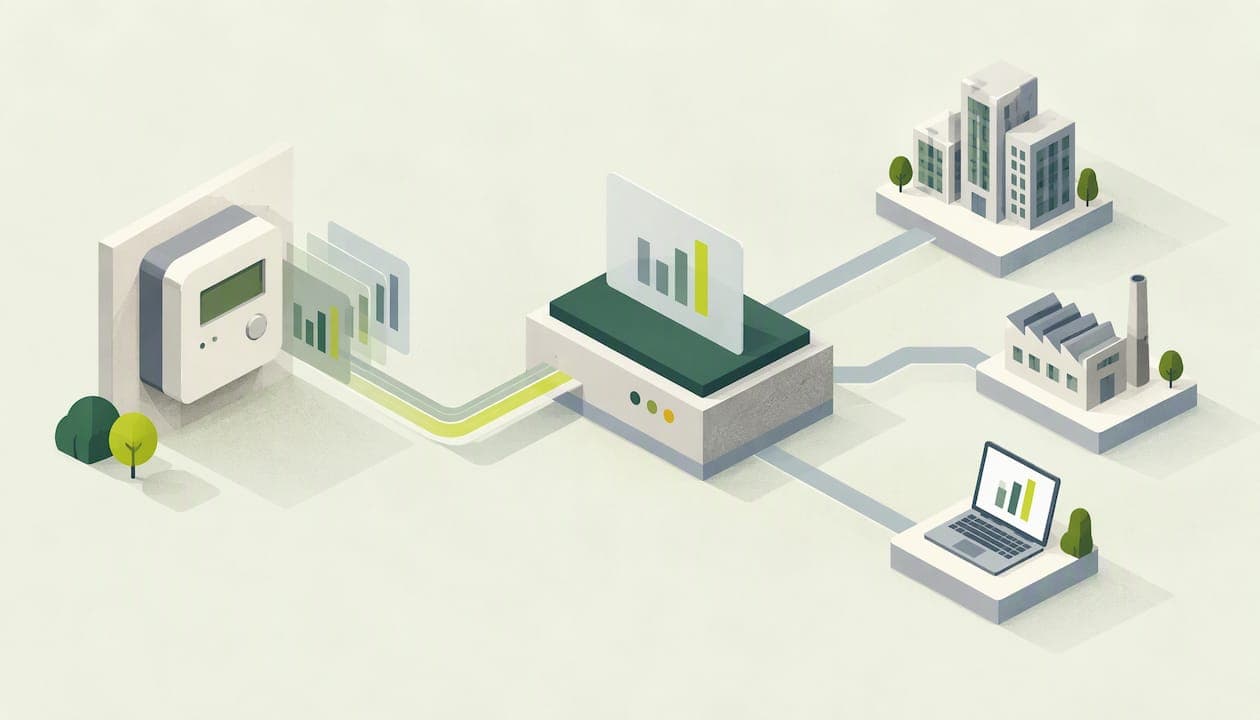
If you run a business in Great Britain, you can get at your smart meter data in three main ways: through your supplier's portal or app, by downloading files from it, or by giving an authorised third party your consent to pull half-hourly readings straight from the meter. Which one works depends on your meter type, your contract and how much detail you need. This guide explains each route, what the rules say about consent, and how to turn raw readings into something your finance and sustainability teams can use.
TL;DR
- Suppliers collect monthly data for billing by default. Finer detail, such as half-hourly readings, has its own consent rules, and these differ for homes and microbusinesses.
- Third-party platforms can only read your meter data with your unambiguous consent, given through a specific, informed, positive step.
- Half-hourly data is what makes bill checking, anomaly detection and Scope 2 reporting practical, so it is worth requesting for every site.
- Market-wide half-hourly settlement is gradually making half-hourly data the default for modern contracts.
- EnerlyticsAI has a free forever plan that lets you start working with multi-site consumption data without an upfront charge.
Table of Contents
- What "smart meter data" actually means for a business
- Who is allowed to see your data, and on what terms
- Four ways to get your meter data
- Download smart meter data: what to ask for
- Why half-hourly data is worth the effort
- Settlement reform: why access is getting easier
- Privacy and governance: what you should still ask
- Our perspective
- From raw data to something you can act on
- A simple 30-day plan
- FAQ
- Sources
What "smart meter data" actually means for a business
A smart meter does more than send a monthly total. Smart and advanced meters can record consumption in every half-hour period and, for sites with generation, how much electricity is exported to the grid in each one. That gives 48 readings a day per meter, which is the level of detail you need to see when a site actually uses energy rather than just how much.
For a business, there are really three layers of data:
- Billing data. Monthly or quarterly totals your supplier uses to invoice you.
- Daily data. Useful for spotting trends, but too coarse to catch overnight base load or a plant start-up spike.
- Half-hourly data. The layer that supports demand analysis, tariff checks, carbon reporting by time of day and fault detection.
Most frustration with smart meter data comes from mixing these up. A supplier portal that shows a monthly bar chart is not broken; it is showing you the billing layer.
Who is allowed to see your data, and on what terms
The rules sit in supply licence conditions and the Smart Energy Code. In short, the supplier's access depends on purpose and granularity. The Open Energy summary of the rules describes the long-standing framework: monthly data for billing is mandatory, daily data is opt-out, and half-hourly data is opt-in for domestic customers.
Businesses are treated a little differently. According to Ofgem's decision on access to half-hourly data, domestic consumers' half-hourly data can only be accessed for settlement with opt-in consent, while suppliers can access half-hourly data from microbusinesses unless the business has opted out. Larger businesses are typically on half-hourly metering for settlement already, and their data arrives by a different industry route.
The practical upshot: if you are a small or medium site and your portal only shows monthly figures, ask your supplier what granularity they hold for you and whether an opt-out is on file.
Four ways to get your meter data
1. Your supplier's portal or app
This is the easiest place to start. Log in, find the usage section and see what resolution is offered. Some suppliers offer daily views, some half-hourly, and some only monthly for business accounts. Export options vary too, so check for CSV download before you build a process around it.
2. A data request to your supplier
If the portal is thin, ask in writing for half-hourly consumption data for each meter point (MPAN for electricity, MPRN for gas) over a defined period. Give the reference numbers, the date range and the format you want. Keep the reply: it becomes part of your audit trail.
3. Your meter operator or data collector
For half-hourly settled sites, the meter operator and data collector hold the validated readings that feed your bills. They are an underused source when a supplier's reports do not match the invoice.
4. An authorised third-party platform
This is the route that removes the manual work. Under the Smart Energy Code, other parties can choose to become DCC Users, which lets them use DCC services, including obtaining the history of a consumer's consumption data. The Data Communications Company runs the national network that connects smart meters, but it does not hand data to end customers directly. Software providers go through the user entry process and then act on your behalf.
The condition is consent. Under the same guidance, access needs your unambiguous consent, meaning a specific, informed and positive step on your part, such as an electronic sign-up or opt-in. Silence, a pre-ticked box or a clause buried in terms does not qualify. You can also withdraw consent, and a well-run platform will make that straightforward.
Download smart meter data: what to ask for
When you request or export a file, the details decide whether it is usable. Before you download anything, check these points:
| What to check | Why it matters |
|---|---|
| Meter point reference (MPAN or MPRN) | Without it you cannot match readings to invoices or sites |
| Interval (half-hourly, daily, monthly) | Determines which analyses are possible |
| Units and time basis | kWh versus kW, and whether timestamps are UTC or local time, affect clock-change days |
| Date range | Ask for at least 12 months so seasonal patterns show |
| Import and export | Essential if the site has solar or a battery |
| Estimated versus actual flags | Estimated reads are a common source of billing disputes |
Clock changes deserve a special mention. Twice a year a half-hourly day has 46 or 50 periods rather than 48. Spreadsheets that assume 48 rows quietly misalign everything after the change. A platform that handles this for you saves a lot of reconciliation work.
Why half-hourly data is worth the effort
Monthly totals tell you what you paid. Half-hourly readings tell you why. Typical uses include:
- Bill validation. Comparing billed kWh and charges against the underlying readings catches estimated reads, wrong meter multipliers and capacity charges that do not match your real peak. Our guide to half-hourly meter checks for UK energy teams walks through the checks.
- Understanding your bill structure. Seeing consumption by period makes it clear how fixed and variable charges interact, which we cover in standing charge versus unit rate.
- Forecasting. A year of half-hourly data is the basis for energy cost forecasts that avoid budget surprises.
- Carbon reporting. Scope 2 figures built from real consumption beat estimates built from averages, and they feed directly into net-zero plans.
- Operational insight. For plant such as boilers, interval data shows efficiency drift, as in our piece on boiler efficiency tracking.
- Flexibility. Once you know your load shape, you can judge whether shifting demand pays. A guide to demand response programmes explains how devices can earn payments for that flexibility.
Settlement reform: why access is getting easier
Britain's electricity market is moving from estimated consumption profiles to settling each meter on its actual half-hourly use. This is Market-wide Half-Hourly Settlement, or MHHS. Ofgem's case for it is that billing should reflect real meter-specific behaviour, and its analysis estimated net system benefits in the range of £1.6bn to £4.5bn by 2045, as set out on Ofgem's site.

For you, the effect is about defaults. Ofgem's decision on access to half-hourly data was made precisely because suppliers need customers' half-hourly data to settle them half-hourly. Customers moving to the new arrangements, for example when they switch supplier or sign a new contract, are more likely to have half-hourly sharing as the standard. Those who stay on legacy contract structures may see coarser data until they renegotiate.
So the contract you sign matters for data. When you renew, ask three questions:
- Will half-hourly data be collected and shared for all my meters?
- Can I export it, or authorise a third party to read it?
- Are there any charges for data access?
If you are also checking whether past bills were right, our article on recovering six years of refunds on business tariffs shows what the readings can reveal.
Privacy and governance: what you should still ask
Business meter data can reveal when a site is occupied or what processes are running, so governance matters even when no personal data is involved. Sole traders, home-based businesses and some small premises can blur the line, and then data protection law applies in full.
Practical checks before you authorise any platform:
- Is access based on your explicit, recorded consent, and can you withdraw it?
- Does the provider say which meters and which date ranges it reads?
- Where is the data stored, and who can see it?
- Can you export your own data if you leave?
Network operators face a stricter regime of their own: to use consumption data covering periods of less than a month, distribution network operators need an Ofgem-approved Data Privacy Plan. That is a useful benchmark for the standard of care you should expect from anyone handling your readings. For a fuller checklist from meter to report, see our audit-ready energy data governance guide.
Our perspective
We built EnerlyticsAI because most UK businesses already own the data they need and still cannot use it. The readings exist, the invoices exist, and the two rarely meet. The result is that finance teams pay bills they cannot verify and sustainability teams report emissions from estimates.
Our view is that data access should not be the hard part. The consent model in the Smart Energy Code is sound: you decide who reads your meter, and the step you take must be clear. What needs to improve is the next stage, where somebody has to make sense of 17,520 readings per meter per year across several sites.
That is why we focus on automated bill validation and anomaly detection first, then half-hourly analytics, then Scope 1, 2 and 3 reporting. And it is why we offer a free forever plan. A facilities manager should be able to see whether the data is useful before anyone raises a purchase order.
One piece of advice we repeat often: start with your worst-understood site, not your best. That is where the surprises are.
— Chris
From raw data to something you can act on
If you want to try this without a procurement process, EnerlyticsAI offers a free forever Starter plan for managing multiple sites. Once your sites are set up you can review half-hourly consumption, check invoices on the bills page and produce emissions reports.
If you outgrow the free plan, paid tiers are published as Eco at £49 per month, Growth at £79 per month, Professional at £149 per month and Scale at £299 per month. Start with the free plan and see which of your sites show anomalies first.
A simple 30-day plan
- Week 1: List every meter (MPAN and MPRN), site and supplier. Note which are half-hourly settled and which are not.
- Week 2: Check your supplier portals for interval data and request exports where they are missing.
- Week 3: Give consent to your chosen platform for the meters you want read, and record the date and scope.
- Week 4: Validate the last 12 months of bills against the readings, then rank sites by anomalies and unexplained overnight load.
The output is a short list of sites to investigate and a baseline for your carbon reporting.
FAQ
Can I download my business smart meter data?
Often yes, but it depends on your supplier and contract. Check the portal for a CSV export, and if there is none, ask the supplier in writing for half-hourly readings by meter point. A platform you have authorised can also collect the data for you.
Do I need to give consent for a third party to read my meter?
Yes. Third parties need your unambiguous consent, meaning a specific, informed and positive action such as an electronic opt-in. You should be able to withdraw it later.
Is half-hourly data collected by default for small businesses?
For settlement purposes, Ofgem describes microbusiness data as accessible unless the business has opted out, whereas domestic customers must opt in. Check with your supplier which applies to your meters.
Does the DCC give me direct access to my readings?
No. The DCC runs the infrastructure but does not serve consumers directly. Authorised DCC Users, including software providers, can request data from the meter with your consent.
Sources
- SECAS guidance notes: DCC User Entry Process
- Ofgem: Decision for access to half-hourly electricity data for settlement purposes
- Ofgem: Data Protection Impact Assessment on half-hourly data access
- Open Energy: Data protection and smart meter data
- Ofgem: Data Privacy Plan for access to smart meter consumption data
- Ofgem