
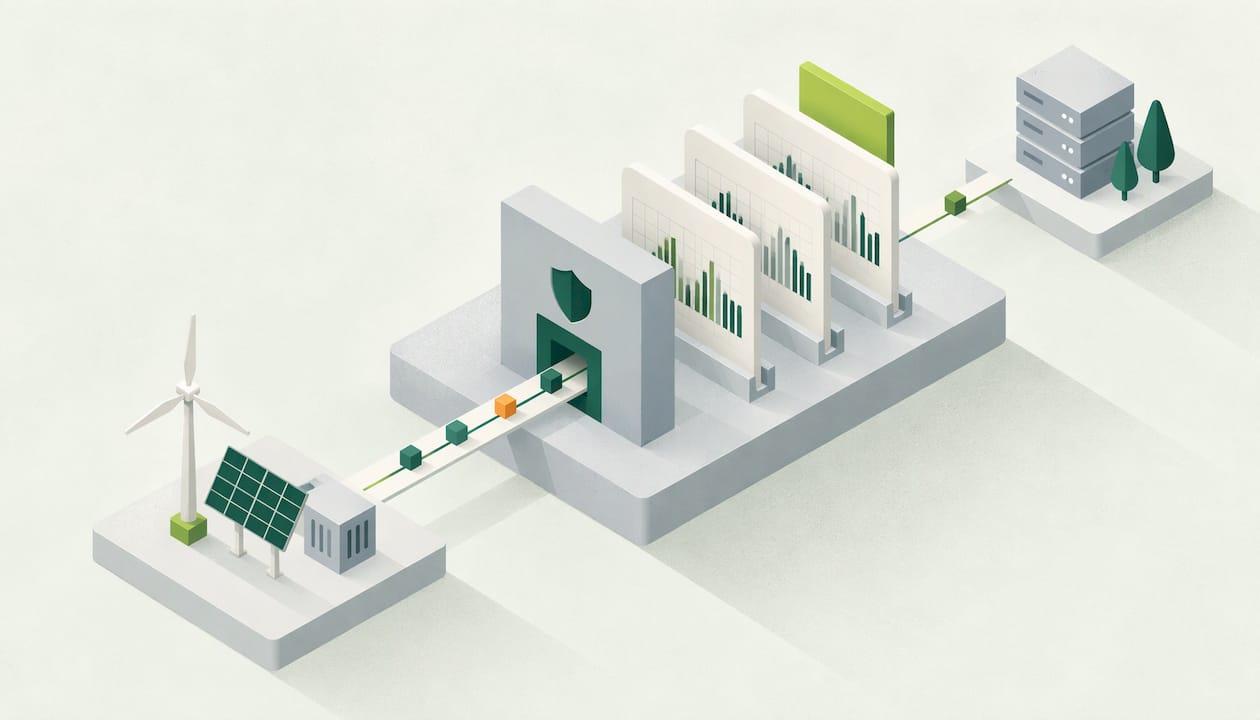
Energy data security means controlling who can see, change and export your meter readings, bills and carbon figures, and proving it afterward. For most UK businesses that comes down to five things: named accounts, role-based permissions, strong sign-in for privileged users, logging of access and changes, and a regular review of who still needs what. The rest of this guide explains why, with the official guidance behind each step.
TL;DR
- Half-hourly energy data is more revealing than it looks. It can show when a site is occupied, which equipment runs and how a factory or data center is behaving.
- The main threats are phishing and stolen passwords, insider misuse, accidental loss and unauthorized changes to readings. Most are controlled with access discipline, not exotic tools.
- Ofgem's guidance points to named accounts, least privilege, multi-factor authentication for privileged and remote access, and prompt changes when people join, move or leave.
- Which rules apply depends on who you are: regulated operators, smart-meter data users and ordinary energy consumers face different obligations.
- For multi-site teams, one access policy, one register of authorized users and regular reviews beat site-by-site improvisation.
Table of Contents
- Why energy data needs protecting
- The main risks to energy data
- Which rules apply to you
- How to control user access to energy data
- Practical safeguards beyond access control
- Governing data across multiple sites
- Our perspective
- Start with your own energy data
- FAQ
- Sources
Why energy data needs protecting
A monthly bill tells an attacker very little. A half-hourly profile tells them a lot. Research hosted by Imperial College reports that fine-grained consumption profiles can reveal appliance use and when people are present, and that business profiles may expose the state of factories or data centers.
For a company, that is operational intelligence. A sudden drop in overnight load can show a production line has stopped. A change in weekend baseload can show a new shift pattern. A competitor, a supplier negotiating a contract or a criminal planning a break-in would all find that useful.
A 2025 study in Scientific Reports found that detailed electricity time series can support inference of devices and occupancy, and that re-identification may remain possible even after pseudonymization or heavy degradation of the data. The practical lesson: stripping a customer name from a dataset does not make it safe to share freely.
If your sites include homes, student accommodation or serviced offices, the same data can also point to individuals, which brings personal data rules into play. More on that below.
The main risks to energy data
Ofgem's smart-meter Data Protection Impact Assessment is a good checklist of what can go wrong. It identifies external attacks, accidental loss, insider misuse, phishing, stolen passwords and deliberate amendment or deletion of half-hourly data as relevant risks. In plain terms:
| Risk | What it looks like in a business |
|---|---|
| Phishing and stolen credentials | A facilities manager's login is captured and used to download usage data or alter site settings |
| Insider misuse | A departing employee keeps access and exports multi-site data to a personal account |
| Accidental loss | A spreadsheet of meter reads is emailed to the wrong recipient or overwritten |
| Unauthorized alteration | Readings are changed or deleted, so a bill dispute or carbon report rests on bad numbers |
| Aggregation | Several harmless datasets are combined and reveal something none showed alone |
The last item is getting more attention. Ofgem's 2026 paper on open data in energy identifies a larger threat surface, reconnaissance and cyber-ingress risks, and greater attacker capability enabled partly by AI, along with the risk that datasets acceptable on their own become sensitive when combined.
Integrity deserves as much attention as secrecy. If someone can quietly change a reading, your bill checks, your anomaly alerts and your emissions figures all inherit the error. That is why logging changes matters as much as blocking access.
Which rules apply to you
There is no single energy data security law for every business. What applies depends on your role.
Operators of essential services. Ofgem's NIS guidance applies to downstream gas and electricity Operators of Essential Services in Great Britain, who are expected to have regard to the NCSC Cyber Assessment Framework. Ofgem's supplementary guidance says effective use of the framework and its sector overlay helps operators meet their duties under Regulation 10 of the NIS Regulations. If you are an ordinary energy consumer, this regime is not aimed at you, but it shows what good looks like.
Smart-meter data users. Under the Smart Energy Code, Section G requires user systems to record access attempts, detect unauthorized attempts and take reasonable steps to prevent them. It also requires personnel security clearances to be appropriate to the role and data access, with each clearance reviewed annually.
Personal data. The Smart Energy Code privacy guidance describes the DCC as a processor and the relevant user as the controller, with appropriate technical and organizational measures to protect personal data. The same guidance says a non-licensee wanting smart-meter consumption data generally needs unambiguous consumer consent, and must state the purpose and period of access and explain withdrawal rights.
Ofgem also names other frameworks relevant to parties involved in settlement: the NIS regime, the Smart Energy Code, electricity-supply licence conditions and the Balancing and Settlement Code. If you are unsure which of these touch your organization, ask your data protection officer or legal adviser before you design controls.
For the routes by which businesses can legitimately obtain meter data, see our guide to smart meter data access for UK businesses.

How to control user access to energy data
This is where most of the risk reduction happens, and it is what people mean when they search for energy user access control. Ofgem's RIIO2 Cyber Resilience Guidelines set out the model. Their access control expectations include named accounts, individual authentication, least privilege, role-based permissions, multi-factor authentication for privileged and remote access, and separate routine and administrator accounts.
The guidelines were written for regulated network companies, but the logic transfers to any business with meter data, bills and carbon reports. Here is how to apply it.
- List every authorized user. Include employees, contractors, consultants and anyone at your energy supplier or broker who can reach your data. The guidelines say organizations should identify each authorized user and document the purpose and parameters of access.
- Give everyone their own account. Shared logins make it impossible to tell who exported a file or changed a setting.
- Apply least privilege. A site manager needs their own site's consumption. A finance officer needs bills and cost allocation. Neither needs administrator rights.
- Separate admin from everyday accounts. Whoever manages users should not do routine reporting from the same login.
- Require multi-factor authentication for privileged and remote access. This is the single most effective answer to stolen passwords.
- Handle joiners, movers and leavers promptly. Remove access on the day someone leaves, and adjust it when they change role.
- Review on a schedule. Check permissions periodically, including third parties and automated scripts. Smart Energy Code Section G goes further for its users, with annual review of each personnel clearance.
- Keep the records. Ofgem expects access records sufficient to support an investigation.
Our separate checklist, seven prioritized user access control steps for IT and security teams, puts these in order of effort and impact.
Privileged accounts and automation
Administrator accounts, API keys and scheduled scripts deserve extra care because they can act at scale. Decide in advance which actions a person must approve and which can run unattended, and review service accounts as carefully as human ones. A useful way to think about this is designing systems where nothing auto-sends: a human checkpoint before anything leaves your control is a design choice, and it has a cost you can plan for.
If you connect energy data to other tools through interfaces, see energy data APIs for UK businesses for the sources and access routes.
Practical safeguards beyond access control
Access rules work best alongside a few technical and procedural basics. Ofgem's guidance lists asset and access registers, segmentation of critical systems, encryption in transit and at rest, vulnerability management, backups and recovery, logging and monitoring, and incident-response arrangements. Smart-meter privacy plans also describe TLS encryption and message-integrity controls.
For half-hourly data specifically, Ofgem's impact assessment identifies storage format, internal access controls, storage location, protection methods and data movement as the key security considerations. It adds that parties handling this data should assess risks and may need a data protection impact assessment, a threat assessment, Cyber Essentials or Cyber Essentials Plus, independent penetration testing and a vulnerability-management programme.
A sensible starting order for a small or mid-sized business:
- Turn on multi-factor authentication everywhere that supports it.
- Build the user register and remove stale accounts.
- Check where meter data and bills are stored, and who can download them.
- Back up your energy records and test that you can restore them.
- Consider Cyber Essentials as a baseline, especially if customers or auditors ask about your controls.
Monitoring ties it together. Unusual data is a security signal as well as an efficiency one: a gap in reads, a sudden spike or an edited value can mean a meter fault, a billing error or tampering. Our guides on spotting missing meter reads and energy anomaly detection show how to catch these early.
Governing data across multiple sites
Multi-site organizations multiply every risk above: more users, more suppliers, more exports. The answer is one policy rather than many local habits. Based on the Ofgem guidance and a UK Power Networks data-sharing policy, a workable approach is:
- One policy for all sites. Classify datasets, name an owner for each, and define purpose and retention.
- Site- and role-scoped permissions. People see their own sites unless they have a reason to see more.
- One authoritative register. Update it whenever roles or suppliers change.
- Log exports and changes. Record access attempts, exports, API activity and material edits.
- Triage before sharing. The UK Power Networks policy says datasets should be checked before release against legal, security, privacy, consumer, ethics, intellectual-property, commercial, quality and dataset-interaction risks.
- Document the lawful basis. Where personal data or consumer consent is involved, record it.
The aggregation warning from Ofgem applies here too. A report that is harmless on its own can reveal more when joined with other data, so check combinations, not just individual files.
For a full meter-to-report approach, our audit-ready energy data governance checklist walks through the stages, and the half-hourly data analysis guide shows what you can do with the data once it is under control.
Our perspective
Energy data usually gets treated as a back-office matter until a bill dispute, an audit or an incident makes it urgent. We think the opposite order works better: decide who can see what first, then analyze.
Our platform is built around bill validation, anomaly detection, half-hourly analytics and Scope 1, 2 and 3 reporting across multiple sites. All of that depends on trustworthy numbers, and trustworthy numbers depend on knowing who touched them. That is why we encourage every team to keep a clear register of users, give each person only the access their job needs, and review it regularly.
We also believe good practice should not sit behind a large budget. That is why our Starter plan is free forever and lets you manage multiple sites, so a small team can set up structure early rather than retrofit it later.
Chris
Start with your own energy data
If your energy data currently lives in supplier portals, shared spreadsheets and inboxes, bringing it into one place is the first step toward controlling it. EnerlyticsAI gives UK businesses automated bill validation, half-hourly consumption analytics and carbon reporting for Scope 1, 2 and 3 emissions across multiple sites.
The Starter plan costs £0 and has no time limit, and you can register for the free plan in minutes. Paid plans run from £49 per month (Eco) through £79 (Growth) and £149 (Professional) to £299 per month (Scale) when you need more.
FAQ
What is the biggest data security risk for business energy data?
For most businesses it is compromised or poorly managed access: stolen passwords, shared logins and accounts that outlive the employee. Ofgem's assessment lists phishing, stolen passwords and insider misuse alongside accidental loss and unauthorized changes. Named accounts, multi-factor authentication and prompt leaver processes address most of these.
Is half-hourly energy data personal data?
It can be. For a business site it is mainly commercial information, but where a meter serves a home or a single occupant, detailed profiles can reveal presence and behavior. Research on fine-grained consumption data shows it can support inference of occupancy and devices. If personal data is involved, identify the controller, the purpose and the lawful basis, and take advice from your data protection officer.
How often should I review who has access to energy data?
At least periodically, and every time someone changes role or leaves. Ofgem's guidelines call for periodic permission reviews that include third parties and automated scripts. Smart Energy Code users must review personnel clearances annually, which is a reasonable minimum benchmark for any team.
Do I need Cyber Essentials to handle energy data?
Not as a general rule for every business. Ofgem's guidance says parties handling half-hourly data may need Cyber Essentials or Cyber Essentials Plus, depending on their role and risk assessment. Check the requirements that apply to you, and consider the scheme as a practical baseline if customers ask about your controls.
Sources
- Privacy-Aware Smart Metering, Imperial College
- The privacy cost of fine-grained electrical consumption data, Scientific Reports
- Ofgem, Data Protection Impact Assessment
- Ofgem, Securing Open Data in Energy
- Ofgem, NIS Guidance for Downstream Gas and Electricity Operators
- Ofgem, NIS Supplementary Guidance and CAF Overlay
- Smart Energy Code, Section G Security
- Smart Energy Code, Section I Data Privacy Guidance
- Ofgem, RIIO2 Cyber Resilience Guidelines
- UK Power Networks, Innovation Data Sharing Policy