
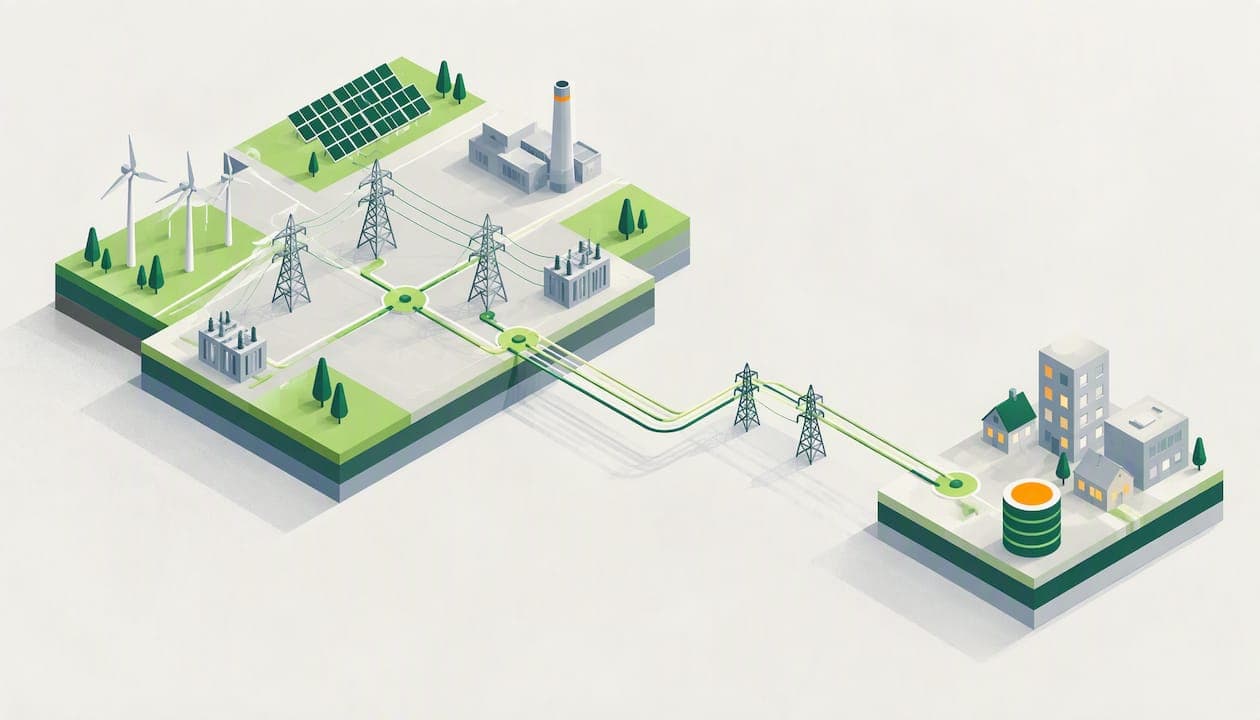
TNUoS stands for Transmission Network Use of System. It is the charge that pays for building, running and maintaining the high-voltage electricity grid, and it reaches your business as a line on your electricity bill. You do not pay it to the grid operator directly. Your supplier does, then passes it on. How much lands on your bill depends on where your sites are and, for half-hourly metered sites, on how much power you draw at the moments the system is busiest.
This guide covers what TNUoS pays for, who is charged, how the charge is built, the 2026/27 figures, and what you can and cannot do about it.
TL;DR
- TNUoS recovers the cost of the high-voltage transmission network in England, Wales, Scotland and offshore. It is set annually and applies from 1 April.
- Generators and suppliers are billed. Suppliers pass the cost to you as a non-commodity (non-energy) charge.
- For half-hourly sites, the locational part of the charge follows your demand during the three Triad half-hours between November and February. A residual part recovers the rest of the network revenue.
- You cannot remove TNUoS, but you can check it is billed correctly, understand your exposure and plan around it.
Table of Contents
- What TNUoS pays for
- Who actually pays TNUoS
- How the charge is built
- What a Triad is
- The 2026/27 figures
- Where to find TNUoS on your bill
- Our perspective
- Check your charges with a free plan
- What to do before the next April reset
- FAQ
- Sources
What TNUoS pays for
The electricity you use travels most of its journey on high-voltage lines, pylons, cables and substations before it reaches the local distribution network. Someone has to pay for that infrastructure. According to NESO's TNUoS page, TNUoS recovers the costs of installing, operating and maintaining the high-voltage transmission system in England, Wales, Scotland and offshore.
The money collected goes to the onshore transmission owners, the offshore transmission owners and other network schemes, as set out in NESO's TNUoS in 10 Minutes guide. For 2026/27, the same guide forecasts total TNUoS revenue of about £7.6 billion.
TNUoS is one of several network costs on a business bill. It covers the transmission grid only. The local wires that take power from the grid to your meter are paid for through a separate charge, which we cover in our guide to DUoS charges.
Who actually pays TNUoS
The charge is levied on two groups:
- Generators, charged on the highest level of Transmission Entry Capacity (TEC) they hold, which is their agreed capacity to export onto the grid.
- Suppliers, charged on the demand of the customers they serve.
This split is described in NESO's guide. As a business customer, you are not billed by NESO. Your supplier recovers its TNUoS cost from you, either as a separate line item or bundled into a fixed price.
That difference matters at contract time. On a fixed all-in rate, your supplier has priced TNUoS into the unit rate and carries the risk of it changing mid-term. On a flexible or pass-through contract, the charge arrives as it is set, and a tariff change on 1 April flows straight into your bill. Our piece on business energy tariffs explains how contract types handle these non-commodity costs and what to do if you find you have been overcharged.
How the charge is built
TNUoS is not one flat rate. Demand tariffs have two main building blocks, and the way they apply depends on how your site is metered.
The locational component
Transmission is more expensive to build and reinforce in some parts of the country than others. The methodology uses power flow models to work out how extra demand or generation in a given area changes flows across the network and the need for new investment, which is then reflected in zonal tariffs, according to NESO's final tariff report for 2026/27. The result is that the same amount of demand costs a different amount depending on your transmission charging zone.
The formal rules sit in Section 14 of the Connection and Use of System Code (CUSC), the industry code that governs how these charges are set.
The residual component
The locational part does not recover the whole network bill. A residual charge covers the remainder of the transmission owners' allowed revenue. In the 2026/27 final tariff report, the demand residual to be recovered is around £6.27 billion, and for many final demand sites it is charged in bands rather than by consumption. The four banded tariffs in that report run from roughly £1,402 to £20,829 a year depending on the band, so a site's band is a fixed cost that does not respond to how you operate day to day.
Half-hourly versus non-half-hourly
How the locational part is measured depends on your meter type:
| Meter type | How demand is measured | What it means for you |
|---|---|---|
| Half-hourly (HH) | Your metered demand across the three Triad periods | Your own behavior at a few critical half-hours drives the charge |
| Non-half-hourly (NHH) | Your annual consumption between 4pm and 7pm each day | The charge is averaged and pooled, so you have little control over it |
The measurement basis is set out in NESO's TNUoS in 10 Minutes. If you are unsure which category a site falls into, our guide to half-hourly meter checks shows how to confirm it and catch settlement mistakes.
What a Triad is
The Triads are the three half-hour settlement periods of highest system demand between November and February inclusive, separated by at least ten clear days, per NESO. They are only known after the winter has ended, which is the awkward part: you cannot know on a cold evening whether it will turn out to be a Triad.
For a half-hourly site, the locational charge is based on your demand across those three half-hours. A site that happened to run at full load in all three pays a lot more than an identical site that was ramped down. That is why some businesses with controllable load, such as batteries, standby generation or flexible process plant, try to reduce draw on likely peak winter evenings.
A practical way to think about it:
- Peaks are usually weekday winter evenings. Cold, dark early evenings are when national demand is highest.
- Your reduction only counts if it lands on the right half-hours. Cutting demand on the wrong evening saves nothing on TNUoS.
- Some load cannot move. A production line or a hospital ward cannot be switched off. The saving is for flexible load only.
Any load-shifting plan should be checked against your contract and your operational constraints before you act, and the decision belongs with whoever manages your site operations and your energy contract.
The 2026/27 figures
NESO publishes final tariffs by 31 January each year, and they take effect on 1 April, according to its TNUoS page. For 2026/27, NESO's final tariff report gives these averages:
| Item | 2026/27 |
|---|---|
| Forecast total TNUoS revenue | About £7.6 billion |
| Average gross half-hourly demand tariff | £2.79/kW |
| Average non-half-hourly demand tariff | 0.38p/kWh |
Treat these as averages across the country. Your own tariff depends on your zone, and the actual cost to your site depends on your Triad demand or your 4pm to 7pm consumption, plus your residual band. The figures also change every year, so confirm the current tariff set on NESO's page rather than relying on a number copied into an older article.
A worked example
Suppose a half-hourly site averages 400 kW across the three Triad half-hours, and the tariff that applies to its zone were £2.79/kW (the national average, used here only to show the arithmetic). The locational and residual elements differ in practice, but the sums look like this:
- 400 kW × £2.79/kW = £1,116 a year.
- If the site cut its Triad demand by 100 kW, to 300 kW, the same sum gives £837.
- That is a £279 difference, before the residual band and your supplier's own margin.
The example is illustrative, not a forecast. Your real tariff, zone and band will give a different number. The point is that the exposure scales directly with demand at those few half-hours, which is why accurate half-hourly data matters.
Where to find TNUoS on your bill
TNUoS is a non-commodity charge: it is not the cost of the electricity itself. On a business bill it typically shows up under a heading such as additional charges or electricity charges, and on some suppliers' invoices it carries a label naming the charge and the current price control period. If your contract is fixed all-in, it may be folded into the unit rate and not shown at all.
When you review a bill, look for:
- The charging year. A charge applied at last year's tariff after 1 April is a common error.
- The meter classification. A site billed as non-half-hourly that should be half-hourly, or the reverse, gets the wrong basis.
- The zone. Check that the site is assigned to the right area.
- Consistency across sites. If two similar sites in the same zone show very different TNUoS, find out why.
For the wider picture of how network costs sit alongside your unit rate and standing charge, see our explainer on standing charge versus unit rate. Taxes such as the Climate Change Levy are separate again.
Our perspective
Most finance and sustainability teams we speak to treat non-commodity charges as a block they cannot influence, and for the most part they are right: you cannot negotiate TNUoS away. But "cannot remove" is not the same as "cannot manage". Three things are within your reach.
First, accuracy. Network charges are applied by formula to your meter data, so a wrong meter class, a wrong zone or a stale tariff produces a wrong bill, and nobody notices unless something checks it line by line. That is the core of what we built: automated bill validation and anomaly detection, so a bill that does not match your half-hourly data gets flagged before it is paid.
Second, visibility. If you cannot see your half-hourly profile across a winter, you cannot say whether your Triad exposure is high or low, or whether a load-shifting project is worth the effort. Half-hourly analytics turn that from guesswork into a number.

Third, budgeting. Tariffs reset every April. A forecast built on half-hourly cost data, like the approach in our guide to energy cost forecasting, stops the April change from being a surprise.
We would rather you spend an hour understanding the structure than assume the charge is untouchable. Most of the savings we see discussed come from catching errors and acting on flexible load, not from clever tricks.
— Chris
Check your charges with a free plan
If you manage several sites, the hardest part of TNUoS is not the theory, it is checking every bill against the right meter data. EnerlyticsAI's free forever Starter plan lets you set up your sites and start validating bills at no upfront cost, with paid plans only if you need more: Eco at £49 per month, Growth at £79, Professional at £149 and Scale at £299. You can compare them on the pricing page, look at how bill checking works, or go straight to registration.
It works best alongside clean meter data, so if you are still sorting out access, read our guide to smart meter data access. Once you track network costs next to other indicators, our list of energy management KPIs shows what else is worth measuring.
What to do before the next April reset
A short routine keeps TNUoS from catching you out:
- Confirm each site's meter class (half-hourly or not) and its charging zone.
- Read your contract. Establish whether TNUoS is fixed or passed through, and when it can change.
- Review the published tariffs on NESO's page each winter, once the final figures are out by 31 January.
- Compare the first bills after 1 April against the new tariffs and your meter data.
- Identify flexible load and decide whether winter evening demand can be reduced without harming operations.
- Challenge errors in writing with your supplier and keep the evidence, as billing corrections are easier when you can show the data.
FAQ
What is TNUoS in simple terms?
It is the fee for using the high-voltage grid that carries electricity across Great Britain. It is paid by generators and suppliers, and suppliers pass their share on to business customers as a non-commodity charge on the bill.
Are TNUoS and DUoS the same thing?
No. TNUoS pays for the national high-voltage transmission network. DUoS pays for the regional distribution networks that deliver power to your premises. Both appear as non-energy costs, but they are set by different rules and different bodies.
Can a business avoid TNUoS charges?
No, the charge itself cannot be removed. What you can do is check it is billed on the right meter class, zone and tariff year, and, if you have half-hourly metering and flexible load, consider reducing demand during likely winter peak periods. Talk to your energy contract manager before changing how a site operates.
When do TNUoS tariffs change?
NESO publishes final tariffs by 31 January, and they take effect from 1 April each year. Check NESO's TNUoS page for the current year's figures.
How do I know if my site is half-hourly?
Your bill or supply contract normally states the meter profile class, and your supplier can confirm it. Half-hourly sites record demand every 30 minutes, which is what allows Triad-based charging.
Sources
- NESO: Transmission Network Use of System (TNUoS) Charges
- NESO: TNUoS in 10 Minutes
- NESO: Final TNUoS Tariffs for 2026/27