
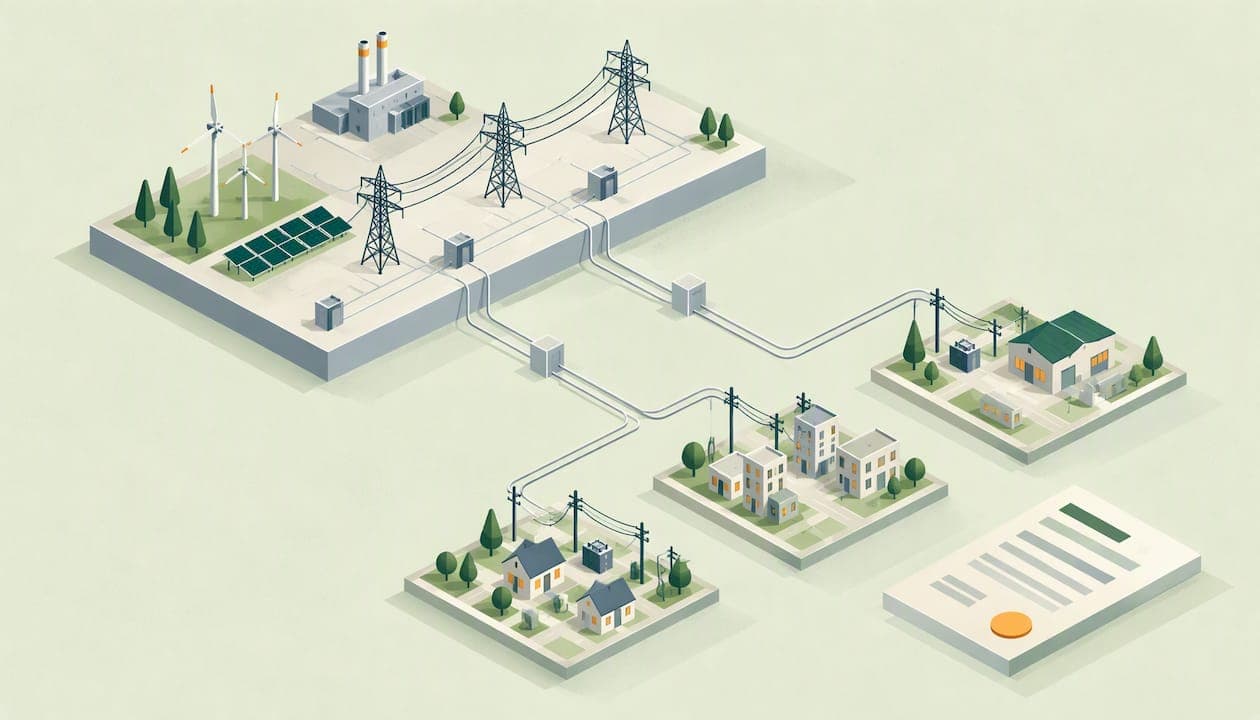
Distribution Use of System (DUoS) charges are the fees for moving electricity across your local network, from the national transmission system to your meter. Your Distribution Network Operator (DNO) sets them. Your supplier passes them on, and they usually appear on a business bill as a pass-through line or sit inside your rates. You can't switch them away, but you can understand them, check them and influence how much of them you trigger.
This guide explains what DUoS pays for, how a half-hourly bill builds the charge, what is changing under Ofgem's reforms, and how a finance or facilities team can spot errors and reduce exposure.
TL;DR
- DUoS charges recover the cost of running, maintaining and investing in the local electricity network. TotalEnergies puts them at roughly 10% to 15% of a typical electricity bill.
- Since the Targeted Charging Review, more of the charge sits in fixed daily amounts and less in variable unit rates, so consumption alone no longer drives the bill.
- Capacity (your Maximum Import Capacity, or MIC) is the lever most sites overlook. Set it too high and you overpay. Set it too low and excess capacity charges apply.
- From 1 April 2027, DUoS will apply to migrated sites from the point consumption is detected, even if a site is wrongly flagged as de-energised.
- Checking DUoS lines against half-hourly data each month is the practical way to catch billing errors.
Table of Contents
- What DUoS charges pay for
- How a half-hourly business bill builds the DUoS charge
- Fixed charges and the Targeted Charging Review
- What is changing: Ofgem's DUoS reform
- DUoS for generators: sometimes a credit
- Perspective: what we see in DUoS lines
- How to check your DUoS charges: a practical routine
- Why DUoS matters more for multi-site operators
- Where EnerlyticsAI fits
- A note on household figures
- FAQ
- Sources
What DUoS charges pay for
The electricity you buy travels over two kinds of network. High-voltage transmission carries it long distances. Regional distribution networks, run by DNOs, take it the last stretch to homes, factories and offices. DUoS is how those regional networks get paid.
According to SSEN's explainer on DUoS, the charges apply to every connection to the distribution network. They collect the revenue the distribution licensee needs to build, operate, maintain, repair and invest in that network. TotalEnergies describes the same cost base: maintenance, repairs and investment in each region's network.
Two consequences follow:
- The charge depends on where you are. Each DNO region publishes its own tariffs, so two identical sites in different regions can pay different amounts.
- You pay for the network whether or not you use much energy. A growing share of the charge is fixed, as explained below.
Where DUoS sits among other bill components
A business electricity bill has several layers. The energy itself is the wholesale and supplier cost. Then come network charges (DUoS for the local network, TNUoS for transmission), policy levies and tax. NESO's Transmission Demand Residual guidance describes TNUoS as the charge all users of the GB electricity network pay to use it. Climate Change Levy is a separate tax; our note on UK Climate Change Levy rates covers what finance teams should check each April.

If you want the same logic applied to the simpler fixed-versus-variable split on a bill, see our piece on standing charge versus unit rate.
How a half-hourly business bill builds the DUoS charge
Larger sites are settled half-hourly: the meter records consumption every 30 minutes, and the charge is calculated from that profile rather than from an estimate. Our guide to half-hourly meter checks explains why that data matters for billing accuracy.
DUoS for these sites is typically made of four building blocks.
| Component | What it is | What drives it |
|---|---|---|
| Unit rates by time band | A pence-per-kWh charge that varies by time of day (Red, Amber and Green periods) | When you consume, not only how much |
| Fixed daily charge | A standing amount per day | Your tariff and your residual charging band |
| Capacity charge | A pence-per-kVA-per-day charge on your agreed capacity | Your Maximum Import Capacity (MIC) |
| Excess capacity charge | A penalty rate when you go above your MIC | Peaks above the agreed limit |
The exact rates, time windows and tariff names differ by DNO and by charging year, so the right figures always come from your DNO's published charging statement and your supplier's bill. National Grid's guidance on DUoS for low and high voltage connections shows the structure: the tariff applied depends on the maximum energy you import, and charges are layered by voltage level.
Time bands: why 4pm on a weekday costs more than 3am
The time-band design exists to send a signal. Network capacity is sized for the busiest periods, so consumption in those periods costs more than the same kWh overnight. The Red band is the expensive peak, Amber is the shoulder, and Green is the cheapest. A site that runs a large compressor, a kiln or a charging bay during the Red band pays more than an identical site that shifts the load.
This is where the difference between baseload and peak load becomes a money question. Baseload is the steady floor your site draws all day. Peak load is the spikes. Time bands and capacity charges both punish the spikes more than the floor.
Capacity and the MIC trap
Your Maximum Import Capacity is the amount of power your connection is agreed to draw. It is charged daily whether you use it or not. TotalEnergies notes that many businesses still pay for a high MIC set years ago that no longer matches their needs.
Reducing it can cut ongoing capacity charges, but there are two risks:
- If you exceed the lower limit, you may incur excess capacity charges.
- If you later need the higher capacity back, you might have to pay for network reinforcement.
So do not cut capacity on a hunch. Look at at least a full year of half-hourly demand, including the coldest week and any seasonal production peak, then compare the true maximum with your MIC. A new heat pump, a fleet of electric vans or a second production shift can change that maximum quickly. Our look at EV charging load and fuse checks shows how fast a few chargers can reshape a 30-minute profile.
Excess capacity charges are the other expensive surprise. A 2018 guide to DCP 161 is not something we can cite for rates, so check your current DNO statement rather than assuming a multiple of the standard rate.
Fixed charges and the Targeted Charging Review
Since the 2022/23 charging year, the Targeted Charging Review has moved a larger proportion of network costs from variable unit rates into fixed daily charges for most non-domestic customers, according to TotalEnergies' DUoS guide. The fixed amount depends on your site's residual charging band, which is based on voltage level and consumption patterns.
The practical effect: cutting kWh still saves energy cost, but it saves less DUoS than it used to. The fixed element does not shrink when you consume less.
There is one piece of good news for planning. Network operators treat residual bands as locked for the length of a price control period. For the RIIO-3 period, 2026/27 to 2030/31, NESO's guidance on the transmission demand residual is consistent with a static band, which gives a measure of predictability. Unit rates and capacity charges still change each year through methodology updates and inflation adjustments.
What is changing: Ofgem's DUoS reform
DUoS is under review. Ofgem descoped DUoS from the wider Access and Forward-Looking Charges review in 2022 and launched a dedicated DUoS Significant Code Review. Its stated aim is for electricity networks to be used efficiently and flexibly, reflecting users' needs, in preparation for Clean Power 2030.
What does that mean for a business budget?
- Expect methodology to keep moving. Forecasting DUoS has become harder because of inflation, tax changes and methodology shifts, according to TotalEnergies. Build a range into budgets, not a single number.
- Expect stronger signals for flexibility. Charges are meant to influence behavior, so load that can move is likely to be rewarded over time.
- Don't assume final rules. Reform is a process. Check Ofgem's page for the latest position before you commit to a long-term investment case that depends on a particular charge design.
Our article on half-hourly energy cost forecasting covers how to turn that uncertainty into budget ranges.
The April 2027 change for de-energised sites
Ofgem approved modification DCP440, and the practical change lands on 1 April 2027. Today, a site wrongly flagged as de-energised in industry systems can avoid DUoS even while it consumes power. Under DCP440, for sites migrated to Market-wide Half Hourly Settlement, charges will apply from the point consumption is detected regardless of the flag.
If you run a portfolio with closed, vacant or newly acquired premises, audit the status of each meter now. A site that looks dormant on paper but draws power could generate backdated-looking charges once the new rule bites.
DUoS for generators: sometimes a credit
DUoS is not only a cost. Sites that export power can earn credits. National Grid's DUoS guidance shows that generators exporting during peak demand (Red) periods can receive credits, which depend on time of day. For a business with on-site solar or a battery, that makes the timing of export a revenue question and not only a technical one.
Perspective: what we see in DUoS lines
We build our platform around bill validation and half-hourly analytics, so we look at network charges more closely than most teams do. Our view is simple: DUoS is the part of a business bill that is easiest to accept and hardest to verify.
It arrives as a pass-through, so finance teams often assume it is correct. But it is calculated from meter data, a capacity figure, a band and a tariff. If any of those inputs is wrong, the charge is wrong, and nobody questions it because it looks regulated.
Three habits would improve most businesses' position:
- Reconcile capacity yearly. Compare your MIC with your measured maximum demand, and do it before any site change, not after.
- Read the bill by component. Separate fixed, time-band and capacity elements so that a change in one is visible.
- Treat unusual spikes as questions. A single half-hour that triggers an excess capacity charge is worth investigating: was it a real load, a faulty meter reading or a one-off commissioning test?
We also think the coming reform rewards teams that already hold clean half-hourly data. Whatever design Ofgem lands on, the sites that can show when they use power will be the sites that can respond to it.
— Chris
How to check your DUoS charges: a practical routine
You don't need to be a network specialist. A monthly routine catches most issues.
- Collect the right documents. You need the supplier bill, your half-hourly data and your DNO region. If you lack access to your meter data, our guide to smart meter data access options sets out the routes.
- Confirm your DNO region and voltage level. A wrong region or voltage assignment changes every rate.
- Compare MIC with measured demand. If your highest 30-minute peak is far below your MIC across a full year, ask your supplier or DNO what reducing it would cost and risk.
- Look for excess capacity lines. Match any such charge to a specific half-hour in your data.
- Check the bands applied. Make sure your fixed daily charge matches the residual band you were assigned.
- Check site status. Look for sites flagged as de-energised that are actually drawing power, ahead of April 2027.
- Log disputes with evidence. Raise errors with your supplier, with the half-hourly data attached. Our note on recovering historic overcharges on business tariffs covers how far back claims can go.
Reducing exposure without guessing
Once the bill is clean, there are three levers worth testing:
- Shift flexible load out of the Red band: pre-cooling, batch processes, charging.
- Flatten peaks so that no single half-hour sets your capacity need.
- Right-size capacity only after reading a full year of data.
Each has a cost and a risk. Shifting load may disrupt operations. Flattening peaks may need controls or storage. Right-sizing capacity carries the reinforcement risk described above. Test with data first.
Why DUoS matters more for multi-site operators
A single site can eyeball a bill. A portfolio cannot. With ten or fifty sites across several DNO regions, the same business faces different tariffs, bands and capacity agreements at every address. Errors hide in the spread: one site with an inflated MIC, another with a stale status flag, a third billed in the wrong band.
Sustainability and finance teams also have a shared interest. Half-hourly profiles that expose DUoS inefficiencies are the same profiles that feed carbon reporting. If you are building a decarbonization case, our piece on heat decarbonization planning from meter data shows how one data set serves both purposes.
Where EnerlyticsAI fits
EnerlyticsAI is a platform for UK businesses that checks energy bills automatically, flags anomalies and analyzes half-hourly consumption across multiple sites. That is the data you need to test the routine above: bill validation to compare what you were charged with what your usage supports, and half-hourly data to see the peaks that drive capacity and time-band charges.
The Starter plan is free forever, so you can load your sites and look at your bills before spending anything. Create a free account to start. Paid plans run from Eco at £49 per month to Growth at £79 per month, Professional at £149 per month and Scale at £299 per month, for teams whose needs outgrow the free tier.
A note on household figures
Readers sometimes arrive here after searching household price questions. Those are a different market. Ofgem's cap for 1 October to 31 December 2026 shows an average electricity unit rate of 26.32p per kWh and a daily standing charge of 54.83p, and VAT is removed from household electricity from 1 October 2026. Those apply to domestic default tariffs. Business contracts are priced differently, and DUoS is a network cost that sits underneath both.
FAQ
What is DUoS?
DUoS stands for Distribution Use of System. It is the charge your local network operator makes for carrying electricity across its regional network to your premises. Suppliers pay it and pass it on to you, usually as a pass-through item or built into your rates.
How much of my electricity bill is DUoS?
TotalEnergies says DUoS typically represents about 10% to 15% of a customer's electricity cost. Your own share depends on your region, voltage level, capacity and consumption pattern. Check the component lines on your bill for the real figure.
Can I avoid DUoS charges?
No. DUoS applies to every connection to the distribution network. What you can influence is how much you trigger: by shifting load out of peak periods, avoiding excess capacity and keeping your MIC in line with real demand. Generators exporting at peak times can earn credits.
Are third-party charges on my energy bill the same as DUoS?
Not exactly. Third-party charges is a broad label that usually covers network costs (DUoS and TNUoS), levies and other pass-throughs your supplier does not control. DUoS is the local-network part of that group. Ask your supplier for an itemized breakdown if your bill bundles them.
Will DUoS charges change soon?
Yes, the framework is under review. Ofgem is running a dedicated DUoS Significant Code Review, and a rule change on 1 April 2027 affects sites migrating to half-hourly settlement. Budget with a range and watch your DNO's annual charging statement.
Sources
- TotalEnergies: Changes to DUoS
- SSEN: What are DUoS charges
- NESO: Transmission Demand Residual guidance
- National Grid: DUoS charging for LV and HV
- Ofgem: DCP440 DCUSA changes
- Ofgem: DUoS Significant Code Review update
- Ofgem: DUoS Significant Code Review launch
- Ofgem: energy price cap unit rates and standing charges
- GOV.UK: Breathing space on your energy bill