
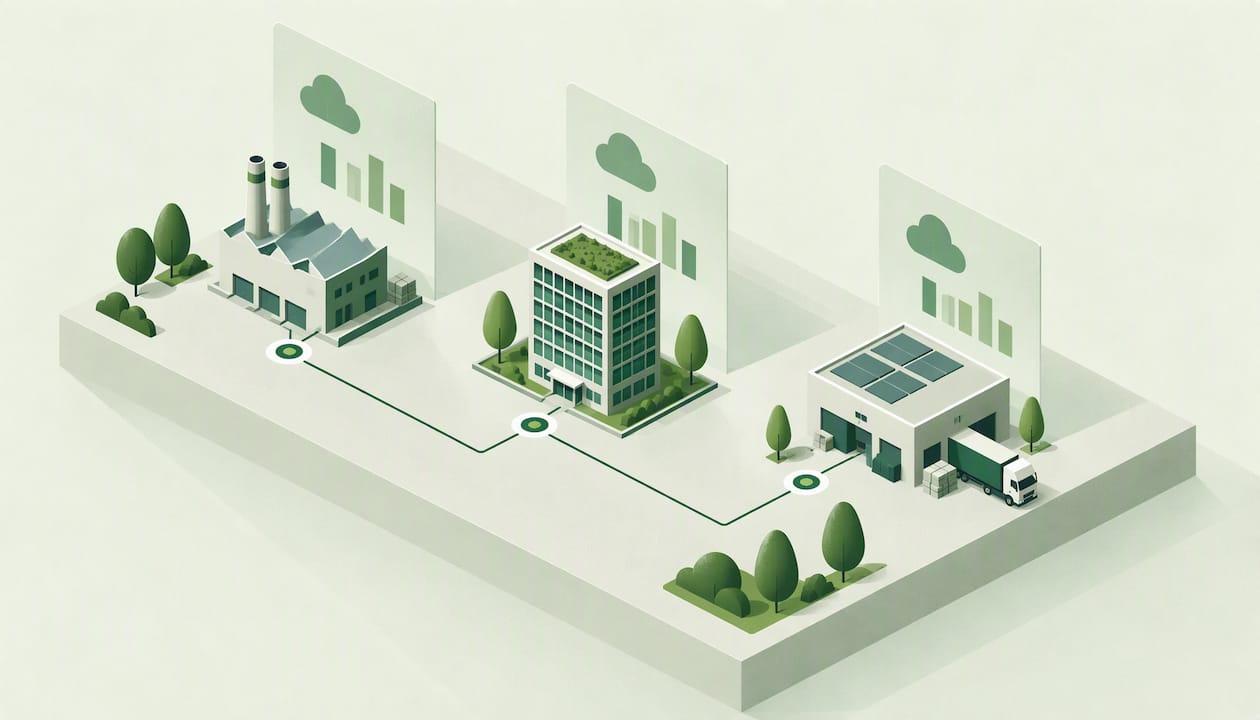
Carbon footprint tracking means collecting your energy, fuel and travel data on a regular schedule, converting it into tonnes of CO2e with government emission factors, and comparing the result with a baseline. Do that monthly rather than once a year and the numbers stop being a reporting chore. They become a way to find waste, check bills and show progress toward a net-zero target. This guide covers what to collect, how the calculation works, which rules apply in the UK and how to run it across several sites.
TL;DR
- Tracking is a repeatable loop: gather activity data (bills, meter readings, fuel, travel), multiply by emission factors, total the result and compare it with a baseline.
- Scope 1 and 2 come first. Scope 3 is largely voluntary for most UK organizations, but customers increasingly ask for it.
- SECR makes energy and carbon reporting mandatory for quoted companies, large unquoted companies and large LLPs. Smaller firms can still track voluntarily.
- Half-hourly data and validated bills make tracking more accurate, and they also show where the money is going.
- Our free Starter plan lets you begin tracking multiple sites at no cost.
Table of Contents
- What carbon footprint tracking actually is
- The calculation behind every footprint
- Scope 1, 2 and 3: what goes where
- What data to collect across multiple sites
- Which UK rules apply to you
- From tracking to savings
- Using tracking to measure progress toward net zero
- Our perspective
- Choosing a plan and getting started
- A simple 30-day setup plan
- FAQ
- Sources
What carbon footprint tracking actually is
A footprint is a snapshot. Tracking is the habit of taking that snapshot repeatedly so you can see movement. Energy Systems Catapult describes carbon accounting as measuring and allocating greenhouse gases emitted within defined spatial and temporal boundaries, which is useful for inventories, corporate environmental reports or the footprint of a product or service. The boundaries matter. Before you collect anything, decide which legal entity, which sites and which period you are measuring.
The same report argues that consistent, coherent monitoring, reporting and verification are needed to account for emissions accurately. In practice, that means the same method each period, so that a change in your number reflects a change in your operations rather than a change in how you counted.
A "carbon footprint tracker" is therefore any system that does three jobs:
- Collects activity data from every site and fleet.
- Converts it into CO2e using the right factors.
- Stores results against a baseline so you can see trends.
A spreadsheet can do this for one small site. Once you have several sites, multiple energy suppliers and monthly bills that arrive in different formats, the collection step is where most of the effort and most of the errors sit.
The calculation behind every footprint
The core formula is simple. Defra's small business guide explains that you multiply activity data by an emission factor, and the government conversion factor spreadsheets turn your inputs into kilograms of CO2e. The British Business Bank gives the same logic as data multiplied by an emission factor equals greenhouse-gas emissions, then adds the results together.
A worked example, using placeholder numbers to show the mechanics:
| Activity data | Unit | Emission factor | Result |
|---|---|---|---|
| Annual gas use at a site | kWh | Gas factor from the current government conversion factors | kg CO2e |
| Annual grid electricity | kWh | Electricity factor (location-based) | kg CO2e |
| Diesel in company vehicles | litres | Diesel factor | kg CO2e |
| Business flights | passenger-km | Flight factor for the haul type | kg CO2e |
The factors change. The UK government updates its greenhouse gas conversion factors every year, so a number calculated with last year's factors is not comparable with this year's unless you document the difference. Our guide to choosing the right emissions factor worksheet explains why the worksheet names matter when someone audits your figures.
Scope 1, 2 and 3: what goes where
The Office for National Statistics sets out the split. Scope 1 covers direct emissions from sources you own or control. Scope 2 covers indirect emissions from generating the energy you buy. Scope 3 covers other indirect emissions from producing and transporting goods and services, including the wider supply chain.
For a typical UK business:
- Scope 1: gas for heating and process, fuel in company-owned vehicles, refrigerant leaks from equipment you own.
- Scope 2: purchased electricity, and purchased heat or steam.
- Scope 3: purchased goods, waste, business travel, employee commuting, leased assets, transport and distribution, and more.
For manufacturers, recyclers and fleet operators, Scope 1 is often large and visible. For office-based firms, Scope 3 usually dominates but is harder to measure. If you are starting out, get Scope 1 and 2 right first, then add Scope 3 category by category. Two of our guides help with the harder parts: tracking all 15 Scope 3 categories and cutting business travel emissions. If you lease buildings or equipment, start by classifying leased asset emissions before you decide which scope they fall into.
What data to collect across multiple sites
The Defra guide says businesses normally measure emissions over a 12-month period, which you can align with your accounting period. The British Business Bank lists the records to gather: electricity, gas and water bills, travel data and fuel receipts.
For each site, build a simple register:
- Meters: MPAN and MPRN numbers, supplier and tariff.
- Bills: consumption in kWh per billing period, not just the cost.
- Half-hourly readings: where a half-hourly meter is fitted, these show when you use energy, not only how much.
- Fuel: litres bought per vehicle or per site, from fuel card statements or receipts.
- Travel: distance, mode and, for flights, the haul type.
- Refrigerants and process gases: top-ups recorded by your maintenance contractor.
What if some data is missing? A 2025 report on carbon accounting data management notes that when primary data is unavailable or inadequate, organizations may use secondary data such as spend-based metrics or industry averages. That is a reasonable starting point for a hard-to-measure Scope 3 category, as long as you label it as an estimate and replace it with primary data when you can.
Where bill errors distort the footprint
Carbon tracking built on bills is only as accurate as the bills. A misread meter, an estimated reading that never gets corrected or a duplicated charge changes both your cost and your reported emissions. This is why we built bill validation into the platform: it is designed to check bills against your consumption and flag anomalies, so your carbon figures and your finance figures rest on the same checked data. Finance teams can also check the Climate Change Levy rates on their April bills against what suppliers actually charged.
Which UK rules apply to you
Is carbon reporting mandatory? It depends on your size and structure.
Under Streamlined Energy and Carbon Reporting (SECR), quoted companies, large unquoted UK companies and large LLPs must report energy and carbon information. An unquoted company or LLP counts as large if it meets at least two of three criteria: 250 employees, turnover above £36 million, or a balance sheet total above £18 million.

The 2026 post-implementation review describes what each group discloses: quoted companies report UK and global energy use and emissions, while large unquoted companies and LLPs disclose UK energy use and associated emissions, including a small amount of Scope 3 business travel. The same document notes that errors in required disclosures can lead to penalties, including resubmitting accounts.
Academy trusts have their own guidance. Those that do not consume more than 40,000 kWh in a reporting period count as low energy users and can be exempt if their report includes a statement to that effect.
Scope 3 is a different story. The government's Scope 3 call for evidence says Scope 1 and 2 disclosures are required for some of the largest UK organizations, while Scope 3 remains largely voluntary. Voluntary does not mean irrelevant: larger customers often ask suppliers for the data.
Companies can file SECR data digitally too. The SECR taxonomy lets companies report energy and carbon data in XBRL alongside digital accounts filed with Companies House. For the disclosure checklist, see our board playbook for SECR, our carbon reporting basics and our note on CSRD carbon reporting for UK businesses.
From tracking to savings
The financial case is the part that persuades a finance director. Defra says measuring emissions helps you identify energy-intensive activities, reduce energy and resource use and save money, and also helps you answer customer information requests.
The government's energy savings guide makes a related point about projects: monitoring and verifying performance helps you identify and fix problems early, track results against objectives and provide evidence for future investment. Tracking is how you prove that a boiler upgrade or a new shift pattern worked.
Good places to look first:
- Out-of-hours load. Half-hourly data shows what runs overnight and at weekends. A site whose night-time baseline is close to its daytime peak is a candidate for a quick audit.
- Heating plant. Compare gas use against degree days or production to spot a declining boiler; our guide to boiler efficiency tracking with half-hourly data shows how.
- Site comparisons. Two similar sites with very different kWh per square meter point to a controls or behavior problem at one of them.
- Billing anomalies. Sudden jumps in cost without a matching jump in consumption suggest a billing error rather than a usage issue.
If you are planning to move away from gas, a heat decarbonization plan starts from exactly this metered data.
Using tracking to measure progress toward net zero
A target such as net zero by 2030 needs a starting point and a way to check you are on course. The UK Business Climate Hub recommends using a detailed emissions inventory as your baseline, prioritizing hotspots with high emissions or costs, setting SMART KPIs and regularly comparing results with the baseline to stay accountable.
A workable routine looks like this:
- Fix the baseline year and record the method, factors and boundaries you used.
- Rank your hotspots by tonnes of CO2e and by cost. Where the two overlap, act first.
- Set KPIs such as kWh per unit produced, kg CO2e per vehicle-km or night-time baseload per site.
- Review monthly. Compare against the baseline and against the same month last year, adjusting for weather and output.
- Recalculate the baseline if you acquire a site, close one or change your boundaries, and say so in your report.
The monthly rhythm is the main advantage of tracking over an annual calculation. By the time an annual footprint is complete, the opportunity to fix a leak or a wasteful schedule has already cost you twelve months of waste.
Our perspective
Most UK businesses we speak to do not struggle with the carbon formula. They struggle with getting clean data from many sites on time. Bills arrive late, estimated reads go uncorrected, and the person who owns the meter is not the person who writes the report.
That is why we start with the bill. If the bill is validated and the half-hourly profile is visible, the Scope 2 number follows from data you can trust, and the same data tells the finance team where money is leaking. Anomaly detection is designed to surface the oddities early, while they are still easy to query with a supplier.
We also think cost should not be the barrier to starting. Our Starter plan is free forever and lets you manage multiple sites, so a sustainability manager can build a baseline before asking for any budget. When the need grows, paid plans add capacity, and you decide when that moment arrives.
Our advice: start with Scope 1 and 2 at every site, track monthly, and add Scope 3 categories one at a time as your data improves.
Chris
Choosing a plan and getting started
Our platform brings bill validation, anomaly detection, half-hourly analytics and Scope 1, 2 and 3 carbon reporting into one web interface for UK businesses. You can create a free Starter account at £0 and begin loading sites straight away.
When you need more, the paid plans are published at these monthly prices: Eco at £49 per month, Growth at £79 per month, Professional at £149 per month and Scale at £299 per month. Start free and move up only if your sites and reporting needs outgrow Starter. Inside the platform, the Sites, Bills and Half Hourly Data areas are where most tracking work happens, and you can see more at EnerlyticsAI.
A simple 30-day setup plan
If you want a practical first month, use this order:
- Week 1: list every site, meter and vehicle. Decide the reporting boundary and baseline period.
- Week 2: gather twelve months of bills and fuel records. Flag estimated reads and missing months.
- Week 3: calculate Scope 1 and 2 with the current government conversion factors, and record which factor set you used.
- Week 4: identify your top three hotspots, set one KPI for each and schedule a monthly review.
Once that works, add Scope 3 categories, starting with business travel and waste, which are usually the easiest to source.
FAQ
What is a carbon footprint tracker?
It is a tool or process that collects activity data such as energy use, fuel and travel, converts it to CO2e with emission factors, and records results over time. Unlike a one-off calculator, it keeps the history so you can compare periods and measure progress against a baseline.
Is carbon reporting mandatory for UK businesses?
For some, yes. SECR applies to quoted companies, large unquoted companies and large LLPs. Smaller businesses are not covered by that duty, but many track anyway to cut costs and answer customer questions. Check the current guidance on GOV.UK or ask your accountant if you are near the thresholds.
How often should I track my footprint?
Measure over a 12-month period for your headline figure, but update the underlying data monthly. Monthly tracking catches billing errors and energy waste while you can still act on them.
Do I need to include Scope 3?
For most UK organizations Scope 3 remains largely voluntary, according to the government's Scope 3 call for evidence. Start with Scope 1 and 2, then add categories such as business travel as your data allows, especially if customers request them.
Sources
- Carbon Accounting in Industry (Energy Systems Catapult)
- Small Business User Guide: how to measure and report your greenhouse gas emissions (Defra)
- Carbon accounting: recommendations for data management (Digital Catapult)
- How to measure your carbon footprint (British Business Bank)
- Measuring UK greenhouse gas emissions (Office for National Statistics)
- Environmental reporting guidelines including SECR (GOV.UK)
- New digital tool enables easier energy and carbon reporting (GOV.UK)
- SECR for academy trusts (GOV.UK)
- 2026 post-implementation review of the SECR regulations 2018
- UK greenhouse gas emissions reporting: Scope 3 emissions (GOV.UK)
- A Guide to Implementing Energy Savings Opportunities (DECC)
- Measure your carbon emissions (UK Business Climate Hub)