
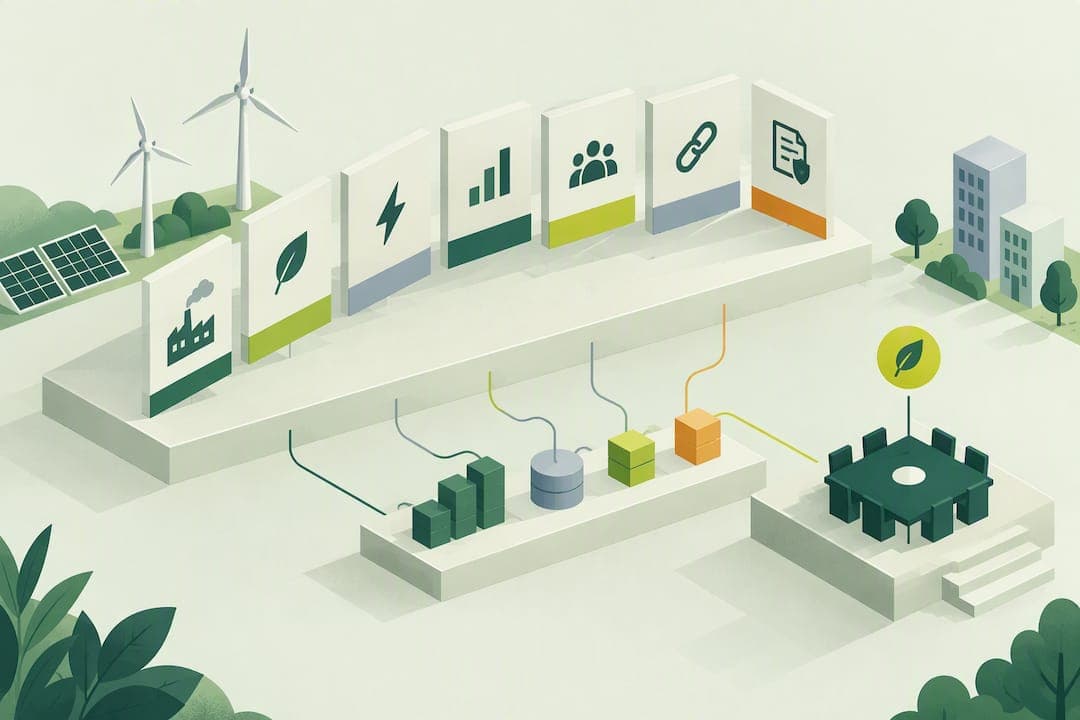
If your company is quoted, or meets any two of the SECR size tests, your Directors' Report must publish total energy use, Scope 1 and Scope 2 emissions, at least one intensity ratio, and a narrative on energy-efficiency actions taken during the year. Miss the boundary call or the methodology note, and auditors will flag it before Companies House ever does.
TL;DR:
- Quoted companies and large unquoted firms meeting at least two SECR thresholds must publicly disclose energy use, emissions, and energy-efficiency actions, with some exemptions for low-energy users.
- Data collection should start with clear boundary setting and detailed documentation, including supplier bills, meter data, and consistent application of conversion factors to ensure audit readiness.
- Auditors perform mainly consistency checks on prior-year comparisons, supporting invoices, and methodology notes, so maintaining a robust paper trail is essential for compliance.
- The SECR reporting deadline coincides with the company's annual accounts, and late submissions carry reputational risks, even though enforcement remains light.
- Platforms like EnerlyticsAI can automate data gathering, validation, and emissions calculations, easing manual effort but not replacing the need for procedural discipline in boundary decisions and methodology documentation.
Table of Contents
- Who Has to Comply With SECR Reporting Requirements?
- What Are the Seven Mandatory SECR Disclosures?
- How Do You Collect the Data for SECR Carbon Reporting?
- When Is SECR Reporting Due, and What Do Auditors Check?
- What Exemptions and Mistakes Should You Watch For?
- How EnerlyticsAI Supports SECR Reporting Requirements
- A Practical SECR Playbook Directors Actually Need
- Get SECR-Ready Reports Without the Manual Data Chase
- Where to Verify SECR Requirements Before Board Sign-Off
- Sources
- FAQ
Who Has to Comply With SECR Reporting Requirements?
Two groups fall under SECR: quoted companies of any size, and large unquoted companies or LLPs that meet at least two of three tests: £36 million turnover, £18 million balance sheet total, or 250 employees. These thresholds live in the SECR regulations themselves and don't automatically shift when Companies Act size categories change, which is why an organization can qualify as "medium" for accounts purposes while still sitting squarely inside SECR's scope.
Quoted companies report worldwide energy and emissions. Unquoted companies and LLPs report UK energy use plus transport fuel only, a distinction that trips up groups with overseas subsidiaries almost every year.
A few scope details worth locking down early:
- The low-energy-user exemption applies if annual consumption is 40,000 kWh or less, roughly the usage of a small office. You still must state that you're claiming it.
- Group reporting allows a parent to file one consolidated SECR disclosure covering in-scope subsidiaries, provided the boundary is clearly stated.
- The two-year rule means once you cross the threshold, you generally stay in scope even if the following year's numbers dip below it.
- Subsidiary exemptions exist in limited circumstances, but they need explicit documentation, not assumption.
What Are the Seven Mandatory SECR Disclosures?
Once you know you're in scope, the checklist itself is short but unforgiving on detail. The post-implementation review of the SECR regulations confirms seven core elements, and skipping any one of them is the most common reason boards get pulled back into a report before sign-off.
Pro Tip: Build your methodology statement before you calculate a single figure. Deciding your boundary and conversion factors up front stops you from redoing the math twice.
- Total energy consumption in kWh — unquoted reporters break this into electricity, gas, and transport fuel.
- Scope 1 and Scope 2 emissions in tCO2e, using the location-based method for Scope 2; quoted companies may add a market-based figure as a supplementary note.
- At least one intensity ratio, such as tCO2e per £m turnover, per full-time employee, or per square meter of floor space. There's no prescribed ratio, only a requirement that it fits the business and stays consistent year over year, according to SECR's own guidance on thresholds and disclosures.
- A methodology statement naming the calculation approach (usually the GHG Protocol), the year's DESNZ conversion factors, and any material assumptions.
- Prior-year comparatives, required from your second reporting year onward.
- An energy-efficiency narrative describing actions taken during the year, from LED retrofits to fleet electrification.
- Any exemption statements, such as low-energy-user status or a documented "not practicable to obtain" gap.
Voluntary Scope 3 disclosure, especially business travel, isn't mandatory under SECR but increasingly expected by investors who read the report alongside broader ESG disclosures.
How Do You Collect the Data for SECR Carbon Reporting?
Start by fixing your reporting boundary and naming who owns each data stream. Vague ownership is the single biggest reason SECR data collection drags into the final weeks before filing.
From there, the sequence is fairly linear:
- Pull half-hourly meter data and supplier bills for electricity and gas.
- Gather fleet fuel logs and any transport fuel receipts.
- Check estates or landlord-supplied meters for shared buildings, which are easy to miss.
- Map each activity to Scope 1 (direct combustion, owned vehicles) or Scope 2 (purchased electricity).
- Apply the current year's DESNZ conversion factors consistently across every site.
- Calculate your intensity ratio and draft the methodology note alongside it.
Pro Tip: Keep a version-controlled spreadsheet or system export that shows exactly which factor set and boundary assumptions you used. Auditors ask for this trail far more often than they ask for the final number.
Where a genuine data gap exists, say a landlord won't release submeter readings, document the request, the refusal, and your estimation method. That paper trail is what separates a defensible "practicable to obtain" claim from a guess.
When Is SECR Reporting Due, and What Do Auditors Check?
SECR has no standalone filing. Your energy and carbon disclosures go inside the Directors' Report or, for LLPs, the Energy and Carbon Report, and they follow the same Companies House deadline as your annual accounts. Late accounts mean a late SECR disclosure by default.
Auditors typically run a consistency check rather than a full assurance exercise. Expect requests for:
- The prior year's report, to confirm comparatives line up.
- Invoices or meter data supporting the kWh total.
- The methodology note, checked against the conversion factors actually used.
Enforcement under the statutory instrument itself is light-touch, but a sloppy or inconsistent report still carries real reputational risk with investors and lenders who read these disclosures as a proxy for governance quality.
What Exemptions and Mistakes Should You Watch For?
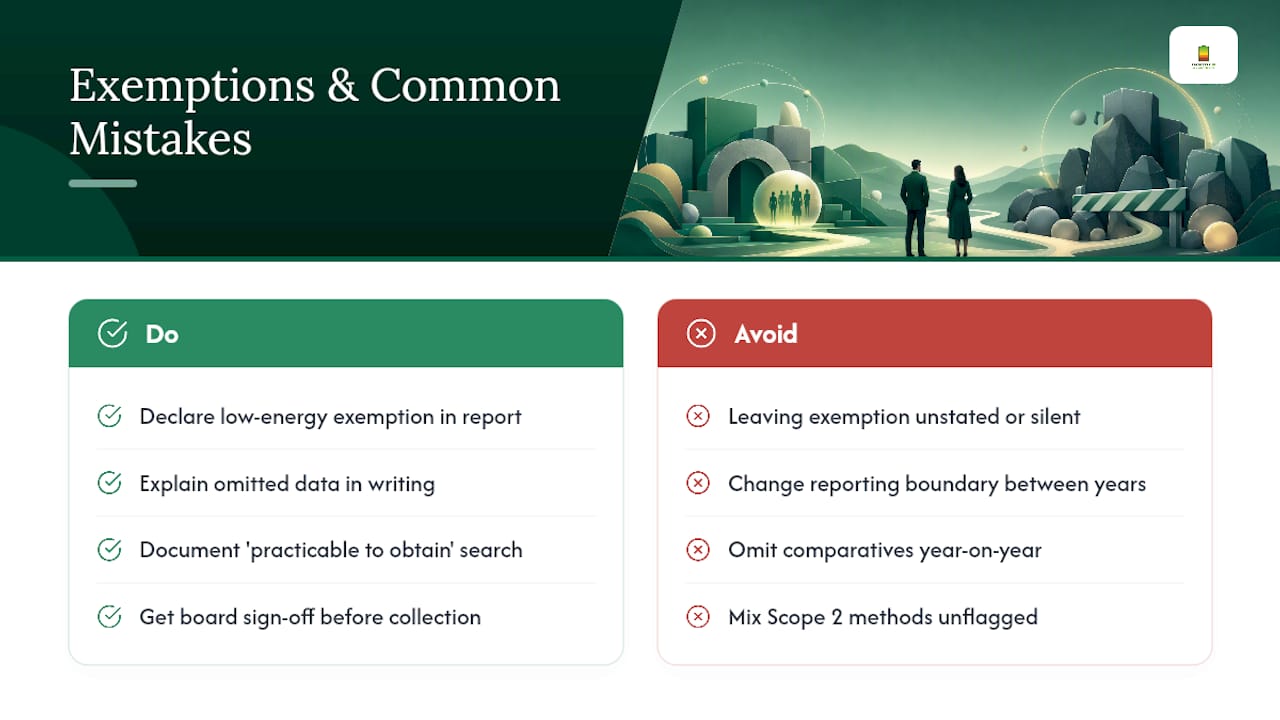
The low-energy-user exemption (40,000 kWh or below) is the cleanest way out of full reporting, but it still requires a stated declaration, not silence. The "practicable to obtain" and "seriously prejudicial" limbs cover genuine data gaps or commercially sensitive figures, and both need a written explanation of what was omitted and why.
Pro Tip: If you're relying on "practicable to obtain" in year one, document your search process now. Reviewers found that reporters who kept that record faced far less auditor friction in later years.
Common pitfalls include shifting reporting boundaries between years, missing comparatives, an unclear or unstated methodology, and mixing Scope 2 calculation methods without flagging it. The fix is usually procedural: get board sign-off on the boundary before data collection starts, and loop in auditors early rather than at the eleventh hour.
How EnerlyticsAI Supports SECR Reporting Requirements
Most of the manual grind in SECR compliance comes from chasing meter data, cross-checking bills, and reconciling numbers across sites. Enerlytics AI's half-hourly consumption analytics and automated bill validation build the kWh totals and flag anomalies before they become a methodology headache.
The platform's emissions reporting covers Scope 1, 2, and 3, giving you the tCO2e figures and a consistent basis for your intensity ratio. Site-level dashboards let multi-site organizations consolidate group data without spreadsheet gymnastics, and the Reports exports are structured to hand an auditor exactly what they'll ask for: the underlying data, the conversion basis, and the year-over-year comparison.
A Practical SECR Playbook Directors Actually Need
Most SECR advice treats the regulation as a compliance chore to hand off to finance. That's backwards. The post-implementation review found the regime drove real energy savings, and the mechanism behind that isn't the disclosure itself. It's board visibility. Once energy numbers sit in the Directors' Report, someone with budget authority reads them.
The conventional advice, get the numbers, file them, move on, misses where the actual risk sits: inconsistent boundaries between years and undocumented methodology choices. Both are avoidable with basic version control, not extra headcount.
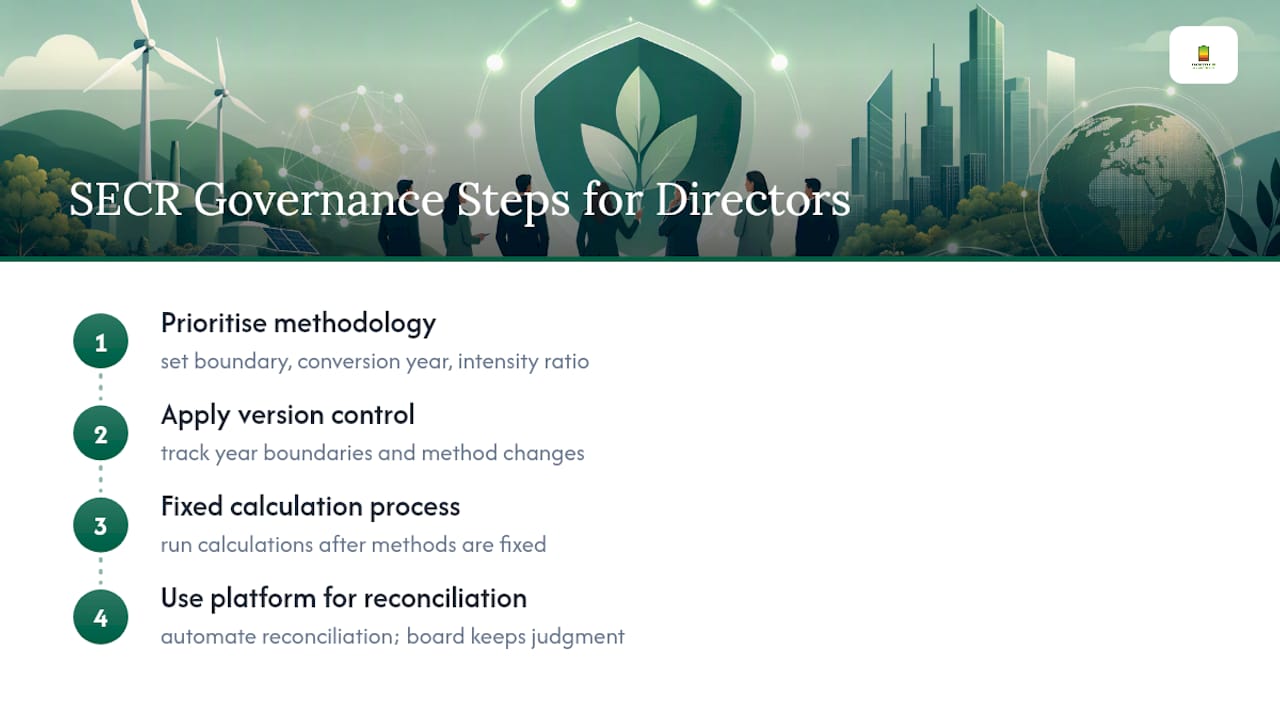
Prioritize the methodology statement before the calculations. Decide your boundary, your conversion factor year, and your intensity ratio first, then let the numbers follow a fixed process. Boards that treat SECR as a live governance input, not an annual scramble, get better data and fewer year-two surprises when comparatives kick in.
A platform can genuinely remove the manual reconciliation work. It cannot decide your boundary or defend your methodology to an auditor. That judgment call stays with the board.
— Chris
Get SECR-Ready Reports Without the Manual Data Chase
The platform offers a way to pull half-hourly consumption data, validate bills automatically, and generate emissions reports covering Scope 1, 2, and 3, providing the raw material needed for SECR disclosures.
The Free forever plan (Starter) costs nothing upfront and lets you manage multiple sites while you test whether the platform's reporting outputs fit your board's SECR timeline. Additional paid tiers add deeper features as reporting needs grow. Start by registering a site and pulling your first emissions report to see how close it gets you to a filing-ready methodology note.
Where to Verify SECR Requirements Before Board Sign-Off
Before your board signs off, cross-check your figures against the primary sources rather than secondary summaries. The Environmental Reporting Guidelines on GOV.UK remain the authoritative implementation guide, covering boundary setting and the Scope 2 location-based method in detail.
The 2026 DESNZ post-implementation review is worth reading in full if your organization is weighing how future refinements might affect your boundary or methodology. Finally, confirm you're citing the correct year's DESNZ conversion factors in your methodology statement, since these update annually.
This article is general information, not a substitute for advice from a qualified lawyer. Consult a qualified legal professional about your own circumstances before acting on anything here.
Sources
- SECR Requirements: Thresholds, Disclosures & Scope (2026)
- 2026 post-implementation review of the SECR regulations 2018
FAQ
What Do You Need to Report Under SECR?
You need total energy consumption in kWh, Scope 1 and Scope 2 emissions in tCO2e, at least one intensity ratio, a methodology statement, prior-year comparatives from year two onward, and a narrative on energy-efficiency actions, per the SECR post-implementation review. Any exemption claimed, such as low-energy-user status, must also be stated.
What Does SECR Stand For?
SECR stands for Streamlined Energy and Carbon Reporting, the UK framework requiring large companies and LLPs to disclose energy use and emissions in their annual accounts. It was introduced by statutory instrument and inserted into the Companies Act reporting framework.
Is ESG Reporting Still Required Alongside SECR?
SECR itself remains a mandatory legal requirement for in-scope organizations, while broader ESG disclosure expectations from investors and other frameworks sit alongside it rather than replacing it. Many companies now use their SECR data as the energy and carbon foundation for wider ESG reporting.
What Are the SECR Thresholds?
Large unquoted companies and LLPs qualify for SECR if they meet at least two of three tests: £36 million turnover, £18 million balance sheet total, or 250 employees, according to SECR's scope guidance. Quoted companies are in scope regardless of size, and low-energy users consuming 40,000 kWh or less annually can claim an exemption.
Can a Platform Like EnerlyticsAI Handle SECR Data Collection?
Enerlytics AI's half-hourly analytics and automated bill validation can generate the kWh totals, emissions figures, and intensity ratios that feed directly into a SECR disclosure. The platform's Free forever plan lets you test this across multiple sites at no upfront cost.