
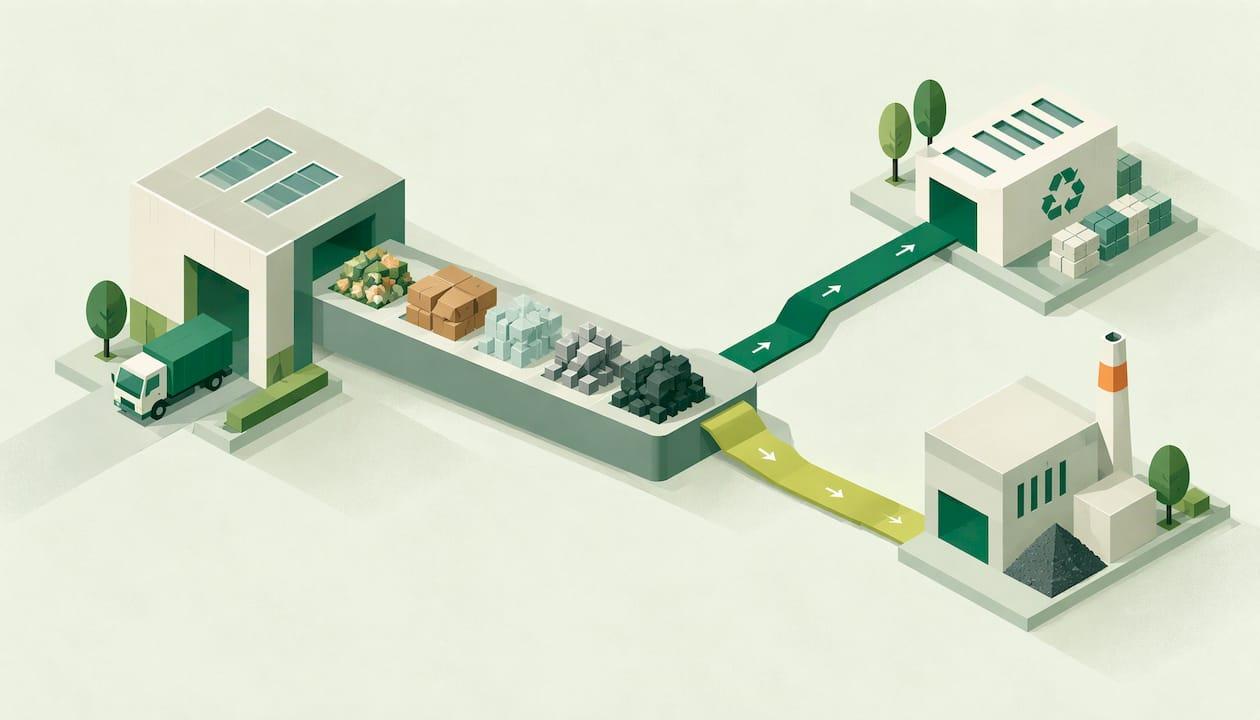
To calculate your waste emissions, multiply the weight of each waste type by the emission factor for the route it takes after collection, then add the results together. The government's own small business guidance puts the principle simply: activity data multiplied by an emission factor gives your greenhouse gas emissions. For waste, the activity data is tonnes, and the factor depends on whether those tonnes went to landfill, recycling, incineration with energy recovery or another route.
The arithmetic takes minutes. Getting reliable tonnages and treatment routes takes longer, and that is where most UK businesses lose accuracy. This guide covers the formula, the data you need, where to find UK factors, a worked example, and how to keep waste emissions in the right scope.
TL;DR
- The core formula is waste quantity in tonnes × emission factor in kg CO2e per tonne, calculated for each waste type and treatment route, then summed.
- Use the annual UK Government (Defra) conversion factors and the waste disposal listing, not the material use factors.
- Weight and treatment route matter more than anything else. Skip capacities and estimates are not measurements.
- Waste sent to third-party facilities usually sits in Scope 3 Category 5. Waste facilities you own or control fall in Scopes 1 and 2.
- Keep transfer notes, invoices and weighbridge tickets so every figure can be traced back during an audit.
Table of Contents
- The basic formula for business waste emissions
- The data you need before you start
- Choosing UK emission factors
- Three calculation methods, from best to simplest
- A worked example
- How treatment routes change the result
- Which scope does waste belong to?
- Records that make your figure defensible
- Putting waste emissions in one place with EnerlyticsAI
- FAQ
- Sources
The basic formula for business waste emissions
The GHG Protocol's waste-type-specific method sets out the calculation as a sum across waste types: the tonnes of each waste type produced, multiplied by the emission factor for that waste type and its treatment, in kg CO2e per tonne. Written out:
Emissions (kg CO2e) = Σ (tonnes of waste type × factor for that waste type and treatment route)
Two things follow from this formula.
- You need a separate line for every combination of material and treatment. A tonne of mixed paper going to recycling and a tonne going to landfill are different lines with different factors.
- The answer is only as good as the two inputs. A precise factor applied to a guessed tonnage still gives a guess.
The result is in kg CO2e. Divide by 1,000 for tonnes CO2e, which is the unit most reports and customer questionnaires ask for.
The data you need before you start
The Defra small business guide says businesses should collect the total mass and type of waste generated, and the treatment method for each type. For waste disposal and recycling, the same guide points you to your waste collection provider for tonnes sent to landfill and tonnes recycled.
In practice, build a simple table with these columns:
| Column | What to record | Typical source |
|---|---|---|
| Waste type | Paper and card, plastics, glass, food, general waste, WEEE, hazardous and so on | Waste transfer notes |
| Weight | Tonnes, ideally measured | Weighbridge dockets, contractor invoices |
| Treatment route | Landfill, recycling, energy from waste, composting, anaerobic digestion | Contractor reports, end-destination statements |
| Period | Reporting month or year | Invoice dates |
| Site | Which location produced it | Collection address |
If you run several sites, the site column is not optional. Without it you cannot see which location is driving your total, or compare like with like.
Why skip size is not weight
The most common data gap is the one hiding in plain sight. Commentary for UK SMEs notes that skip hire weight ratings are capacities rather than measurements. A business that multiplies a skip's rated capacity by the number of collections has not reported its actual waste. The same piece observes that typical SME paperwork answers only about one of the three questions you need: how much, of what type, and by which route.

Ask your waste contractor for a data pack that gives weights by material and the final destination of each stream. Many hauliers can produce this on request, and it is the single biggest improvement you can make to the quality of your figure.
Reporting categories to expect
If you also report under UK environmental reporting guidance, Defra's Environmental Reporting Guidelines advise reporting total metric tonnes per year, broken into categories by weight such as paper, glass, aluminium, plastics, WEEE, aggregates and hazardous waste. The guidance also asks for the final destination by the waste hierarchy, for example a split between re-use, recycling, incineration with energy recovery and landfill. Collecting your data in that structure from the start saves rework later.

Choosing UK emission factors
UK businesses normally use the annual Defra and DESNZ greenhouse gas conversion factors. The waste disposal factors are expressed in kg CO2e per tonne, with different values for each material and route. Always use the edition that matches your reporting year, and record which edition you used.
Two points from Defra's own guidance prevent the most frequent mistakes:
- The material use factors in the conversion factor sets are not appropriate for waste. For end-of-life figures, use the waste disposal listing.
- The same guidance explains that after 2011 the factors moved away from a full lifecycle approach. Recycling and energy recovery factors now reflect collection and transport to the facility, with landfill categories as the exception. That is why recycling factors look low in the inventory compared with what a lifecycle view of avoided virgin material would suggest.
Worksheet names and category labels shift between editions, and picking the wrong line is an easy audit finding. Our guide to emission factor selection and worksheet names for UK audits walks through how to document the choice.
Reporting factors versus decision-making tools
There is a second family of numbers that looks similar and is easy to confuse. WRAP's CarbonWARM2 provides net CO2e conversion factors for a range of materials across five treatment options: closed-loop recycling, open-loop recycling, energy from waste, anaerobic digestion and composting. It is intended for comparing waste management approaches, not for compiling a GHG inventory. Those factors can include displacement of virgin materials and energy grid impacts, which makes them useful when you are deciding between routes and unsuitable for your annual footprint.
The practical rule: use Defra factors to report, and use a decision tool to plan.
Three calculation methods, from best to simplest
The GHG Protocol sets out three main methods for Scope 3 Category 5, waste generated in operations:
- Supplier-specific method. Your waste contractor or treatment facility provides emissions data for your waste directly.
- Waste-type-specific method. You know the tonnes of each material and its treatment route, and apply a specific factor to each.
- Average-data method. You know total waste and estimate the proportion going to each treatment route, then apply averaged factors.
The average-data method is the quickest, and it is also the least accurate. The Defra small business guide notes that for this method you should collect the proportion of waste treated by each method. Treat it as a starting position while you improve your data. Move to the waste-type-specific method as soon as your contractor can give you material splits and destinations.
A worked example
Imagine a site that sends four waste streams away in a year. The factors below are illustrative only, chosen to keep the arithmetic readable. Replace them with the current Defra waste disposal factors for your materials and routes before using any result.
| Waste stream | Tonnes | Illustrative factor (kg CO2e per tonne) | Emissions (kg CO2e) |
|---|---|---|---|
| General waste to landfill | 2 | 40,000 | 80,000 |
| Mixed recycling | 5 | 2,000 | 10,000 |
| Food waste to anaerobic digestion | 4 | 10,000 | 40,000 |
| Cardboard to recycling | 5 | 500 | 2,500 |
| Total | 16 | 132,500 |
The steps are always the same:
- List each stream with its measured weight in tonnes.
- Match each stream to the factor for its material and treatment route.
- Multiply weight by factor for each line.
- Add the lines. Here the total is 132,500 kg CO2e, or 132.5 tonnes CO2e.
- Record the factor edition, the data source for each weight and any assumptions.
Look at the table and you can see what the number is telling you. Although landfill is the smallest tonnage, it produces the largest share of emissions in this illustration. That is the kind of insight you only get when you keep streams separate rather than reporting one blended figure.
How treatment routes change the result
The route matters as much as the weight. Moving the same tonnage from landfill to recycling or energy recovery is one of the standard operational steps for cutting Category 5 emissions, as UK Scope 3 guidance highlights. When you model a change, do it line by line: take the tonnes you plan to divert, apply the factor for the new route, and compare with the old line.
Waste also starts upstream of the bin. Cleaning operations, for example, can create their own waste streams, and reducing secondary waste from cleaning means fewer tonnes enter your waste data in the first place. Less waste at source beats a better disposal route on both cost and emissions.
Which scope does waste belong to?
For most UK businesses, waste is collected by a contractor and treated at a facility someone else operates. That is Scope 3, Category 5. The GHG Protocol guidance draws the line this way: Scopes 1 and 2 cover waste facilities you own or control, while Category 5 covers third-party treatment.
To avoid double-counting:
- Emissions from recycling are allocated to the user of the recycled material through the recycled content method, so your inventory does not also carry them for the same material.
- If you buy electricity from the same energy-from-waste facility that takes your waste, report the electricity in Scope 2 and do not claim negative emissions in your waste inventory.
- Keep waste that is part of your own on-site combustion in Scope 1, not in Category 5.
For the wider picture across all fifteen categories, see our Scope 3 playbook for energy teams, and for how the electricity side is handled, our guide to Scope 2 totals. If you are setting up a reporting process from scratch, carbon reporting basics for UK businesses is the place to start.
Perspective: why waste is where good data pays back
We see waste as the Scope 3 category where a modest effort produces the biggest improvement in credibility. Most businesses already pay for waste collection every month, so the records exist. What is usually missing is structure: weights by material, destinations, and one place where all sites are held together.
That is the same discipline we apply to energy. When you validate bills, watch half-hourly consumption and keep your Scope 1, 2 and 3 reporting in one platform, the carbon figure stops being a once-a-year scramble and becomes something you can explain line by line. Waste should follow the same rule: measured tonnes, a named factor, a recorded source.
We built EnerlyticsAI to be easy to use and free to start, because we think the first step towards net zero should not need a budget approval. Get the data tidy first. The calculations are the easy part.
Chris
Records that make your figure defensible
A calculation you cannot trace is a liability the first time a customer, auditor or lender asks about it. Keep:
- Waste transfer notes for every collection.
- Contractor invoices and any monthly or annual data summaries.
- Weighbridge dockets where available.
- Building manager reports for multi-tenant sites.
- A note of the factor edition and the worksheet line used for each stream.
Some regimes set their own retention periods. Landfill Tax registrants, for instance, must keep records such as invoices and weighbridge tickets for six years to support their returns. Even if that rule does not apply to you, a similar retention habit makes your emissions data much easier to defend. Our checklist on audit-ready energy data governance applies the same thinking from meter to report.
Putting waste emissions in one place with EnerlyticsAI
Waste is rarely the biggest line in a footprint, but it often sits in a different spreadsheet from everything else. EnerlyticsAI is built for UK businesses that want energy, bills and carbon reporting for Scope 1, 2 and 3 in one web platform, with multiple sites managed together.
You can start on the Starter plan, which is free forever, and add paid capacity as your needs grow: Eco is £49 per month, Growth £79 per month, Professional £149 per month and Scale £299 per month. See how our reports bring your emissions together, or create a free account to begin.
If you manage several locations, the sites view helps you keep each one's data separate while reporting a combined total.
FAQ
What is the formula for waste emissions?
Multiply the tonnes of each waste type by the emission factor for its treatment route, in kg CO2e per tonne, then add the results. This is the waste-type-specific method described in the GHG Protocol guidance. Divide the total by 1,000 to get tonnes CO2e.
Which emission factors should a UK business use?
Use the Defra and DESNZ greenhouse gas conversion factors for your reporting year, taken from the waste disposal listing rather than the material use factors. Note which edition you used. Tools such as WRAP's CarbonWARM2 are for comparing waste options, not for your annual inventory.
Is waste Scope 1, 2 or 3?
For most businesses it is Scope 3, Category 5, because a third party collects and treats the waste. It moves into Scopes 1 and 2 only where you own or control the treatment facility. Keep each source in one scope to avoid double-counting.
Can I estimate my waste if I do not have weights?
You can use the average-data method as a starting point, estimating total waste and the share going to each route. It is the least accurate option, so ask your contractor for measured weights by material and destination as soon as you can.
Sources
- Defra: Small Business User Guide to measuring and reporting greenhouse gas emissions
- GHG Protocol: Waste Generated in Operations, Technical Guidance (2022)
- GHG Protocol: Waste Generated in Operations, Category 5 guidance
- Defra: Environmental Reporting Guidelines (March 2019)
- Defra: UK Greenhouse Gas Conversion Factors, common queries
- WRAP: CarbonWARM2 report
- SME Business News: From skip hire to Scope 3
- The Carbon Stamp: Scope 3 emissions guide (UK 2026)
- GOV.UK: Sending returns and keeping records for Landfill Tax