
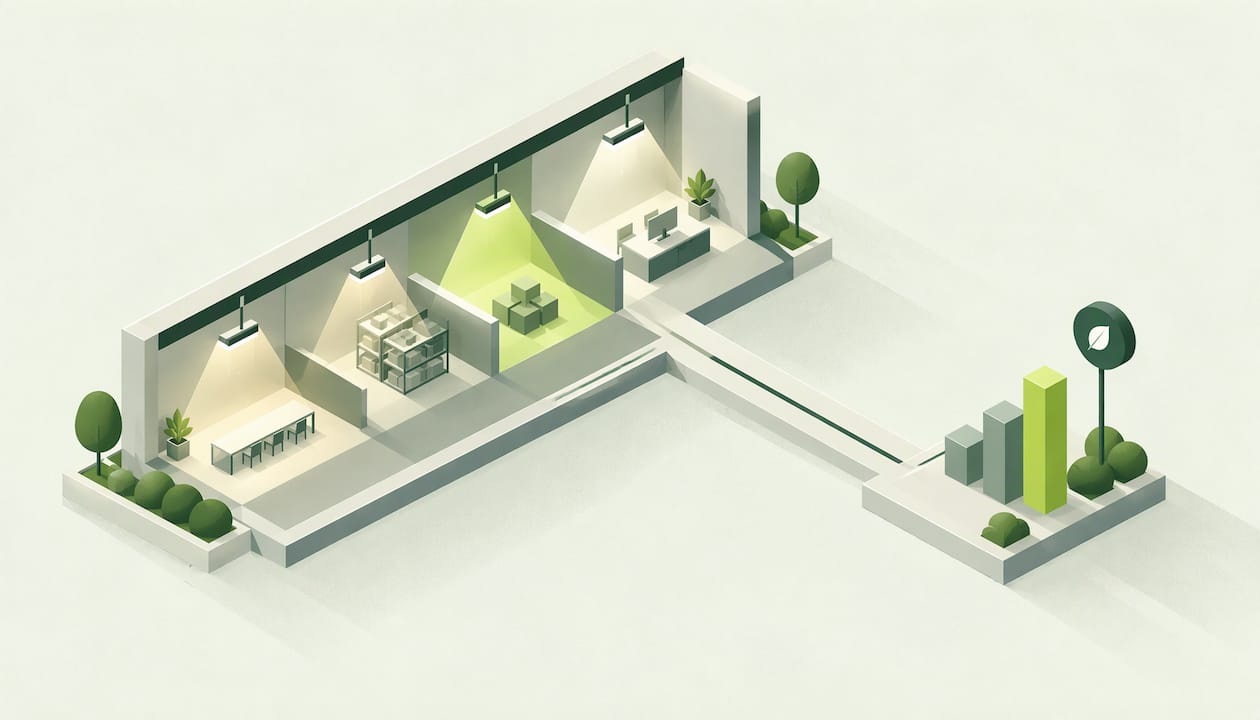
A lighting control strategy is the plan that decides when each light switches on, how bright it runs and when it switches off. For a UK business, the strongest version combines occupancy sensing, daylight harvesting, dimming and scheduling, then checks the result against half-hourly meter data and your bills. Installing the controls delivers the saving. Verifying it across every site is what makes the saving real in your budget, and we built Enerlytics AI to help with that second part.
TL;DR
- A strategy is a set of inputs (sensors, schedules, switches), logic and outputs (on, off, dim). Design it per space, not per building.
- The main methods are occupancy sensing, daylight harvesting, dimming or task tuning, and scheduling. Combined, they save far more than any one alone.
- UK guidance cites savings of up to 30–40% or more in some building types, but the result depends on how the space is used.
- Building Regulations Part L expects reasonable control provision whenever you carry out lighting work in a non-dwelling building.
- Compare your half-hourly consumption and bills before and after the change to confirm the saving, site by site.
Table of Contents
- What a lighting control strategy actually is
- The core strategies and where each fits
- What UK rules and schemes expect
- How much can you realistically save?
- Choosing a strategy for your space
- Verify the savings, site by site
- Where Enerlytics AI fits
- Our perspective
- FAQ
- Sources
What a lighting control strategy actually is
The Lighting Controls Academy defines a control strategy as the practical application of inputs, programming and outputs to produce a desired lighting behavior. An input is information entering the system: someone pressing a switch, a motion sensor, a photosensor reading daylight, a scheduled event or a signal from another building system. The programming is the logic that decides what happens next. The output is the command sent to the lighting: on, off, dim to a preset level, change color temperature, or pass data to something like the HVAC system.
The same source notes that every control system, from a wall switch to a building-wide network, can be described with the same fundamentals. That is useful for a facilities or sustainability manager, because it gives you one language for comparing a warehouse, an office floor and a plant room. For each space you ask three questions. What tells the lights to act? What rule applies? What does the light do?
The strategy is not the hardware. LED fittings cut the power a light draws. Controls cut the hours and the output. Both matter, and the second is often overlooked once the LED retrofit is signed off.
The core strategies and where each fits
Most guides, including the DesignLights overview, describe the same four building blocks.
| Strategy | What it does | Typical fit |
|---|---|---|
| Occupancy sensing | Lights are active only when the space is occupied | Offices, toilets, stores, corridors, meeting rooms |
| Daylight harvesting | Dims or switches off electric light when natural light is sufficient | Perimeter offices, atria, warehouses with rooflights |
| Task tuning (high-end trim) | Sets the maximum output to 70–80% of full to avoid over-lighting | Spaces where fittings were specified above the needed level |
| Scheduling | Switches or dims at predetermined times | Retail opening hours, shift patterns, out-of-hours reduction |
Occupancy: request ON, auto OFF
The FMUK mini guide describes a successful energy-reduction regime as "request ON, auto OFF". Staff switch lighting on deliberately, and movement sensors turn it off when the area empties. Whether "request ON" or "auto ON" is better depends on the application and on other features such as daylight harvesting. In a corridor or a stairwell, automatic on is usually right for safety and convenience. In a private office with good daylight, manual on avoids lights coming on when they are not needed.
Daylight harvesting
Daylight sensors measure the light reaching a zone and dim the fittings to make up only the difference. BRE advises that areas with different daylight levels should be controlled separately, so the row of lights by the window is not forced to follow the row at the back of the room.
Dimming and task tuning
BRE also notes that dimming is usually preferable to simple switching because occupants can choose their level, and people often prefer lower illuminance, which saves energy. Task tuning applies the same idea at commissioning: instead of running every fitting at 100%, you cap output at the level the task really needs.
Scheduling
Time control is the simplest layer and the easiest to get wrong, because shift patterns change. A UK planning document for a retail development sets out a staged sales-area sequence: one third of the lighting comes on at store opening, and full output is reached 15 minutes before trading. The principle applies elsewhere: schedule in stages that match how the site is used, rather than a single on/off time.
Combining them
The FMUK guide lists a typical office system as a combination of manual on, dimming to prevent over-lighting, time controls to reduce light levels out of hours, daylight harvesting and movement sensors that switch off when the area is unoccupied, with each layer adding to total savings. The Thelia guide to IoT lighting applications makes the same point: a control system is greater than the sum of its parts, deciding on time of day, time of year and external conditions together.
What UK rules and schemes expect
Two UK reference points shape a commercial strategy.
Building Regulations. BRE states that reasonable provision of lighting controls is required by UK building regulations whenever lighting work is carried out in non-dwelling buildings. Work is notifiable under Part L if more than 100 m² of floor area is being provided with new fixed lighting. Controls may also be eligible for Enhanced Capital Allowances and can help a building earn BREEAM credits. Check the current position with your building control body or tax adviser before you rely on either.
The Energy Technology List. The government's Energy Technology List covers building lighting controls that automatically switch or dim lighting. Its criteria align with class A systems of BS EN 52120-1:2022, which replaced BS EN 15232. It covers two categories: presence detectors with controllers that switch off or dim unoccupied areas, and daylight detectors with dimming controllers. Eligible dimming controls must be able to reduce controlled lamp power by at least 75%, each presence detector may draw no more than 0.5 W of parasitic power when the lights are off, and products that let local users override automatic switch-off or dimming are not eligible. If you are specifying for a scheme, those details belong in your tender.
Design guidance. For the design process itself, CIBSE's LG14 Control of electric lighting (second edition, 2023) covers consultation, design, specification, commissioning and handover. It spans manual, timed, presence detection, photocell, daylight-linked and dimming control, plus networked systems, Power over Ethernet and wireless controls. It is written for professional designers, so it is a good document to hand your lighting designer or contractor.
How much can you realistically save?
Treat any single percentage as a range, because the result depends on the space, the hours and what you had before.
- BRE's digest says lighting controls can give savings of up to 30–40% or more in some types of building.
- The FMUK guide notes lighting can account for up to 40% of a building's electricity use, and early demonstration projects reported savings of 60% or more.
- A one-year study of 90 office workers found occupancy sensing, daylight harvesting and individual dimming together produced average savings of 47%, with experts estimating 35–50% in most applications for advanced systems.
- A US laboratory validation study found integrated retrofit packages in open-office perimeter zones delivered savings from 20% for daylight dimming and automated shades to over 70% for LED retrofits with advanced controls.
A UK industrial example shows the upper end. At Siemens' Parsons Works site in Newcastle, an LED upgrade cut lighting power by 75%, and IoT controls saved a further 88% by adjusting output to task, daylight and occupancy, a 96% lighting energy reduction, according to the CILS case study. High-bay sensors there return lights to an unoccupied level after 30 minutes without activity and restore a defined occupied level, not maximum output, when someone returns.
The wider picture explains why this is worth the effort. The government's Building Energy Efficiency Survey (England and Wales, 2014–15 stock) found lighting replacement and control, carbon and energy management, and building services instrumentation and control were among the measures with the largest savings potential, together representing 55% of total abatement potential. Over a third of the total potential came from measures with a private payback of three years or less. The survey also found the most commonly perceived barriers were economic: low capital availability, investment cost, hidden costs and risk. A worked example later in this article shows how to turn that into a case for your finance team.

Choosing a strategy for your space
BRE advises matching controls to the type of space, how it is used and the amount of daylight available. CIBSE frames the same idea as a question of purpose: understanding users and expectations decides whether you design for energy reduction, comfort or visual effect. In practice, work through a space-by-space table.
| Space | Sensible starting strategy |
|---|---|
| Open-plan office | Daylight dimming on window zones, occupancy sensing, out-of-hours schedule, individual dimming |
| Warehouse or high-bay | Presence detection with a reduced unoccupied level, rooflight daylight harvesting, task tuning |
| Retail floor | Staged schedule linked to opening and cleaning, task tuning, daylight zones near glazing |
| Corridors and toilets | Automatic occupancy on/off with a short time delay |
| Plant rooms and stores | Presence detection, request ON, auto OFF |
Then apply four implementation rules from the specification guidance.
- Plan for change. Thelia advises choosing an open technology platform not limited by features or manufacturer, and allowing for expansion and reconfiguration as space use changes.
- Set the software baseline. At minimum it should provide daylight harvesting, occupancy, scene selection and group and building control. Thelia also treats automated emergency testing and reporting as a prerequisite of any smart lighting system.
- Commission properly. Sensor sensitivity, time delays and lux set points decide whether staff accept the system or override it. Overridden controls save nothing.
- Write down the expected saving. Record the hours, the connected load and the target before the work. You will need them in the next step.
A worked example for your finance team
Take a warehouse with 200 kW of lighting running 6,000 hours a year, which is 1,200,000 kWh. If controls reduce running hours and output by 30%, you save 360,000 kWh. At an illustrative 25p per kWh, that is £90,000 a year. These figures are an arithmetic illustration, not a forecast: replace each number with your own connected load, hours and contract rate. The point is that the saving is calculated from three numbers you can check on your bills.

Verify the savings, site by site
Many lighting projects end at handover. The sensors work, the contractor is paid, and nobody checks whether the electricity bill moved. Your strategy is incomplete until you can show the saving in your own data. That is also what an energy performance contract or a board paper will ask for. In the Siemens project, every fitting reports motion, power consumption, ambient light and temperature, which the case study says simplifies the measurement and verification the contract depends on. Most businesses will not have fitting-level data on every site, so the practical route is to verify at the meter.
The method is simple:
- Capture a baseline. Collect at least several months of half-hourly consumption for each site before commissioning, so seasonal daylight is represented.
- Look at the shape, not only the total. Controls change the profile: lower overnight and weekend base load, and less consumption in daylight hours. A flat overnight line after the retrofit is a sign the schedule or sensors are not doing their job.
- Compare against bills. Check that the billed kWh and the rates match the metered data, so the saving you report is the saving you actually receive.
- Rank the sites. If one of eight sites shows no change, the controls there are probably overridden, mis-set or on the wrong schedule.
- Feed it into reporting. Lower electricity use flows into your Scope 2 figures, and the same data supports your KPI and budget tracking.
For the measurement side, our guides on energy management KPIs and building an energy monitoring strategy set out what to track. If you are building the business case, where to look for energy savings and the current UK energy efficiency grants are useful next reads, and energy budgeting shows how to lock the saving into next year's plan.
Where Enerlytics AI fits
Enerlytics AI is a platform for UK businesses that combines automated bill validation and anomaly detection with half-hourly consumption analytics and Scope 1, 2 and 3 carbon reporting. You can manage several locations in one place through multi-site management, and check each invoice in Bills. That means the before-and-after comparison described above sits in one view, rather than in a spreadsheet per site.
The Starter plan is free forever, so you can load a site, see its half-hourly profile and test your lighting baseline without an upfront charge. Paid plans are Eco at £49 per month, Growth at £79 per month, Professional at £149 per month and Scale at £299 per month, for when you need more.
Start with the free plan and bring your first site's data in before your next lighting upgrade.
Our perspective
A lighting control strategy is a promise about future consumption. Promises should be checked.
We see the topic as two jobs. The first is design: choose inputs, logic and outputs that fit each space, the way CIBSE and BRE describe. The second is evidence: show, from half-hourly data and validated bills, that the site now behaves differently. Most of the conversation online covers the first job. The second decides whether finance believes the project worked.
That is why we built Enerlytics AI around accurate bills, half-hourly analytics and multi-site visibility, and why the Starter plan is free forever. A facilities manager should not need a budget approval just to see whether last quarter's lighting upgrade changed the load profile. Start with the baseline, change one site, compare, then roll out what works.
Chris
FAQ
What is a lighting control?
A lighting control is any device or logic that changes what a light does: a switch, an occupancy sensor, a daylight sensor, a timer or a networked system. Each one takes an input, applies a rule and sends an output such as on, off or dim. A strategy is the set of those rules chosen for a particular space.
Is there a way to control lights remotely?
Yes. CIBSE's LG14 covers networked and centrally managed lighting control, including integration with a networked building management system, Power over Ethernet, internet access and wireless controls. Remote control lets you change schedules across sites from one place. Confirm each change in your consumption data afterwards.
What are the risk control measures for poor lighting?
Start with a lighting assessment of each task area, then fix levels, glare and flicker, and keep emergency lighting working. Controls must never leave a space unsafe: sensors need sensible time delays, and emergency fittings should be tested on schedule. Thelia treats automated emergency testing and reporting as a prerequisite of a smart lighting system. For a workplace risk assessment, involve your health and safety adviser.
Do lighting controls pay back quickly?
Often, but it depends on hours of use and tariff. The government's survey found that over a third of the total energy efficiency potential came from measures with a private payback of three years or less. Calculate your own payback from connected load, running hours and your contract rate.
Sources
- Deep Dive: Fundamentals of Commercial Lighting Controls, Lighting Controls Academy
- Lighting Control Strategies for Energy Efficiency, DesignLights
- Lighting Control: Mini Guide, FMUK
- Guide to IoT Lighting Applications, Thelia
- Selecting lighting controls, BRE
- Building Lighting Controls, Energy Technology List
- LG14 Control of electric lighting (2023), CIBSE
- Building Energy Efficiency Survey, Executive Summary
- Laboratory Validation of Integrated Lighting Systems, Lawrence Berkeley National Laboratory
- Lighting Controls: Maximizing System Efficiency, Facilitiesnet
- Siemens Energy: Parsons Works Energy Efficiency Upgrade, CILS UK
- Mixed use commercial and employment planning document