
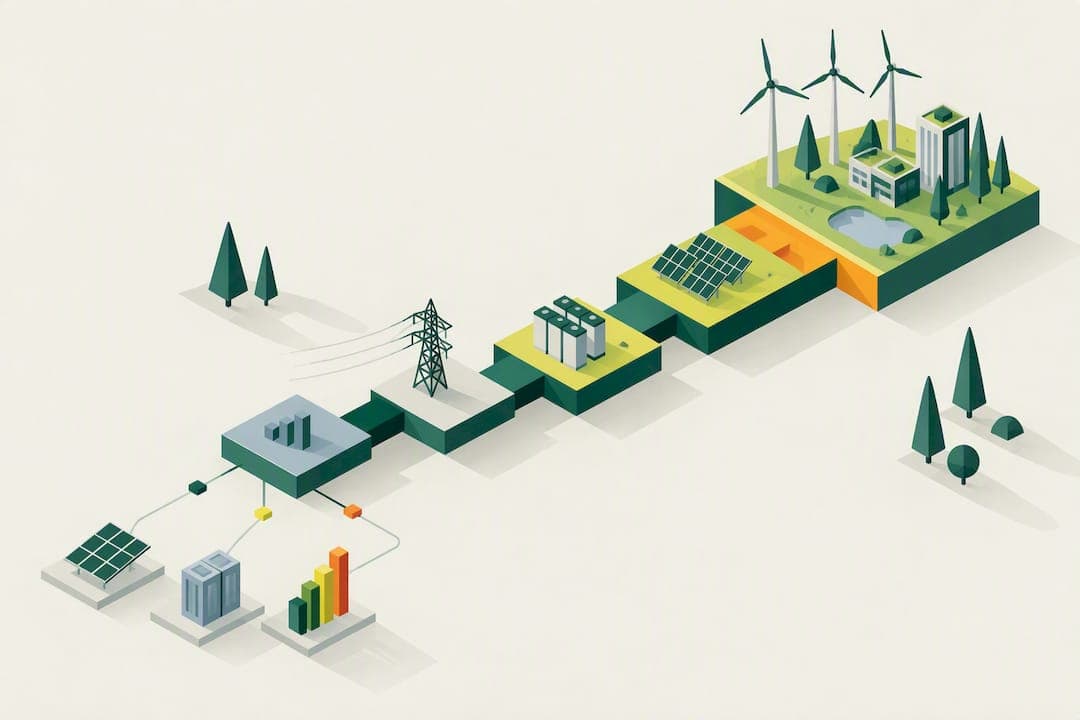
A credible net zero roadmap gets carbon dioxide emissions to net zero by covering every major emissions source, front loading reductions before 2030, and treating carbon removal as a last resort rather than a shortcut. It rests on four pillars: electrification, energy efficiency, low-emissions fuels, and methane abatement. Hit those hard by 2030, and 2050 becomes achievable without betting the plan on unproven carbon dioxide removal.
TL;DR:
- Most net zero plans rely heavily on electrification but often neglect energy efficiency, low-emissions fuels, and methane abatement, which are crucial for structural balance.
- Delays in reducing emissions before 2030 significantly increase reliance on costly, unproven carbon removal technologies at later stages.
- Policy tools like carbon pricing, permitting reform, grid investments, and offtake agreements are essential to turn theoretical pathways into practical infrastructure.
- Sectoral milestone targets for 2030 and 2040, such as renewable power dominance and electric vehicle adoption, are key to maintaining credible long-term progress.
- Organizations should focus on accurate measurement, verified data, and adaptive targets to prevent plans from becoming static, ineffective wish lists.
Table of Contents
- What Does the Global Pathway to Net Zero Look Like?
- The Four Pillars Every Net Zero Strategy Must Include
- What Are the Key Milestones on the Way to 2050?
- How Do You Build an Organizational Net Zero Roadmap?
- What Metrics and Standards Make a Roadmap Verifiable?
- Where Do Net Zero Plans Usually Break Down?
- How EnerlyticsAI Turns Roadmap Metrics Into Action
- An Editorial Take on Getting Net Zero Right
- Sources
- FAQ
What Does the Global Pathway to Net Zero Look Like?
The International Energy Agency's net zero pathway projects energy-sector emissions falling significantly by 2035 against a 2024 baseline, under its Net Zero Emissions scenario. That number is not a forecast of what will happen. It is the trajectory required if the world wants a reasonable shot at limiting warming, built on the same four pillars that anchor this article: electrification, efficiency, low-emissions fuels, and methane cuts.
Multi-model analyses tell a more sobering story about where current policy actually sits. Studies assessing national pledges against long-term strategies find that expanding and accelerating those commitments narrows the gap to the Paris goals, but holding warming to 1.5°C without overshoot is now unlikely under any realistic pledge scenario. That is not a reason to relax the timeline. It is the reason 2030 matters more than 2050.
Every year of delayed action before 2030 compounds. Emissions not cut this decade do not simply carry over to next decade's to-do list. They raise the cumulative carbon budget, which pushes later decades toward heavier reliance on carbon dioxide removal technologies that remain expensive, land-intensive, and unproven at gigaton scale. Front-loading is not a philosophical preference. It is math.
At the national level, a handful of policy levers determine whether a pathway stays on paper or becomes physical infrastructure:
-
Carbon pricing mechanisms that make low-emissions options the economically rational default
-
Permitting reform that shortens the multi-year queues currently strangling clean-energy projects
-
Grid investment paired with electrification mandates for vehicles and heating
-
Industrial offtake agreements that give hydrogen, low-carbon steel, and green cement a buyer before they exist at scale
-
Methane regulations targeting oil and gas operations, where abatement is often cheap relative to the climate benefit
The Four Pillars Every Net Zero Strategy Must Include
Every credible carbon neutrality strategy, whether written for a country or a company, stands on the same four technical pillars. Skip one and the roadmap has a structural hole no amount of tree planting fixes later.
- Electrification. Electric vehicles, heat pumps, and electrified industrial processes replace direct fossil fuel combustion, but only if the grid supplying them decarbonizes in parallel. Electrifying a heating system on a coal-heavy grid moves emissions around rather than cutting them.
- Energy efficiency. Insulation upgrades, smarter building controls, and process optimization in manufacturing deliver the cheapest emissions cuts available, often with payback periods under three years. The catch: you cannot manage what you do not measure, which is why efficiency programs live or die on metering quality.
- Low-emissions fuels. Green hydrogen, sustainably sourced bioenergy, and synthetic fuels fill the gaps electrification cannot reach, particularly in aviation, shipping, and high-heat industrial processes. Bioenergy comes with real land-use and feedstock constraints, so treat it as a bridge for hard-to-electrify demand, not a universal substitute.
- Methane abatement. Methane traps far more heat than carbon dioxide over a 20-year window, and a large share of oil and gas sector leaks can be fixed with existing detection technology at relatively low cost. This is the pillar most roadmaps underweight, despite it often being the fastest win available.
Pro Tip: If your organization's plan leans heavily on one pillar (usually electrification) while treating the other three as afterthoughts, that's the clearest sign the roadmap was built for a press release, not for verification.
None of these pillars function without policy scaffolding. Carbon pricing shifts investment toward the pillars that need it, permitting reform gets electrification infrastructure built on schedule, and offtake contracts give low-emissions fuel producers the demand certainty to scale production before subsidies run out.
What Are the Key Milestones on the Way to 2050?
A roadmap without dated checkpoints is a wish list. Sectoral milestones convert the abstract 2050 target into measurable progress you can audit at 2030 and 2040, which is exactly how national long-term strategies like the EU's are structured.
Representative checkpoints look roughly like this across sectors:
- Power: Renewables supplying the majority of electricity generation by 2030, with unabated coal retirement schedules locked into national plans well before 2040.
- Transport: Electric vehicles making up a rising majority of new car sales by 2030, with combustion-engine sales effectively phased out in leading markets by 2035.
- Buildings: Deep retrofit rates accelerating sharply this decade, since building stock turns over slowly and 2050-era buildings are mostly standing today.
- Heavy industry: Steel, cement, and chemicals piloting low-carbon production routes now, with commercial-scale deployment expected through the 2030s.
- Agriculture and land use: Methane reductions from livestock and rice paddies paired with reduced deforestation, both achievable with current technology.
Milestone ambition is not uniform across regions, and pretending otherwise undermines credibility rather than building it. Wealthier economies with mature grids can move faster on electrification; emerging economies often need concessional finance and technology transfer to hit comparable targets on comparable timelines, a point the UN's net-zero coalition has repeatedly flagged as a make-or-break issue for global alignment.
At each checkpoint, report the same core data: absolute emissions against baseline, sector-specific intensity metrics, renewable share of generation, and progress against interim targets. Consistency in what you report matters as much as the numbers themselves, because a milestone nobody can independently verify is just a promise.

How Do You Build an Organizational Net Zero Roadmap?
Translating a national pathway into a company plan follows a sequence, and skipping steps is the single most common reason corporate net zero pledges collapse under scrutiny.
- Measure your baseline. Inventory emissions across Scope 1 (direct), Scope 2 (purchased energy), and Scope 3 (supply chain and product use) using the GHG Protocol, the standard nearly every credible framework references. Scope 3 is usually the largest and the hardest to pin down, which is exactly why skipping it is the fastest way to produce a roadmap nobody trusts.
- Set interim, science-based targets. A 2050 target with nothing in between is unfalsifiable. Validate near-term goals through the Science Based Targets initiative, and prioritize the reductions your organization can execute internally before looking outward for offsets.
- Cut emissions where you have direct control. This means electrifying fleets, switching to renewable power contracts, improving process efficiency, and re-engineering the highest-emission parts of your operations first, not the easiest ones.
- Build a residual emissions strategy. Once internal reductions plateau, decide how to handle what is left. Oxford Net Zero's framework calls for cautious, high-permanence removals rather than cheap avoidance offsets, and for treating removals as a last step, not a first resort.
- Govern it properly. Board-level oversight, a named implementation team, and procurement policies that push suppliers toward lower-carbon inputs turn a roadmap document into an operating system rather than a slide deck.
Pro Tip: Put your Scope 3 supplier engagement plan in writing before your CFO asks for a capital allocation number. Vague supply-chain ambitions are the line item that kills board confidence fastest.
Finance underpins every step above. Capital planning needs to route toward low-carbon equipment upgrades years ahead of asset retirement dates, procurement teams need green criteria baked into vendor contracts, and forward-looking organizations increasingly make buyer commitments for low-carbon materials before those markets fully exist, which is precisely the kind of demand signal industrial offtake agreements are designed to provide. Reviewing your emissions inventory against a structured Scope 1, 2, and 3 reporting framework makes it far easier to see where your organizational roadmap has real teeth and where it is still aspirational.
What Metrics and Standards Make a Roadmap Verifiable?
A roadmap is only as credible as the data behind it, and that data needs a recognized standard, a reporting cadence, and a way for outsiders to check it.
Start with the standards: the GHG Protocol for building the inventory itself, and SBTi for validating whether interim targets actually align with the temperature goal claimed. National long-term strategies add a third reference point for organizations operating in jurisdictions with formal government pathways.
Data cadence matters more than most sustainability teams assume going in. Annual emissions reporting tells you what happened; half-hourly consumption data tells you why, and lets you catch a stalled efficiency retrofit or a malfunctioning system within days instead of a year later during audit season.
Core KPIs worth tracking on a rolling basis:
- Absolute emissions against your baseline year
- Emissions intensity per unit of output or revenue
- Renewable electricity share of total consumption
- Verified removals volume, tracked separately from avoided-emissions offsets
- Net residual emissions after reductions and removals
Independent oil and gas analysis found that clean electricity met a significant portion of new global energy demand growth in 2025, according to the Energy Transition Monitor, evidence that deployment is accelerating even as bottlenecks persist elsewhere. Third-party assurance on your emissions inventory closes the loop, turning a self-reported number into one auditor and investors can actually rely on.
Where Do Net Zero Plans Usually Break Down?
The gap between a roadmap on paper and one that survives contact with reality tends to open at the same three points, year after year.
Carbon dioxide removal gets treated as a safety net rather than what it actually is: expensive, land-intensive, and unproven at the gigaton scale most pathways quietly assume. The fix is not abandoning removals. It is refusing to let projected future removals substitute for reductions you could make today.
Grid and permitting bottlenecks stall electrification even when the technology and capital are ready. The Energy Transitions Commission describes this as a "two-speed transition," where record clean-energy investment outruns the grid connections and permits needed to actually deploy it. Practical responses include streamlined permitting for renewable and storage projects, dedicated grid-connection queues for priority industrial offtake, and regional cooperation on transmission buildout.
Offset quality remains the third weak point. Cheap avoidance offsets with shaky permanence claims have damaged trust in the entire removals market. Roadmaps that survive scrutiny lean toward high-permanence storage and disclose methodology rather than just a headline offset volume.
- Stress-test your plan against a scenario where CDR costs stay high through 2040
- Build a contingency budget for grid connection delays running two to three years past initial estimates
- Favor removal contracts with independent permanence verification over the cheapest available credits
Pro Tip: Ask any offset or removal vendor for their permanence guarantee in writing before you count a single ton toward your target. If they can't produce one, that volume doesn't belong in your net figure.
How EnerlyticsAI Turns Roadmap Metrics Into Action
A roadmap full of targets and no data pipeline stays theoretical. A platform closes that gap for businesses by pairing half-hourly consumption analytics with automated bill validation and anomaly detection, so a spike in energy use or a billing error surfaces within days rather than at year-end audit.
That granularity matters because it converts abstract efficiency targets into specific, traceable savings across multiple sites without manual spreadsheet work. Integrated Scope 1, 2, and 3 reporting can feed directly into the governance and target-verification steps every organizational roadmap needs, giving sustainability managers and finance officers one consistent source of truth instead of reconciling numbers from three departments.
An Editorial Take on Getting Net Zero Right
Net zero roadmaps fail less often from bad intentions than from treating 2050 as a fixed document instead of a living process. Technology costs shift, policy incentives change, and markets for low-carbon materials mature faster or slower than any model predicted five years earlier. The organizations getting this right revise their interim targets when the data tells them to, not when it's politically convenient.
Prioritize reductions you can verify this quarter over removals you're promising for 2045. Build the monitoring habit early, because a roadmap without granular tracking data is just a hope dressed up in spreadsheet formatting. Get a free forever plan tracking your energy data now, and the accountability builds itself.
— Chris
Sources
For readers who want to verify the frameworks referenced throughout this piece, start with the IEA's World Energy Outlook and Net Zero Emissions by 2050 pathway, the definitive global modeling reference. Oxford Net Zero's seven principles for credible net zero and the companion Nature Climate Change analysis explain the science behind responsible target-setting. The Energy Transitions Commission tracks deployment bottlenecks in near real time, while the EU's 2050 long-term strategy and the UN net-zero coalition offer working models of national policy translation. For measurement standards, the GHG Protocol and SBTi remain the two frameworks worth building your inventory and targets around.
- Net Zero emissions by 2050 (IEA / World Energy Outlook 2025)
- Net Zero principles (Oxford Net Zero)
- Promising climate progress from net-zero ambitions to the Paris Agreement goal (multi-model study / submission)
- 2050 long-term strategy - EU Climate Action
FAQ
What Are the Core Principles of a Credible Net Zero Plan?
A credible plan covers every major emissions source rather than cherry-picking the easy ones, front-loads reductions before relying on removals, and uses carbon removal cautiously with attention to permanence. Oxford Net Zero's framework also stresses equitable transition, meaning the plan doesn't shift costs onto communities or countries least able to absorb them.
How Close Is the World to Reaching Net Zero?
The world is not on track for net zero by 2050 under current policies, though expanded and accelerated pledges narrow the gap. Multi-model analyses find that even with stronger commitments, limiting warming to 1.5°C without overshoot is now unlikely, which is why front-loaded action this decade matters more than distant 2050 promises.
What Does Net Zero Actually Mean in Simple Terms?
Net zero means the amount of greenhouse gas going into the atmosphere from an organization, sector, or country roughly equals the amount being removed or avoided. It is not "zero emissions everywhere." It's a balance achieved mostly through deep cuts, with any unavoidable remainder offset by verified, high-permanence removals.
Which Countries Have Committed to Net Zero by 2050?
Dozens of countries, including the EU member states under the bloc's 2050 long-term strategy, have adopted 2050 net zero targets, with commitment levels and enforceability varying widely. The UN net-zero coalition tracks both stated pledges and the policy detail backing them.
What's the Difference Between Carbon Offsets and Carbon Removals?
Offsets typically fund emissions avoided elsewhere, such as preventing deforestation, while removals actively pull carbon dioxide out of the atmosphere and store it, often with stronger permanence guarantees. Credible roadmaps favor verified removals over cheap avoidance offsets, since Oxford Net Zero's analysis points to permanence and additionality as the biggest integrity risks in offset markets.